


Most WordPress countdown plugins are easy to install and easy to misuse. The widget takes five minutes; deciding whether the deadline it shows is real takes longer. One plugin this article used to recommend has since been pulled from WordPress.org for a security issue, and another has quietly changed owner and slug. Here are six still worth considering, what they renew at, and where the honesty line sits.
Quick verdict
- Best overall: HurryTimer. Evergreen, recurring and scheduled timers in the free plugin, WooCommerce support, and a $39-a-year Pro tier you probably will not need.
- Best free: Countdown, Coming Soon, Maintenance – Countdown & Clock, if you want circle and flip-clock styles plus a coming-soon page and no upsell path.
- Skip it if: you are shopping for a perpetual timer that resets forever on an offer that never ends. That is the one use case none of these tools should be bought for, and for US traders it is a legal exposure rather than a matter of taste.
- Our call: install HurryTimer free, set a real deadline, and only pay for something when the free plugin actually runs out of road.
The best WordPress countdown plugins in 2026, compared
| Plugin | Free version | Entry paid licence | Renews at | Evergreen mode | WordPress.org rating |
|---|---|---|---|---|---|
| HurryTimer | Yes, evergreen included | $39/yr or $69 one-time, 1 site | $39/yr (one-time licence does not renew) | Yes, in the free plugin | 4.8/5, 20,000+ installs |
| Countdown & Clock | Yes, full plugin | No upgrade listed on WordPress.org | n/a | Yes, in the free plugin | 4.7/5, 10,000+ installs |
| OptinMonster | Connector plugin only; service is paid | Pro, $29/mo billed annually | $870/yr | Yes, Pro tier and above | 4.3/5, 1,000,000+ installs |
| SeedProd | Yes, SeedProd Lite | Basic, discounted first year | $79/yr | Yes, Visitor Timer | 4.9/5, 700,000+ installs |
| Widget Countdown | Yes | $13 (1 site), $27 (5), $45 (unlimited) | Billing period not stated | Not documented | 3.6/5, 10,000+ installs |
| Evergreen Countdown Timer | Yes | $82/yr or $345 one-time, 1 site | $82/yr | Yes | 3.6/5, 2,000+ installs |
The evergreen timer problem, and why it matters before you pick
An evergreen timer starts counting when a specific visitor arrives, stores that start time in a cookie, and shows that person their own private deadline. Used honestly it is a good tool: someone joins your email sequence, they genuinely get 48 hours on the launch price, the timer tracks the promise you actually made them.
Used the other way, it is a lie with a nice font. The offer never expires. The timer resets when the cookie clears. The visitor comes back in a different browser and gets a fresh 48 hours on the same “final” discount.
That version has a name in Washington. The FTC’s staff report Bringing Dark Patterns to Light, published 15 September 2022, lists among its deceptive-design examples “countdown timers designed to make consumers believe they only have a limited time to purchase a product or service when the offer is not actually time-limited.” If you sell to US consumers, a perpetual timer on an offer that never ends is a Section 5 exposure, not a growth hack.
The practical test is one question: if a customer emailed and asked what happens at zero, could you answer honestly and keep the sale? If the answer is “nothing, it restarts,” you do not have a deadline. You have a prop. Every plugin below can build either version, so the tool is not the safeguard — you are. And if you are chasing conversions, there are less risky ways to lift conversion rates than pretending a sale is ending.
One more thing evergreen mode drags in: it sets a cookie to identify returning visitors. That puts it in scope for consent in the EU and UK, so it needs to sit behind whatever GDPR consent tooling you already run.
HurryTimer
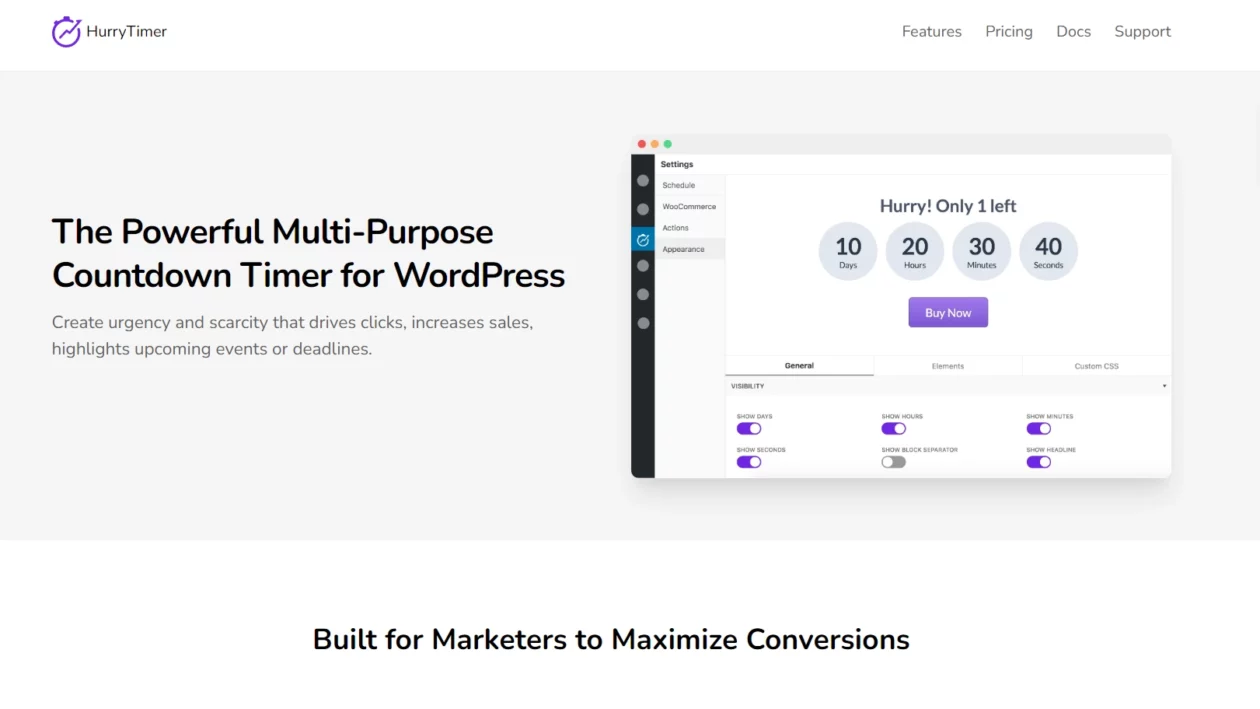
HurryTimer is the one we reach for first, and the reason is unglamorous: the features you would expect to be paywalled are not. Evergreen mode, recurring campaigns, scheduled start and end dates, and the expiry actions that decide what happens at zero are all in the free plugin on WordPress.org. Version 2.15.0 was updated on 27 August 2026 and is tested against WordPress 7.1 — it and SeedProd are the only two entries here current with 7.1.
It also handles the awkward part properly. Expiry actions let you hide the timer, redirect, or show a different message when the clock hits zero, which is what separates a real deadline from a prop that quietly restarts.
- Key features: evergreen, recurring and fixed-date campaigns; WooCommerce integration; expiry actions including redirect and hide; sticky bars; CTA buttons; a live design customiser; custom CSS in Pro.
- Price: free plugin. Pro on the HurryTimer pricing page is $39/yr or $69 one-time for one site, $79/yr or $109 one-time for five, $129/yr or $199 one-time unlimited. Annual licences include a year of updates and support; the one-time licences include lifetime updates. Sold in USD through Paddle, so local VAT may be added at checkout.
- Best for: anyone running genuine launch or sale deadlines, especially on WooCommerce, who does not want to pay for basic functionality.
- Skip it if: you need the timer inside a popup with behavioural targeting rules. HurryTimer places timers; it is not a campaign platform.
If you do buy, the one-time Personal licence at $69 pays back against the $39 annual in under two years, which for a plugin you will still be running three renewals from now is the easier maths.
Countdown, Coming Soon, Maintenance – Countdown & Clock

Formerly listed as Countdown Builder, this one gives away more design range than anything else here. Circle countdowns, flip clocks, seven numbered clock styles, sticky countdowns, WooCommerce countdowns and coupon timers, plus a coming-soon page, all under the [ycd_countdown] shortcode. Evergreen countdown arrived in version 3.0.4 and is in the free plugin.
The caveat is maintenance pace. Version 3.0.8 was last updated on 8 February 2026 and is tested to WordPress 6.9.7 — not alarming, but it is the least recently touched plugin in this table. Check it against your WordPress version before you commit it to a client site.
- Key features: circle, digital, flip-clock and sticky countdown types; evergreen countdown; WooCommerce countdowns and coupons; coming-soon and maintenance pages; popup variants; live preview; shortcode placement anywhere.
- Price: free. The WordPress.org listing carries no upgrade link, which is why the renewal column above is blank rather than guessed.
- Best for: a fixed-date timer that has to match a specific design, or a launch that needs a coming-soon page and a countdown from the same plugin.
- Skip it if: you need a vendor with a support SLA, or you are on a bleeding-edge WordPress release and cannot test first.
OptinMonster
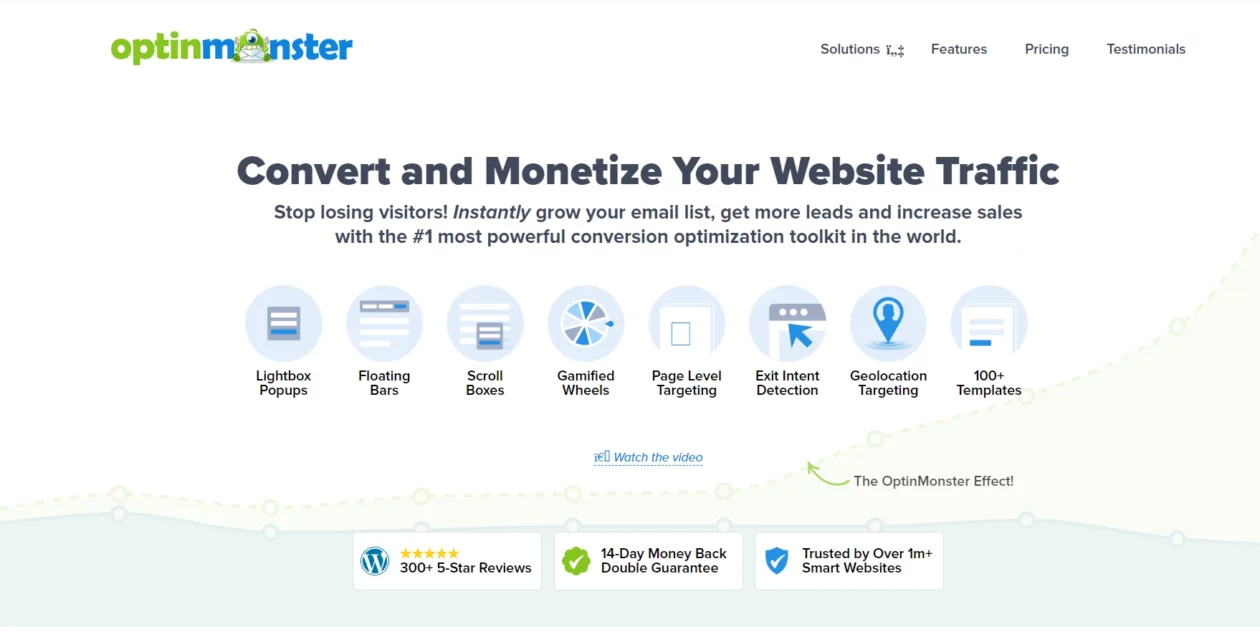
OptinMonster is not a countdown plugin. It is a campaign platform that happens to include countdown timers, and you should only be here if you want the rest of it: exit-intent popups, floating bars, page-level and geolocation targeting, A/B tests. Both fixed and evergreen timers are supported, and you can run different timers on different pages.
The number that matters is the one on the second invoice. Countdown timers start at the Pro tier, which is listed at $29 a month billed annually. That is $348 for the first year. The OptinMonster pricing page then states plainly that all renewals are at full price, and full price for Pro is $870 a year — more than ten times the next-highest renewal in this table, the $82 Evergreen Countdown Timer licence. Budget for year two before you sign up for year one.
- Key features: drag-and-drop campaign builder; lightbox popups, floating bars and slide-ins; exit-intent detection; page-level, device and geolocation targeting; fixed and evergreen countdown timers; A/B testing.
- Price: Basic $7/mo billed annually, Plus $19/mo, Pro $29/mo, Growth $49/mo. Renewals are $210, $570, $870 and $1,470 a year respectively. Countdown timers require Pro or above.
- Best for: ecommerce and lead-gen sites already committed to running popup campaigns, where the timer is one widget among many.
- Skip it if: you only want a countdown. Paying $870 a year for a timer you could get free from HurryTimer is not a decision, it is an accident.
SeedProd

SeedProd is a landing page and theme builder with a countdown block in it, which makes it the right answer when the timer and the page are the same project — a launch page, a coming-soon holding page, a maintenance screen with a return date on it. Its countdown block documentation describes two modes: a DateTime Countdown where every visitor sees the same end point, and a cookie-based Visitor Timer that resets per visitor. Worth flagging, because this article previously claimed SeedProd had no evergreen option. It does.
At 4.9 out of 5 it holds the highest WordPress.org rating in this table, and version 6.20.9 was updated on 24 August 2026. If you are weighing it against alternatives, it sits in the same bracket as the other visual page builders for WordPress rather than against the timer plugins.
- Key features: drag-and-drop page and theme builder; countdown block with DateTime and evergreen Visitor Timer modes; coming-soon and maintenance modes; template library; access controls; email marketing integrations; revision history.
- Price: free Lite version. Paid tiers on the SeedProd pricing page are Basic $79/yr, Plus $199/yr, Pro $399/yr and Elite $599/yr at full price, discounted for the first year, with renewals stated as full price.
- Best for: launch pages, coming-soon pages and maintenance screens where you are building the page anyway.
- Skip it if: you already run Elementor, Bricks or another builder. Installing a second page builder to get one block is a heavy way to place a timer.
Countdown Timer – Widget Countdown
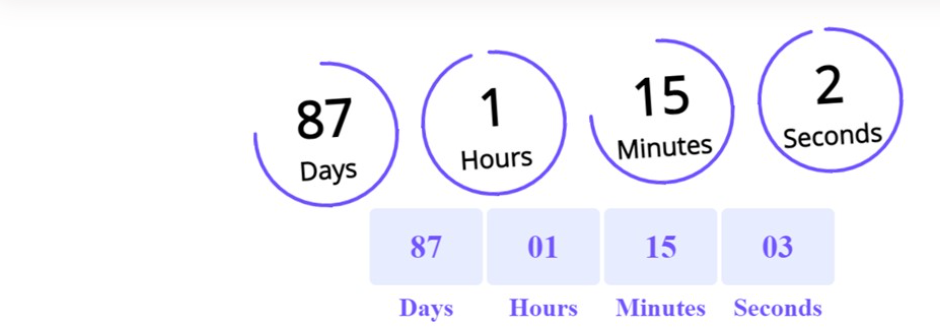
wpdevart’s plugin does the simple thing well: unlimited timers, a Gutenberg block, a classic-editor option and a sidebar widget, an after-expiry action, and animation effects in the paid version. If all you need is a countdown to a fixed date in a sidebar, it will do it today.
Be honest about the reception, though. It sits at 3.6 out of 5, sharing the lowest rating in this table with Evergreen Countdown Timer. Version 3.0.1 was updated on 21 April 2026 and is tested to WordPress 6.9.7.
- Key features: unlimited timers on posts, pages and sidebars; Gutenberg block and classic editor support; sidebar widget; configurable after-expiry action; 39 animation effects in Pro; device display controls.
- Price: free version, with Personal at $13 for one site, Business at $27 for five and Developer at $45 for unlimited on the wpdevart pricing table. That $13 is the cheapest paid licence in this comparison, but the page does not state whether it is annual or one-time, so confirm at checkout before you rely on it.
- Best for: a fixed-date sidebar or in-post timer on a small site where the budget is essentially zero.
- Skip it if: you need evergreen behaviour — the plugin does not document a per-visitor mode — or you want the reassurance of a strong review record.
Evergreen Countdown Timer
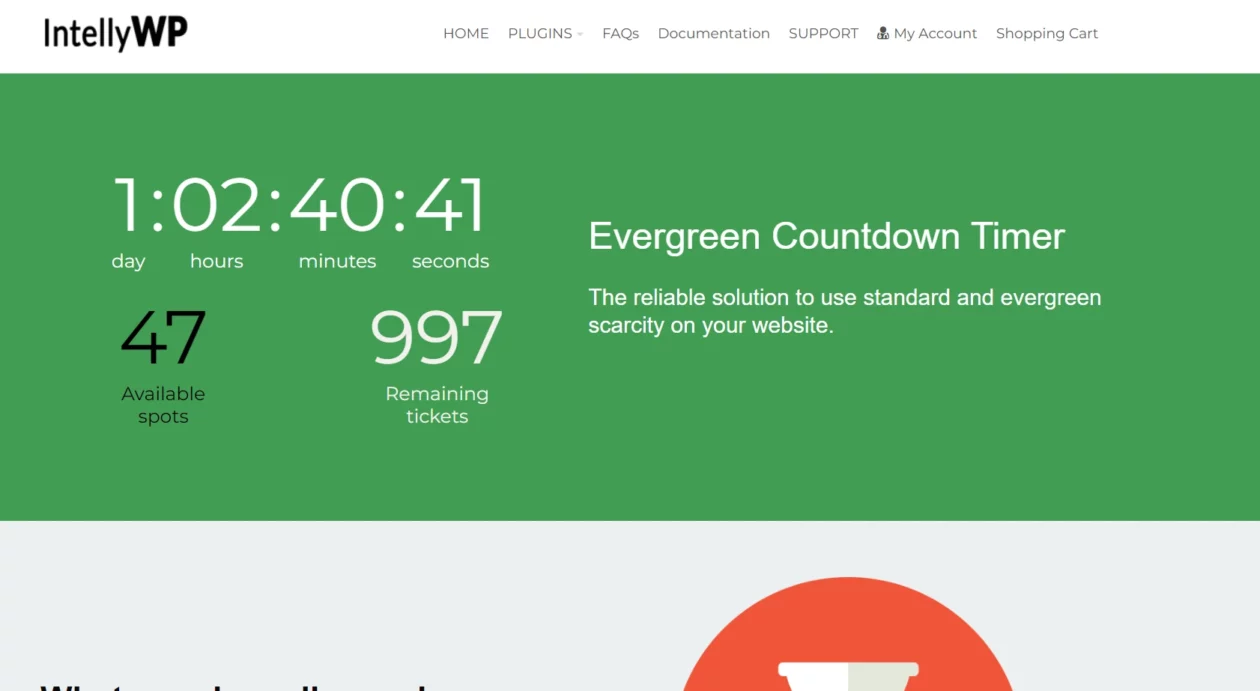
This one has changed hands and changed slug. It is now published by Data443 Risk Mitigation under the IntellyWP brand, and the old WordPress.org URL no longer resolves — the current plugin listing shows 2,000+ active installs and 3.6 out of 5 from 14 ratings, a long way from the numbers this article used to quote.
Feature-wise it is competent: evergreen and standard timers, cookie or IP visitor detection, spot and ticket scarcity counters, redirect on expiry, custom CSS. The problem is the price against the field. The IntellyWP pricing page asks $82 a year for a single site, or $345 one-time — that annual figure is higher than SeedProd Basic’s $79 renewal, for a plugin with 2,000 installs against SeedProd’s 700,000. And HurryTimer gives you evergreen mode for nothing.
- Key features: evergreen and standard countdowns; cookie or IP-based visitor detection; available-spots and remaining-tickets scarcity counters; automatic resetting; redirect URL on expiry; unlimited colours and custom CSS.
- Price: free on WordPress.org. Personal is $82 per year for one site; a single-site lifetime licence is $345 one-time.
- Best for: the specific case where you want scarcity counters for seats or tickets alongside the timer and nothing else offers both.
- Skip it if: you just want an evergreen countdown. On price and on rating, this is the hardest paid tier here to justify.
A word on those scarcity counters: “47 available spots” is a factual claim about your inventory. If it is decorative, it carries the same problem as a fake timer, only more concretely.
Countdown Timer Ultimate: remove this one

Countdown Timer Ultimate used to be a reasonable recommendation, and earlier versions of this article said so. It is not one now. Its WordPress.org listing carries this notice: “This plugin has been closed as of April 7, 2026 and is not available for download. This closure is permanent. Reason: Security Issue.”
A permanent closure for a security issue means no patches are coming and no update will ever arrive through your dashboard. If it is still installed anywhere you manage, deactivate and delete it, then replace the timer with one of the plugins above. This is also the sort of thing a WordPress security plugin should be flagging for you rather than a blog post.
The catch: caching, layout shift and timezones
Three things break countdown timers on real sites, and no roundup mentions them because they show up a week after install rather than during a demo.
Full-page caching freezes timers. If your timer renders server-side, the cache stores one copy of “3 days 4 hours” and serves it to everyone until the cache clears. Evergreen timers suffer worse, because the whole point is a per-visitor value and a cached page has no idea who is looking. The fix is to make sure the countdown is rendered in JavaScript from a timestamp rather than baked into the HTML, and to exclude the page if it is not. Whichever of the WordPress caching plugins you run, this is the setting to check first.
Timers cause layout shift. A timer that appears after the page paints pushes every element below it down the screen. Google’s Core Web Vitals guidance puts a good Cumulative Layout Shift score at 0.1 or below at the 75th percentile of page loads, and a hero-area timer is an efficient way to blow through that. Reserve the height with CSS before the script runs. If you are already fighting this, the fuller treatment is in our guide to avoiding layout shift in WordPress, and general WordPress speed optimisation covers the script-loading side.
Timezones bite at the worst moment. Countdown plugins take their end time from WordPress, and WordPress takes it from Settings, General, which on a lot of installs is still UTC. Set a sale to end at midnight and you may find it ending at 7pm for your customers. Set the site timezone to a named city rather than a UTC offset so daylight saving is handled for you, then set your deadline.
Which one should you install?
- A real deadline on a sale, launch or webinar: HurryTimer, free.
- A fixed date that has to match a particular visual style: Countdown & Clock, free.
- A launch or coming-soon page where the timer is part of the design: SeedProd.
- WooCommerce sale scheduling with discounts and inventory goals attached: look at Finale Lite, which is built for that job specifically and free on WordPress.org. It pairs with the rest of your WooCommerce plugin stack.
- You already pay for a page builder: check before you install anything. Elementor Pro ships a Countdown widget with both fixed and evergreen modes, and several free Elementor addon packs include one too.
- A single hardcoded date, once: a code snippet plugin and a few lines of JavaScript, and you own no new dependency.
Frequently Asked Questions
Are evergreen countdown timers legal?
A per-visitor timer is fine when the deadline it shows is real, such as a genuine 48-hour window that starts when someone joins your funnel. It becomes deceptive when the offer never actually expires. The FTC dark patterns report names timers that imply a limited window on offers that are not time-limited.
What is the difference between a standard and an evergreen countdown timer?
A standard timer counts down to one fixed date and time, so every visitor sees the same number. An evergreen timer starts when a particular visitor arrives and stores that start in a cookie, so two people on the same page see different numbers. Same widget, very different promise.
Do I need a paid plugin for a countdown timer?
No. HurryTimer puts evergreen, recurring and scheduled modes in its free plugin, and Countdown and Clock covers fixed dates, circle timers and coming-soon pages for nothing. Pay when you need WooCommerce sale scheduling, popup targeting, or support with a response time attached to it.
Why does my countdown timer show the wrong time?
Almost always a timezone or a caching problem. WordPress uses the timezone in Settings, General, which is often still UTC while you are thinking in local time. If the number is frozen rather than wrong, a full-page cache is serving one stored copy of the countdown to every visitor.
Will a countdown timer slow down my site?
Barely, in bytes. The real cost is layout shift: a timer that loads after the page paints pushes everything below it down, and Google treats a Cumulative Layout Shift score above 0.1 as needing improvement. Reserve the height in CSS before the script runs and the problem goes away.
Do countdown timers actually increase conversions?
Sometimes, on a real deadline. A genuine sale end date or a webinar start time gives people a reason to act now. A timer bolted onto an offer that never changes trains repeat visitors to ignore it, and it costs more in trust than it earns in orders.
Can I add a countdown timer without a plugin?
Yes, if your page builder already has the widget. Elementor Pro ships a Countdown widget with fixed and evergreen modes, and SeedProd has a countdown block in its own builder. For a single fixed date, a snippet plugin plus a short piece of JavaScript is enough.
Which countdown plugin works best with WooCommerce?
HurryTimer integrates with WooCommerce in its free version and can tie a timer to a product page or a coupon. For sale scheduling with discounts and inventory goals built into the campaign, Finale Lite is designed for that job and is free on WordPress.org.
Our call
Install HurryTimer. It is free, it does evergreen and scheduled and recurring timers without a licence key, it is tested against the current WordPress release, and if you ever do need the paid tier it is $39 a year rather than $870. For a fixed-date timer that has to look a particular way, Countdown & Clock is the better free pick. Buy SeedProd only if you are building the landing page too, and buy OptinMonster only if you want the campaign platform and have priced the renewal.
Then spend longer on the deadline than on the plugin. The best timer is the one telling the truth: a real date, a real consequence at zero, and an offer that genuinely changes when the clock runs out. Everything else is a widget pretending to be a reason to buy.