


WordPress cache plugins are the cheapest speed fix you will ever install, and the easiest one to get wrong. Stack two of them, or run one on a host that already caches at server level, and you get stale carts, white screens and a support ticket. Below are seven, with prices checked in August 2026 and the conflicts spelled out. One of them is not a cache plugin at all, which is worth knowing before you pay for it.
Quick verdict
- Best overall: WP Rocket, $59 a year for one site. It is the only one here that ships delayed JavaScript, critical CSS and cache preloading without a weekend of reading documentation.
- Best free on LiteSpeed hosting: LiteSpeed Cache. Nothing paid beats it, provided your server actually runs LiteSpeed.
- Best free everywhere else: WP Fastest Cache. Plain static HTML, sane defaults, and a free tier that does the job on a blog.
- Skip all of this if: you are on managed hosting that caches at the edge. WP Engine disallows W3 Total Cache outright, and a second page cache on top of a server cache buys you nothing.
- Our call: one page cache, never two. Add Perfmatters only after the cache is working, and only if you still have scripts to kill.
The seven compared
| Plugin | Free version | Paid entry, 1 site | Renewal | Does page caching? |
|---|---|---|---|---|
| WP Rocket | No | $59 / year | No renewal discount published | Yes |
| Perfmatters | No | $29.95 / year | $25.46 / year (15% off) | No, it is a companion |
| WP Fastest Cache | Yes | $49 one-time (Bronze) | None, one-time fee | Yes |
| W3 Total Cache | Yes | $99 / year (Pro) | No renewal discount published | Yes |
| WP Super Cache | Yes | Free only | n/a | Yes |
| LiteSpeed Cache | Yes | Free | n/a | Only on LiteSpeed servers or via QUIC.cloud |
| Hummingbird | Yes | Pro needs a WPMU DEV membership | Not published at check date | Yes |
Two arithmetic notes before anyone emails us. At the one-site tier, W3 Total Cache Pro is the most expensive licence with a published price in that table at $99 a year. And WP Fastest Cache at $49 once is cheaper across three years than any annual licence here: $49 flat against $80.87 for Perfmatters with its renewal discount, $177 for WP Rocket and $297 for W3 Total Cache Pro.
WP Rocket
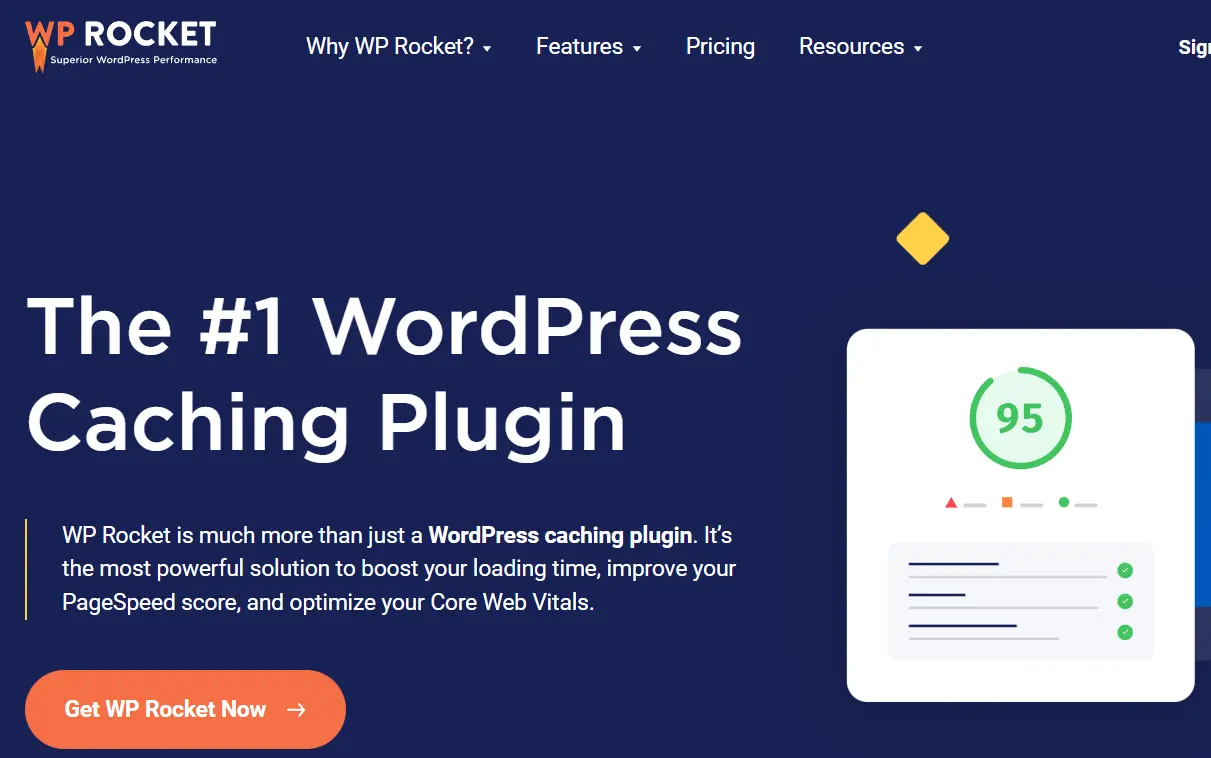
WP Rocket is the one we install on client sites where nobody is going to babysit the settings. Page caching, GZIP, browser caching and cache preloading switch on the moment you activate it, and the settings that usually break things, delayed JavaScript execution and critical CSS generation, are behind toggles with plain-English labels rather than a wall of checkboxes. It is not on the WordPress.org repository, so there is no free tier to try first, only the 14-day refund window.
Where it earns its money is server response time. Preloading means the first visitor to a page is not the one who pays to generate it, which is the single biggest reason a freshly cached site still feels slow.
Key features
- Page cache, browser cache and GZIP on by default
- Cache preloading triggered whenever you edit content
- Delayed JavaScript execution and critical CSS generation
- Database cleanup, plus lazy loading for images and iframes
- Add-ons for Varnish, Cloudflare and Sucuri
Price: $59 a year for one site, $119 for three, $299 for fifty, per the WP Rocket pricing page. The licence renews automatically after a year and no renewal discount is published, so budget the full $59 again.
Best for: client sites, and anyone who would rather pay $59 than spend a Saturday tuning W3 Total Cache.
Skip it if: your host already runs a server-level page cache, or you want to try before you buy. There is no free version.

The button below is an affiliate link. If you buy through it we earn a commission at no extra cost to you, and it does not change what we recommend.
Perfmatters
Here is the thing most roundups leave out: Perfmatters does not cache pages. It is a trimming tool. Its own documentation ships setup guides for running it alongside LiteSpeed Cache and WP Fastest Cache, which tells you exactly how the developers expect it to be used. Buy it as a second plugin, not as your cache.
What it does do is the Script Manager, which lets you unload a plugin’s CSS and JavaScript on every page that does not need it. On a typical site running a contact form plugin, a slider and a social sharing plugin, that alone strips a noticeable number of requests off every page. Nothing else on this list does it as cleanly.
Key features
- Script Manager for per-page unloading of CSS and JS
- Lazy loading, WebP rewriting and CDN URL rewriting
- Local hosting of Google Analytics
- Header, body and footer code insertion
- Database optimisation and multisite support on the top tier
Price: $29.95 a year for one site, $59.95 for three, $124.95 for unlimited, per the Perfmatters pricing page. A 15% discount applies automatically to renewals, so the one-site plan comes back at $25.46. That is the only published renewal discount on this page.
Best for: sites already on LiteSpeed Cache or WP Fastest Cache that need script control the cache plugin does not offer.
Skip it if: you are shopping for a cache plugin. This is not one. Also skip it if you already run WP Rocket, which covers most of the same optimisation ground.

WP Fastest Cache
The free version is genuinely good, and the paid version is the only one on this list you buy once. It writes static HTML, minifies CSS and HTML, sets expiry headers and lets you exclude logged-in users and mobile devices with two checkboxes. The interface looks like it was built in 2014, which is fine, because you configure it once and never open it again.
Its WordPress.org listing shows over one million active installations and a 4.9 rating across roughly 4,200 reviews, the highest average of any plugin here.
Key features
- Static HTML page cache with preloading
- Minify HTML and CSS, combine CSS, GZIP, expiry headers
- Separate cache for mobile and for logged-in users
- Database cleanup for revisions and trashed content
- CDN integration and asynchronous Google Fonts
Price: free on WordPress.org. Premium is a one-time fee: $49 Bronze for one licence, $125 Silver for three, $175 Gold for five, $300 Platinum for ten, per the vendor’s premium page. Each licence includes 10,000 image optimisation credits.
Best for: anyone who hates subscriptions. Over three years it costs less than every annual licence in the table above.
Skip it if: you want delayed JavaScript or automatic critical CSS. That is WP Rocket territory, and pairing this with Perfmatters is the usual workaround.

W3 Total Cache

W3 Total Cache is the most configurable plugin here and the one most likely to break your site, and those are the same fact. It caches at the page, object, database, fragment and browser level independently, works with Memcached and Redis, and supports reverse proxying through Varnish or nginx. If you know which of those layers your site actually needs, nothing else gives you this much control.
If you do not, leave it alone. Its repository listing shows 900,000+ active installations and a 4.4 rating across more than 5,400 reviews, with over 500 of those at one star, which is a fair reflection of how easy it is to misconfigure. It is also the one plugin WP Engine disallows by name.
Key features
- Independent page, object, database, fragment and browser caching
- Memcached and Redis support
- Reverse proxy integration via Varnish or nginx
- Minification of inline, embedded and third-party CSS and JS
- Image Service extension for WebP conversion
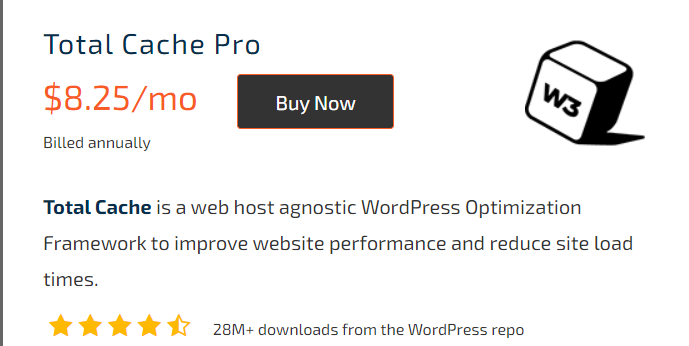
Price: free on WordPress.org. Pro is $99 a year for one site, $350 for five and $500 for ten, per the BoldGrid pricing page, with a 30-day money-back guarantee. No renewal discount is published.
Best for: self-managed VPS setups where you control Redis, Varnish or Memcached and want the plugin to use them.
Skip it if: you are on WP Engine, where it is disallowed, or on any shared host where you cannot see what the caching layers are doing.
WP Super Cache

Maintained by Automattic, free forever, and about as exciting as a fuse box. It serves static HTML files through mod_rewrite and gets out of the way. Three caching modes, a handful of expiry settings, done. Its listing shows 1+ million active installations and a 4.3 rating.
The recurring complaint in its one-star reviews is WooCommerce carts serving stale totals. That is fixable by excluding cart, checkout and account pages, but it is a manual step nobody tells you about, and it is why we do not put this on shops.
Key features
- Static file caching via mod_rewrite, plus simple PHP mode
- Cache preloading and scheduled garbage collection
- Automatic page compression
- CDN support and a settings import and export
Price: free. There is no paid tier.
Best for: blogs and brochure sites on shared Apache hosting where you want one thing that works and nothing else.
Skip it if: you run a store, or you want minification and script control. It does neither.
LiteSpeed Cache

On LiteSpeed hosting this is the best free option by a distance, and it beats most paid ones. Caching happens at server level rather than in PHP, so it is faster than anything that writes HTML files from inside WordPress. It also bundles image optimisation, critical CSS and font handling that you would otherwise buy separately. Its listing shows 7+ million active installations and a 4.8 rating.
The catch is in the name. LiteSpeed’s own installation documentation states that without a LiteSpeed server, none of the caching functionality is available to you, though the optimisation features still work. The escape hatch is QUIC.cloud, LiteSpeed’s own CDN, which will do the caching for you. Its CDN plans include a free tier with unlimited bandwidth across six points of presence in North America and Europe, with paid bandwidth from $0.02 to $0.08 per GB by region.
So before you install it, check what your host runs. If you are shopping anyway, our roundup of WordPress hosting platforms flags which ones are LiteSpeed-based.
Key features
- Server-level page caching, plus object cache and browser cache
- Edge Side Includes, so parts of a page stay dynamic
- Image optimisation and critical CSS through QUIC.cloud
- Minify and combine CSS, JS and HTML, inline and external
- WooCommerce and bbPress handling, WP-CLI commands, multisite
Price: free. QUIC.cloud has a free CDN plan; paid bandwidth is metered per GB.
Best for: anyone on LiteSpeed or OpenLiteSpeed hosting, which covers a large share of budget shared hosts.
Skip it if: you are on Apache or nginx and do not want to route through QUIC.cloud. You will get minification and image tools, and no page cache at all.
Hummingbird
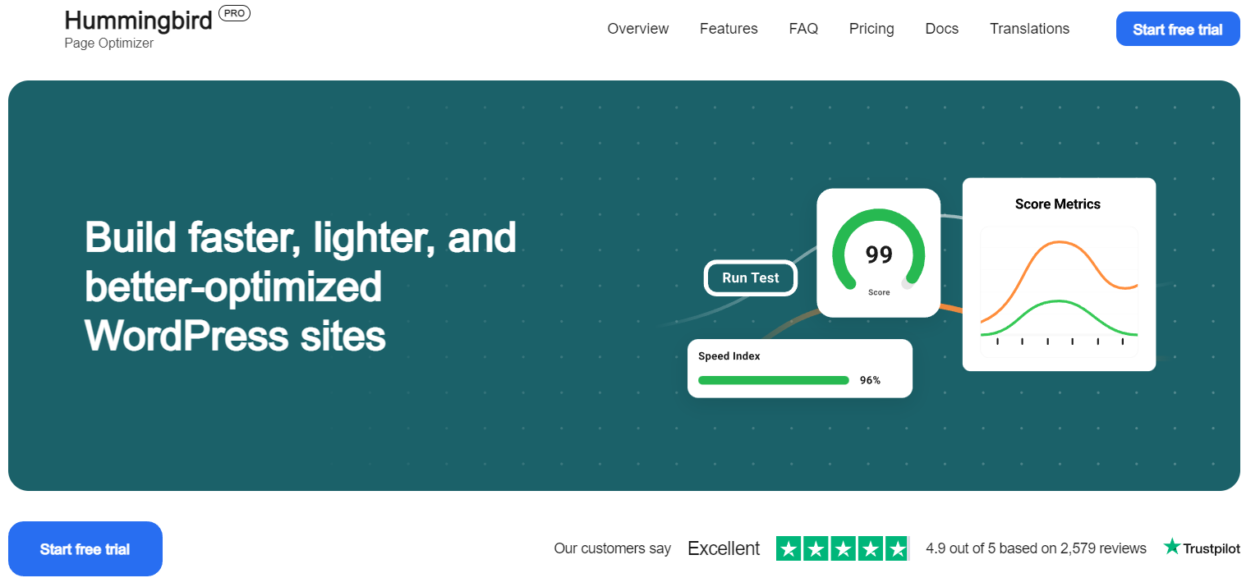
Hummingbird is the smallest name here, with 70,000+ active installations on its repository listing and a 4.7 rating. It does page caching, browser caching, GZIP, asset optimisation and Cloudflare integration, and its scan-and-fix flow is the friendliest introduction to performance work on this list.
It makes most sense if you already pay WPMU DEV for Smush, Defender or their hosting, because the Pro version comes bundled with the membership rather than sold on its own. A current standalone price could not be confirmed: the WPMU DEV pricing page was not reachable at the check date, so confirm the figure at checkout rather than trusting any number you read in a roundup, including ours.
Key features
- Page, browser and Gravatar caching
- Scan-and-fix performance report with one-click changes
- Asset optimisation with per-file control
- Cloudflare integration and WooCommerce cart fragment control
Price: free on WordPress.org. Pro requires a WPMU DEV membership; no standalone price was verifiable at the check date.
Best for: existing WPMU DEV members, and beginners who want the plugin to tell them what to fix.
Skip it if: you want a single-purpose cache plugin without a membership attached to it.
What most roundups get wrong
Perfmatters is filed as a cache plugin almost everywhere, including in the previous version of this article. It is not. It has no page cache. If you buy it expecting one, your site will be exactly as slow as it was, and you will have spent $29.95 finding out.
Caching does not fix Core Web Vitals on its own. Per web.dev, the good thresholds at the 75th percentile are 2.5 seconds for LCP, 200 milliseconds for INP and 0.1 for CLS. A page cache moves LCP and server response time. It does almost nothing for CLS, which comes from images without dimensions, injected ads and late-loading fonts, and you fix those by stopping the layout shift at its source. INP is a JavaScript problem, and aggressive JS delay can make it worse rather than better by bunching all the work into the first interaction.
Your host may have already made this decision for you. WP Engine disallows W3 Total Cache platform-wide because it collides with their own caching layer, and most managed hosts run something similar. Adding a plugin cache on top of a server cache gives you two systems with different opinions about when content is stale. If you are picking a host now, the caching setup should be part of how you choose it, not an afterthought.
Install counts are not endorsements. W3 Total Cache has 900,000+ installs and 516 one-star reviews. Those numbers coexist because it is powerful and easy to break. Read the low reviews on any plugin before the high ones.
A short decision path
- Check your host first. If it advertises server-level or edge caching, install nothing and go tune something else instead, starting with your overall speed setup.
- On LiteSpeed hosting? LiteSpeed Cache. Free, server-level, nothing else needed.
- Budget is zero and the host is Apache or nginx? WP Fastest Cache free, or WP Super Cache if you want the most boring option available.
- Willing to pay, want it working in ten minutes? WP Rocket at $59.
- Running a VPS with Redis or Varnish? W3 Total Cache, and set aside an evening.
- Still slow after caching? Now add Perfmatters and start unloading scripts. Not before.
Whatever you install, exclude cart, checkout and account pages before you do anything else, then load the site in a private window and buy something. That is the verification step people skip, and it is the one that catches the stale-cart bug on the day you deploy rather than the week after.
Frequently Asked Questions
Do I still need a cache plugin if my host already caches?
Usually not. Managed hosts run page caching at server level, and WP Engine disallows W3 Total Cache outright because it conflicts with theirs. Install a plugin only for the extras your host skips, such as script management or delayed JavaScript. Check your host’s policy page first.
Can I run two cache plugins at once?
No. Two page caches fight over the same generated files and the same rewrite rules, which is how you get stale carts and white screens. One page cache, plus at most one non-caching optimiser such as Perfmatters, is the sensible ceiling for any site.
Is Perfmatters a cache plugin?
No. Perfmatters handles script management, lazy loading, database cleanup and asset control, but it does not generate a page cache. Its own documentation ships setup guides for pairing it with LiteSpeed Cache and WP Fastest Cache, so budget for a cache plugin as well.
Does LiteSpeed Cache work on Apache or nginx?
The optimisation features do. Page caching does not, unless you route the site through QUIC.cloud CDN. On a plain Apache or nginx host without QUIC.cloud you get minification, critical CSS and image tools, and no page cache at all. Check your server before installing.
Is a free cache plugin good enough?
For a blog or a brochure site, yes. WP Super Cache and WP Fastest Cache both write static HTML that loads fast. You pay for WP Rocket when you want delayed JavaScript, critical CSS and cache preloading without spending a weekend inside the settings screen.
Will a cache plugin fix my Core Web Vitals?
Only part of them. The good thresholds are 2.5 seconds for LCP, 200 milliseconds for INP and 0.1 for CLS. Caching mainly moves LCP and server response time. Layout shift comes from your theme, images and ads, and no cache plugin repairs that.
What breaks first when I turn caching on?
Logged-in views, carts, checkouts and anything relying on a form nonce. Exclude cart, checkout and account pages from the cache before you change anything else, then test a real purchase in a private browser window rather than assuming it worked.
Does WP Rocket renew at a discount?
Its pricing page publishes no renewal discount, so budget the full $59 a year per site. Perfmatters is the exception on this page: it applies an automatic 15% discount to renewals, which brings the one-site plan down to $25.46 after the first year.
What we would actually install
On LiteSpeed hosting, LiteSpeed Cache, and we would not spend a penny. Everywhere else, WP Rocket at $59 a year, because the settings that matter are on by default and the ones that break sites are labelled clearly enough that a client can be trusted near them.
If $59 a year is not happening, WP Fastest Cache free does most of the same work, and its $49 one-time licence is the cheapest paid three-year cost in the table above. Perfmatters is a second purchase, not a first one. And if your host already caches at the edge, the best cache plugin is the one you never install.


Is there any free plugin to optimize the website for scripts and CSS?
I don’t want to spend so much on caching.
Hi David, definitely there are many free plugins through which you can optimize your website.
You can use Asset Clean Up, Autoptimize, or WP Optimize if you don’t want to spend much on caching and speed optimization.
[…] hosting. Start with our guide to speeding up a WordPress website, add a proper cache layer from the WordPress cache plugins roundup, and if you are rebuilding anyway, pick from the SEO-optimized themes rather than fighting […]
[…] kills the script. A page that used 60M before will use 60M after. If pages feel slow, the fix is a caching plugin that stops PHP running at all for most visitors, or the broader work in our guide to speeding up a WordPress site. Neither has […]
[…] burning. Buy a one-time pack instead — those credits never expire. And if you already run a full WordPress caching plugin with its own image module, check for overlap before switching both […]
[…] submission is exactly the thing aggressive page caching can break. If you run one of the WordPress cache plugins with HTML caching on the comment form, test a real submission before you call it […]
[…] that respect the standard read the same consent state instead of guessing, and it flushes the major WordPress caching plugins when the banner configuration changes, which saves a support ticket you would otherwise open with […]
[…] competes with your site for the same CPU. The cost is usually acceptable and often invisible behind a decent caching layer, but it is not zero, and anyone telling you it is has not […]
[…] is the one we point clients at, and pairing it with a proper production cache layer from our WordPress cache plugins comparison, or WP Rocket, is a better use of an afternoon than debugging […]
[…] you run a page cache plugin, add cache purging to your mental checklist for every global widget edit. A stale cached page looks […]
[…] as it does here, that is fine, because the cached page belongs to that post anyway. Clear your page cache plugin after every edit, though, or you will keep testing yesterday’s HTML and concluding the plugin […]
[…] of these packs let you disable widgets you are not using — turn the unused ones off. Then let a cache plugin such as WP Rocket, or an asset-trimmer such as Perfmatters, clean up what is left. Neither one can […]
[…] go stale on your archive, look at your cache rules before you blame the template. Our guide to WordPress cache plugins covers where those exclusions […]
[…] for. Anyone running a page cache who still needs different content per country. The AJAX mode is the reason it works where cheaper […]
[…] needs the page cache purged before you can judge it. If you are running one of the plugins from our WordPress cache plugins comparison, purge first and swear second. The same goes the other way: a snippet that runs a […]
[…] of viewport on every page they preview. The cache-busting helper pairs well with an aggressive caching plugin, which is exactly when stale previews […]
[…] every cache layer: your cache plugin, your host’s object and page cache, and any CDN in front of […]
[…] and readers want to reply to each other rather than to you. The AJAX loading also plays nicely with page caching, because the thread is fetched after the cached HTML has already been […]
[…] inside the course. Budget for decent WordPress hosting before you budget for the plugin, pick a caching plugin that handles object caching rather than only page caching, and do the usual speed work on the […]
[…] is for. Cache aggressively but exclude cart, checkout and account pages, which every tool in our WordPress cache plugins comparison can do, WP Rocket included. And compress product imagery properly before it ships, using […]