


Most table builder plugins for WordPress will get a grid of numbers onto the page. Far fewer output markup a screen reader can actually read, and several never tell you what the licence costs in year two. That is where the money and the accessibility audits go wrong. This comparison checks both: current pricing straight from each vendor, and the real HTML each plugin’s free build emits. Seven plugins, sorted by what they are genuinely good at.
Quick verdict
- Best overall: Ninja Tables. Its free build is the only one here that emits both a
scopeattribute on header cells and a real<caption>, set from a field in the table editor. - Best free: TablePress. Sorting, search and pagination with no card, no row cap and no upsell wall, on 600,000+ sites.
- Skip it if: you were about to use Visualizer for a data table. Its shortcode prints an empty
<div>and JavaScript builds the table afterwards, so there is no table in the HTML source at all. - Our call: Ninja Tables when the table carries information people need to read and understand. TablePress when the budget is zero and the table is simple.
Best WordPress Table Plugins in 2026, compared
Renewal price is the column that decides your budget, so it gets its own column here rather than a footnote. Two vendors do not publish one at all, and that is recorded as such rather than guessed.
| Plugin | Free version | Paid entry, 1 site | Renews at | Best for |
|---|---|---|---|---|
| TablePress | Yes, 600,000+ installs | Pro $89/year | $89/year | Free sortable data tables |
| Ninja Tables | Yes, 70,000+ installs | $63/year (list $79) | $79/year | Accessible tables, mixed media cells |
| wpDataTables | Yes, Lite, 70,000+ installs | Not published | Not published | Large datasets, SQL and spreadsheets |
| WP Table Builder | Yes, 50,000+ installs | Starter $39/year | Not published; vendor states renewals are at full price | Comparison and layout tables |
| Posts Table Pro | Yes, a cut-down sibling plugin | $69/year | Not stated | Listing posts, CPTs and custom fields |
| WooCommerce Product Table | No | $79/year | Not stated | Order-form product grids |
| Visualizer | Yes, 20,000+ installs | Personal $99/year | $199/year | Charts, not data tables |
Two numbers in that table are worth staring at. WP Table Builder’s $39 is the cheapest published annual price of the seven, though the vendor states it is introductory pricing and that renewals are at full price, which it does not print. Visualizer’s $99 is an introductory rate that renews at $199. Ninja Tables also steps up at renewal, from $63 to $79, but Visualizer’s is the steep one: $99 becomes $199.
TablePress
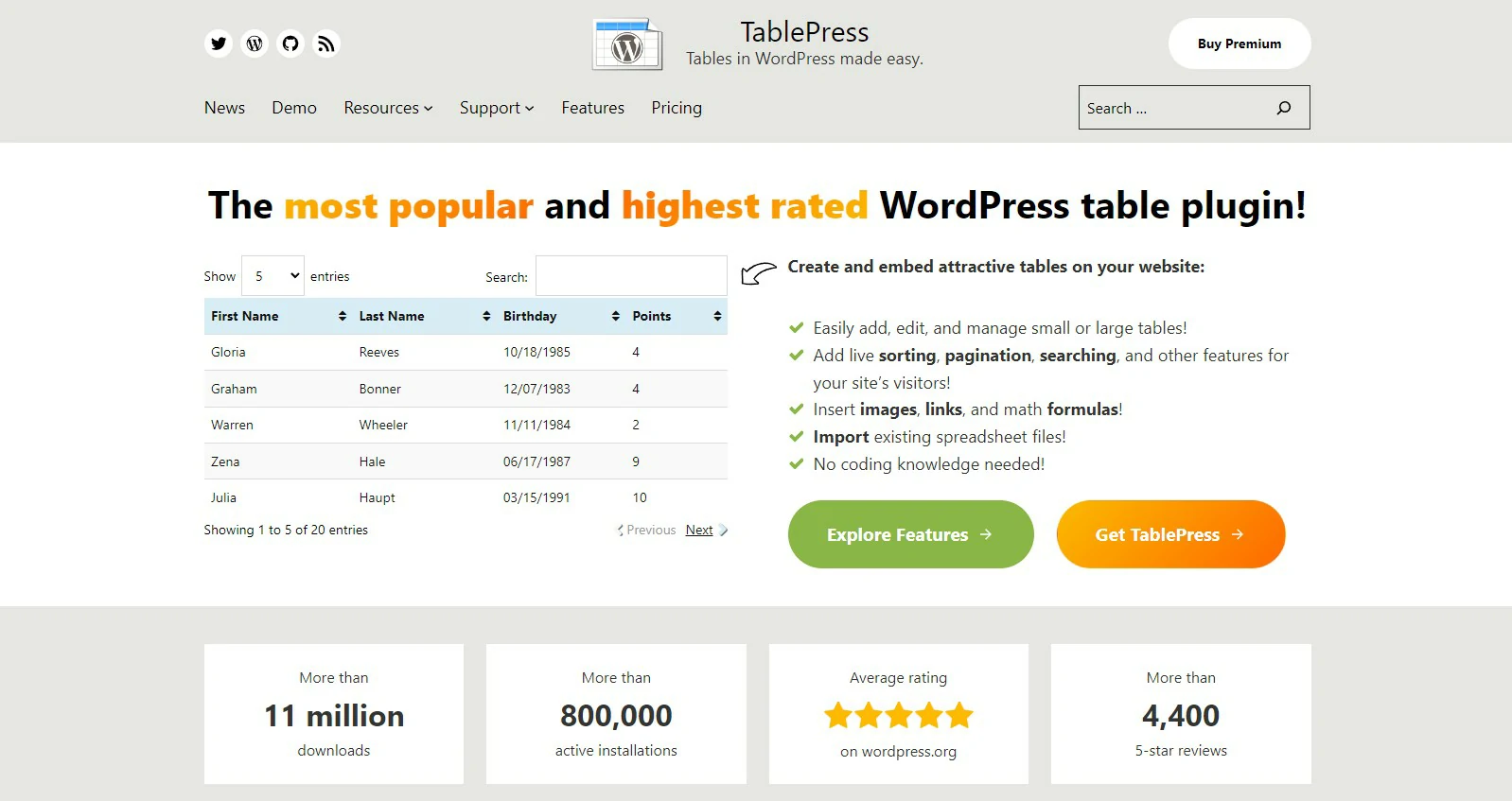
TablePress is the default answer for a reason. The free plugin sits on 600,000+ active installs, and unlike most freemium table plugins it does not cap your rows or hide sorting behind a licence. You build a table in a spreadsheet-style editor, drop a shortcode or block, done.
The catch is the markup. TablePress wraps your header row in <thead> and can promote the first column to <th> cells, which is enough for a simple table. It emits no scope attribute anywhere on the front end, and although it does output a <caption> element, the text inside is empty unless you add the tablepress_print_caption_text filter yourself. That is a five-line snippet, and a code snippet plugin will hold it, but you have to know to write it.
- Key features: sorting, search, pagination, CSV/Excel import, conditional formatting and Excel-style formulas via premium modules.
- Price: free; Pro is $89/year and Max is $189/year for one site, renewing automatically at the same figure. Lifetime licences exist but the plans page does not print their price.
- Best for: anyone who needs a working sortable table today and has no budget.
- Skip it if: you are being audited against WCAG 1.3.1 and cannot add a filter to fill the caption.
Ninja Tables
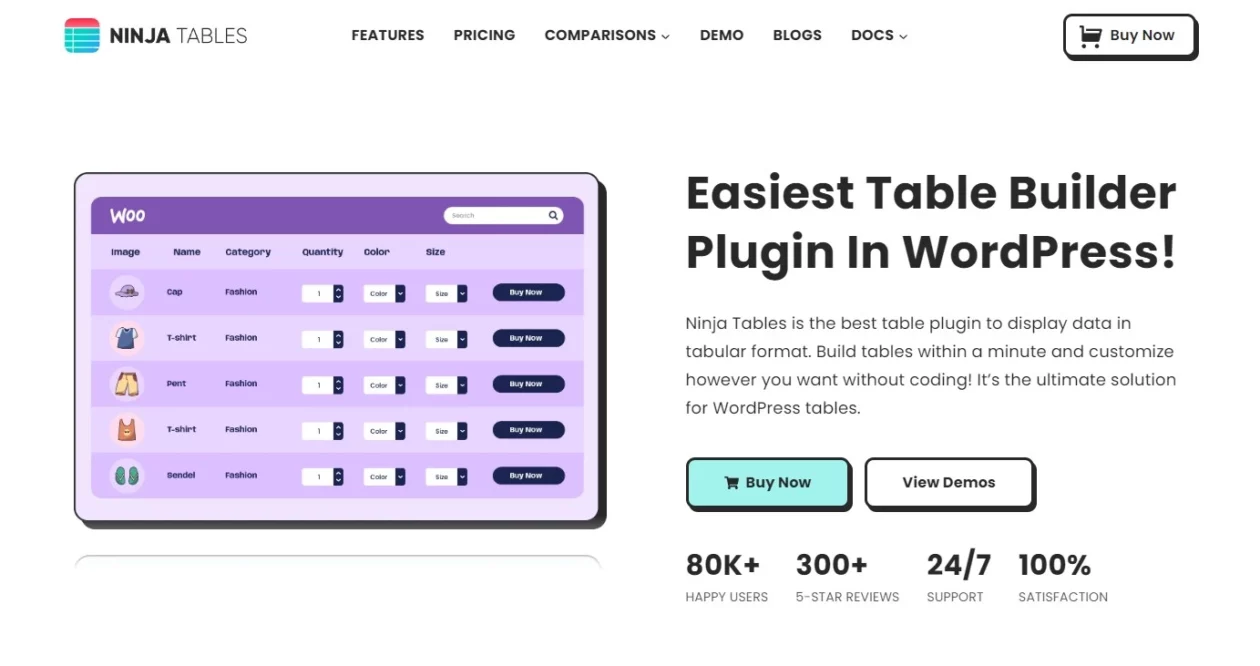
Ninja Tables wins this roundup on a detail nobody advertises. Read its front-end template and you find scope="col" on every header cell, scope="colgroup" on headers that span more than one column, a <caption> element fed by a field in the table editor, and an aria-label fallback pulled from the table title when no caption is set. That is not a marketing claim, it is what the free build on WordPress.org ships.
The rest is competent rather than remarkable. The drag-and-drop editor handles buttons, star ratings, images and HTML inside cells, which is what you want for a comparison table. The free version covers most single-table jobs; the paid add-on brings in external data sources, WooCommerce and conditional formatting.
- Key features: responsive breakpoints per column, media-rich cells, CSV and Google Sheets import, server-side processing for large tables, WooCommerce and Fluent Forms integrations in Pro.
- Price: free on WordPress.org. Pro was $63 for the first year at the check date against a $79 list price, renewing at $79/year for one site. The single-site lifetime licence was $247. Four years of annual renewals come to $300 ($63 + $79 + $79 + $79), so lifetime pays for itself in year four.
- Best for: tables that carry real information, on sites that care about accessibility.
- Skip it if: you only ever build three-row static tables. The core table block does that for free.
wpDataTables
This is the one you reach for when the data is genuinely large or lives somewhere else. wpDataTables can query a MySQL table directly, read a Google Sheet, or pull from an API, then render thousands of rows with server-side processing so the browser is never handed the whole set at once. Nothing else here does that as comfortably.
Two honest problems. First, its front-end template emits plain <th> cells with no scope and no caption, so a complex table needs work you will be doing yourself. Second, the pricing page displays its plan prices as masked placeholders rather than figures, so the number only appears at checkout. Budget accordingly, and confirm before you commit.
- Key features: MySQL and API data sources, server-side processing, front-end editing, charts from table data, conditional formatting, Excel-like editor.
- Price: free Lite version on WordPress.org, 70,000+ installs. Paid plan prices are not printed on the public plans page; check the figure at checkout.
- Best for: reporting tables over hundreds or thousands of rows, or data that must stay in sync with a database.
- Skip it if: your table has twelve rows. This is a lot of plugin for a price list.
WP Table Builder
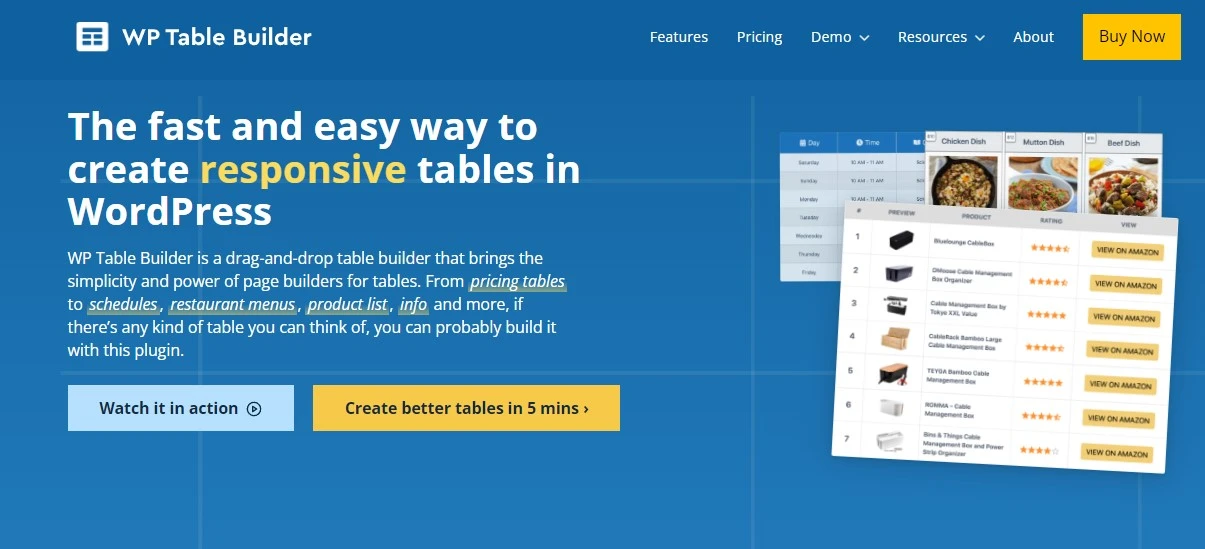
WP Table Builder treats a table as a layout canvas. You drag an image element, a button, a star rating or a block of text into a cell, and what you see in the editor is what ships. For affiliate comparison tables and spec grids that is the fastest route available, and at $39 a year it is the cheapest published price in this comparison.
One setting matters more than the marketing suggests. The renderer only outputs <th scope="col"> when the “use TH for first row” option is switched on, and in the shipped build that option defaults to off. Leave it alone and your table is a grid of <td> with no header cells whatsoever. Turn it on before you publish.
- Key features: visual cell editor with media and button elements, 25+ templates, sticky header and first column, per-column mobile hiding, search and pagination.
- Price: free on WordPress.org with 50,000+ installs. Starter is $39/year for one site; the vendor states renewals are at full price and does not print that figure; Agency is $99/year for unlimited sites. Lifetime is $99 single-site, $249 agency.
- Best for: comparison tables, pricing grids and anything where the cell contents are more design than data.
- Skip it if: you need to import a spreadsheet and keep it updated. That is not what this is.
Posts Table Pro

Every other plugin here asks you to type or import the data. Posts Table Pro reads it out of WordPress. Point a shortcode at a post type and it builds a searchable, sortable table from your existing content, including custom post types, taxonomy terms and custom fields. For a document library, a staff directory or a course index, that is the difference between a table you build once and a table that maintains itself.
Barn2 also ships a free cut-down sibling, Posts Table with Search & Sort, which handles standard posts only and sits around 3,000 installs. Its markup is <thead> with bare <th> cells, no scope and no caption. Pro is a separate premium codebase and was not checked.
- Key features: tables built from posts, pages, CPTs, taxonomies and custom fields; search, sort, filter dropdowns, lightbox media, shortcode-per-table configuration.
- Price: $69/year for one site, $119 for five, $229 for fifty. Lifetime is $349 single-site. The plans page states annual licences must be renewed for updates and support but does not print a renewal price.
- Best for: turning content you already have into a browsable index without duplicating it.
- Skip it if: the data is not in WordPress. You would be paying for the one feature you cannot use.
WooCommerce Product Table

A shop that sells fifty near-identical SKUs does not want a grid of product cards, it wants an order form. WooCommerce Product Table replaces the shop loop with a table carrying a quantity box and an add-to-cart button on every row, plus variation dropdowns inline. Wholesale, spare parts and restaurant menus are the obvious cases. That is a change to how people place an order, not a change of skin.
It is premium-only, so there is no free build to inspect and no way to verify its markup from outside a licence. Treat its accessibility as unknown until you can view source on your own install. If the rest of your stack needs filling out too, our roundup of WooCommerce plugins covers the surrounding pieces.
- Key features: add-to-cart and quantity fields per row, inline variation selectors, product filters, category and attribute filtering, multivendor compatibility.
- Price: $79/year for one site, $179 for five, $299 for fifty. Lifetime is $279 single-site. No free version, and no renewal price stated on the plans page.
- Best for: B2B and wholesale catalogues where buyers order many lines at once.
- Skip it if: you sell a dozen products with strong photography. A table will cost you sales there.
Visualizer

Visualizer is a charting plugin that also does tables, and the distinction matters. For a bar chart, a pie chart or a geo map fed by a Google Sheet that refreshes on a schedule, it is a good tool with a pleasant editor. For a data table, it is the wrong choice, and its own architecture says why.
The [visualizer] shortcode outputs an empty <div>. Everything inside it is assembled at runtime by the Google Visualization API, DataTables.net or Chart.js, which the plugin’s own readme names as its rendering libraries. So there is no table in your HTML source, nothing for a crawler to read without executing scripts, and a block of content that appears after paint, which is exactly how you cause layout shift.
- Key features: line, pie, bar and table types free; scatter, area and geo in Pro; scheduled imports from Google Sheets and external URLs; an AI chart builder from a text prompt.
- Price: free on WordPress.org with 20,000+ installs. Personal is $99 for the first year and renews at $199; Plus is $199 renewing at $399; Infinite is $399 renewing at $799. The page carries a $/€ switcher; figures quoted here are the USD ones.
- Best for: charts and graphs, especially ones fed by a live spreadsheet.
- Skip it if: you want a table. Use anything else on this page.
What most table plugin roundups get wrong
Almost every list of table plugins compares the same six features: drag-and-drop, responsive, import, sorting, pagination, styling. All seven of these plugins tick all six. The features do not separate them. The generated markup does, and it is the thing an accessibility audit will actually fail you on.
A data table needs two things a screen reader can use. Header cells must be <th> with a scope attribute so each value is announced with its column name rather than read out naked, and the table needs a <caption> so someone tabbing through the page knows what they have landed on before committing to forty cells of it. Both are set out in the W3C’s tables tutorial. Here is what these plugins actually emit.
| Plugin | scope on header cells | <caption> | Table present in HTML source |
|---|---|---|---|
| Ninja Tables | Yes, col and colgroup | Yes, editable field | Yes |
| WP Table Builder | Yes, but only if you enable header row | No | Yes |
| TablePress | No | Element present, empty by default | Yes |
| wpDataTables Lite | No | No | Yes |
| Posts Table with Search & Sort | No | No | Yes |
| Visualizer | Not applicable | No | No, built by JavaScript |
| WooCommerce Product Table | Not verifiable, premium only | Not verifiable | Not verifiable |
Read that against the marketing and one line stands out. TablePress describes itself as producing accessible tables, and for a simple grid with one header row it is defensible: <thead> plus <th> covers most screen readers. The moment your table has row headers, spanned columns or two header rows, the missing scope costs you. Ninja Tables is the only one that handled the spanned-header case in its template, and it is the only one with a caption field a normal editor can find.
Both comparison tables on this page use scope and a real <caption>, for what it is worth. It is not hard. It is just not the default.
The other thing nobody mentions: what a table costs your page
Every plugin here ships its own CSS and at least one JavaScript library, loaded on any page holding a table. Several of them lean on DataTables, which wants jQuery too, so that is two libraries downloaded and parsed before a single row of your data appears. On a page with one five-row table that is a poor trade, and the core table block would have cost nothing.
If you keep the plugin, three things pay for themselves: restrict its assets to the pages that need them, put a page cache in front of anything doing a database query per view, and reserve the table’s height in CSS so late-loading rows do not shove your footer down. Tables full of thumbnails also want lazy loading switched on. The wider set of fixes lives in our guide to site speed work.
Which one should you actually install?
- A handful of static rows. No plugin. Use the core table block, or an accordion if the content is really a list of questions wearing a grid costume.
- A sortable data table, no budget. TablePress, plus the caption filter snippet.
- A data table on a site that will be audited. Ninja Tables. The free build already emits what the audit is looking for.
- A comparison or pricing table with images and buttons. WP Table Builder at $39/year, with the header-row option turned on. A page builder you already own may cover this too.
- Thousands of rows, or data living in a database. wpDataTables, once you have the checkout price in front of you.
- An index of content already in WordPress. Posts Table Pro at $69/year.
- A wholesale order form. WooCommerce Product Table at $79/year.
- A chart. Visualizer, and only a chart.
Frequently Asked Questions
Which WordPress table plugin is best for accessibility?
Ninja Tables. Its free build is the only one here that emits both a scope attribute on header cells and a real caption element, set from a field in the table editor. It uses scope=”colgroup” on headers spanning several columns. With no caption set it falls back to an aria-label taken from the table title.
Does TablePress produce accessible tables?
Partly. TablePress wraps the header row in thead and can promote the first column to th cells, which covers a simple grid. It emits no scope attribute on the front end, and its caption element ships empty unless you add the tablepress_print_caption_text filter yourself.
What is the cheapest paid WordPress table plugin?
WP Table Builder Starter, at $39 a year for one site, though the vendor states renewals are at full price and does not print the figure. A one-time $99 lifetime licence for a single site is also offered. Every other published annual price in this comparison is higher.
Why does a table plugin licence cost more at renewal?
Some vendors advertise an introductory first-year rate. Visualizer is the clearest case here: the Personal plan is $99 for the first year and renews at $199. Read the renewal figure rather than the headline one before you put a card in.
Do I need a table plugin at all?
Often not. The core WordPress table block handles a static grid and adds no JavaScript. You need a plugin once you want sorting, search, pagination, hundreds of rows, or data pulled from a spreadsheet, a database or your own posts.
Do table plugins hurt Core Web Vitals?
They can. A table assembled in JavaScript after load pushes surrounding content around and causes layout shift, and every plugin here adds its own CSS and JS to any page holding a table. Load the assets only where a table exists and reserve the table’s height in CSS.
Which table plugin works best with WooCommerce?
WooCommerce Product Table, if you want an order-form grid with a quantity box and add-to-cart button on every row. It is $79 a year for one site with no free version. Ninja Tables and wpDataTables both offer WooCommerce integrations in their paid tiers.
Is a lifetime table plugin licence worth buying?
Sometimes. Ninja Tables’ single-site lifetime licence was $247 at the check date, against $63 for the first year and $79 a year after that. Four years of renewals total $300, so a lifetime licence pays for itself in year four if the site outlives it.
How do I add a caption to a table for screen readers?
Use the plugin’s own caption field where one exists. Ninja Tables offers one in the table editor; TablePress outputs the caption element but needs a small filter snippet to fill it. A heading placed above the table is not a substitute, because it is not associated with the table.
Our call
Install Ninja Tables. Its free build is the only one of the seven that emits both a scope attribute and a caption you can set without writing PHP, and that is the difference between a table people can use and a table that merely looks right. Pro at $79 a year on renewal is fair, and the $247 lifetime licence beats four years of renewals at $300 if the site is a keeper.
If nothing is being spent, TablePress with a five-line caption filter gets you most of the way there and runs on 600,000+ sites for good reason. If the job is a wholesale order form or an index of your own posts, buy the specialist tool instead: Barn2’s two plugins do one thing each and do it properly.
And if the table has six rows and no sorting, close this tab and use the core table block. The best table plugin is often no table plugin at all.




[…] for: block-editor sites that want a table builder worth of blocks without installing a full page […]
[…] want a form plugin for pre-sales enquiries. If the bundled pricing grids fight you, a standalone table builder beats patching […]