


Most newsletter plugins for WordPress look identical on the feature list: drag-and-drop editor, signup forms, open tracking, automation. The thing that decides whether your emails actually arrive sits further down the page: who sends them. Some plugins hand the queue to your web host. Some ship their own delivery service. Some are a form on top of someone else’s platform. That one choice sets your bill, your deliverability and how hard it is to leave later.
Quick verdict
Best overall: FluentCRM. Priced by the number of sites you install it on, not the size of your list, so the bill stops growing the moment your subscriber count starts. You supply the sending service, which is the trade.
Best free: MailPoet’s Starter plan if you want zero infrastructure work: 500 subscribers, 5,000 emails a month, sent on MailPoet’s own servers with no SMTP setup. The Newsletter plugin is the better free pick if you have more than 500 subscribers and are willing to wire up a sending service yourself.
Skip the whole category if you want one plugin that handles everything without you making an email-infrastructure decision. That plugin does not exist. The closest thing is MailPoet Business, and you pay for it by subscriber count forever.
Our call: under 500 subscribers, run MailPoet Starter for free and spend the saved hours on writing instead. Past that, a $129 FluentCRM licence plus Amazon SES undercuts MailPoet Business once your list passes about 2,000 subscribers, and keeps the list in your own database.
The decision nobody puts first: who sends the mail
Every plugin on this page falls into one of three buckets, and the bucket matters more than the editor.
- You own the list, you supply the pipe. FluentCRM, the Newsletter plugin, Mailster and Icegram Express store subscribers in your WordPress database and hand each batch to whatever SMTP or API credentials you give them. Four of the seven picks here work this way.
- You own the list, the vendor can also send it. MailPoet stores subscribers locally but bundles the MailPoet Sending Service on its Business and Agency plans. Its Creator plan is the same plugin with sending left to you.
- The plugin is a bridge. Mailchimp for WordPress and the Brevo plugin build forms and sync contacts, but the list and the sending both live on the vendor’s platform. Uninstall the plugin and your audience is still over there.
Bucket one is where people get hurt. If you install a self-hosted plugin and change nothing, WordPress sends through wp_mail(), which usually falls through to your host’s PHP mail function. That mail is unsigned, it leaves from a shared IP you have no control over, and most budget WordPress hosting platforms also cap outgoing messages per hour. It is the single most common reason a campaign lands in spam.
The fix is a real sending service. Amazon SES is the cheap end: pay-as-you-go outbound is $0.10 per 1,000 emails, though new SES accounts now start on the Essentials plan at $0.16 per 1,000 for the first 10 million a month, with the option to switch to pay-as-you-go, per Amazon’s SES pricing page. At 2,000 subscribers and four sends a month, that is 8,000 emails, or $1.28 at the Essentials rate. The plugin licence, not the sending, is what you are really paying for.
One more thing that applies whichever bucket you pick. Google’s sender guidelines treat anyone sending more than 5,000 messages a day to Gmail addresses as a bulk sender, and require SPF, DKIM and DMARC on the sending domain, a spam complaint rate under 0.30% in Postmaster Tools, and one-click unsubscribe on marketing mail. Hosted services set most of that up for you. Self-hosted sending means you own those DNS records.
Best newsletter plugins for WordPress in 2026, compared
| Plugin | Who sends the mail | Free tier | Paid entry, at renewal | Priced by |
|---|---|---|---|---|
| FluentCRM | You: SMTP, SES or any ESP | Full free plugin, unlimited contacts | $129/yr, 1 site | Sites |
| MailPoet | MailPoet Sending Service, or your own SMTP on the Creator plan | 500 subscribers, 5,000 emails a month | At 500 subscribers: Business $108/yr, Creator $84/yr | Subscribers |
| Newsletter | You: SMTP or a delivery add-on | Full free plugin, no vendor subscriber cap | Essential $69 for one year of updates; renewal $69 | Sites |
| Mailster | You: any provider | None maintained | Starter $79/yr, 1 site | Sites |
| Icegram Express | You: SMTP, SES, Mailgun, SendGrid | Lite, free forever, 1 site | Max $99/yr, 3 sites | Sites |
| Mailchimp for WordPress | Mailchimp | Full free plugin | Premium $59/yr, 1 site | Sites, plus a separate Mailchimp bill |
| Brevo | Brevo | 300 emails a day, unlimited contacts | Starter, from 5,000 emails a month | Monthly email volume |
FluentCRM
FluentCRM is the one on this list that behaves like a CRM rather than a mailing tool. Contacts get tags, lists, a full activity timeline and purchase history, and campaigns are built against segments rather than a single blob of subscribers. The WordPress.org listing shows 80,000+ active installs and a 4.8-star average from 249 reviews, a smaller crowd than MailPoet draws and a noticeably happier one.
Key features: visual automation builder with conditional branches, tag and list segmentation, email sequences, 360-degree contact profiles, native hooks into WooCommerce, Easy Digital Downloads, LearnDash and most membership plugins, and a REST API that developers actually enjoy.
Price: the core plugin is free. Pro is $129/year for one site, $249/year for five and $499/year for fifty, on FluentCRM’s pricing page, which was running 20% off the first year at the check date. Contacts are unlimited on every tier, which is the whole point: a list of 400 and a list of 40,000 cost the same. The same team publishes FluentSMTP free, so wiring up SES or Mailgun takes about ten minutes.
Best for: anyone with a list over a few thousand, a membership or course site, or a freelancer running newsletters for several clients on one five-site licence.
Skip it if: you do not want to configure a sending service and set DNS records. FluentCRM has no delivery infrastructure of its own and does not pretend to. If SPF and DKIM sound like someone else’s job, MailPoet or Brevo is the honest answer.
MailPoet

MailPoet is the only pick here that both stores your list in WordPress and runs its own delivery infrastructure, and it is Automattic-owned, which shows in how little setup it demands. Install it, and sending works. That is a genuinely different experience from every self-hosted option, and it is why it carries 500,000+ active installs.
Key features: 70+ email templates, a drag-and-drop editor that pulls in posts and products, automatic post notifications, welcome sequences, and the deepest WooCommerce integration on this page. Abandoned-cart reminders, first-purchase emails and purchase-behaviour segmentation are built in, which pairs well with the rest of your WooCommerce plugin stack.
Price: the free Starter plan covers 500 subscribers and 5,000 emails a month with MailPoet branding on the footer. Paid pricing scales with subscriber count on a slider at MailPoet’s pricing page: at 500 subscribers, Business is $10 a month or $108 a year, and Creator, which strips out the sending service so you send it yourself, is $8 a month or $84 a year. At 2,500 subscribers those become $312 and $252 a year. At 5,000, Business is $564 a year.
Best for: WooCommerce stores, and anyone under 500 subscribers who wants a working newsletter this afternoon.
Skip it if: your list is growing fast. That $564 a year at 5,000 subscribers is more than four years of a FluentCRM single-site licence at $129, and the meter keeps running. Subscriber-priced plans punish exactly the outcome you are working towards.
Newsletter
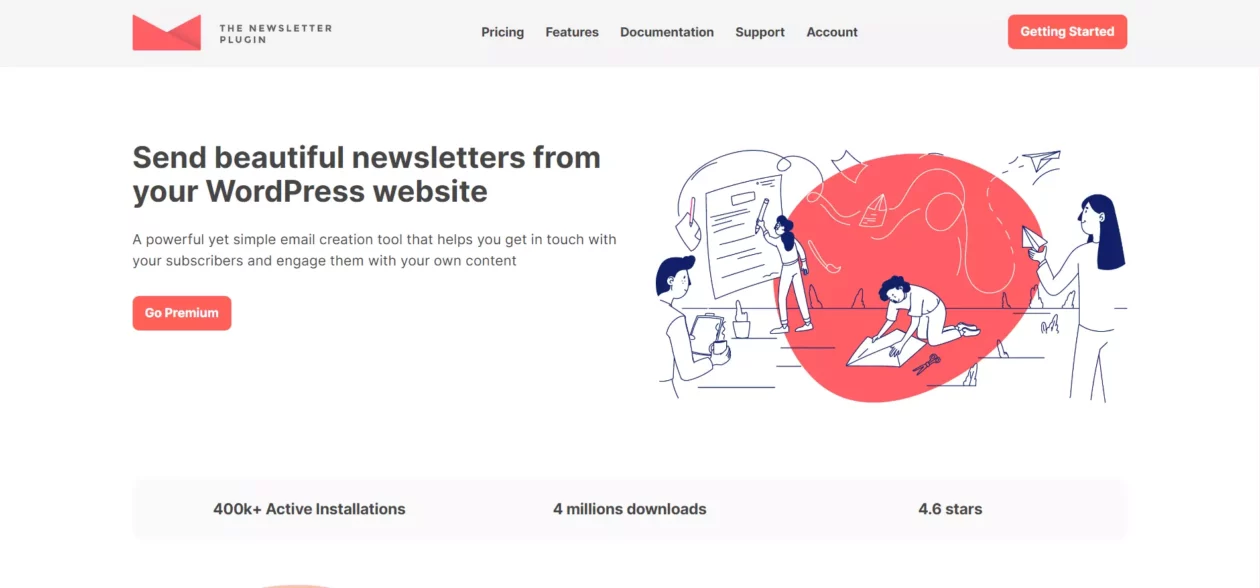
The plugin literally called Newsletter has been around long enough to be boring, in the good way. Version 9.3.5 shipped on 19 August 2026 to 200,000+ active installs. The free version is unusually complete: subscription forms, double opt-in, GDPR consent handling, basic reports and import and export, with no vendor-imposed subscriber cap, because the list lives in your own database.
Key features: a block-based email composer, post-notification and autoresponder addons, a subscriber importer, GDPR-friendly consent handling that plays nicely with your GDPR compliance plugin, and delivery addons for Amazon SES, Mailgun, SendGrid and Brevo.
Price: free core, with three licence tiers on the vendor’s premium page. Essential is $69 for one site, Professional $99 for three and Agency $299 for unlimited sites, each buying a year of updates and support. Renewal for Essential is listed at $69, so there is no loyalty penalty. Addons keep working after the year is up; what you lose is the compatibility guarantee against new WordPress releases. The page geo-switches currency and shows the identical numerals in euros to EU visitors.
Best for: a blog with a list of any size and no budget. It is the free option we would reach for first, once you have pointed it at a sending service.
Skip it if: you need multi-step automation with branching logic. Newsletter does sequences and post notifications well and stops there. It is a mailing tool, not a CRM.
Mailster
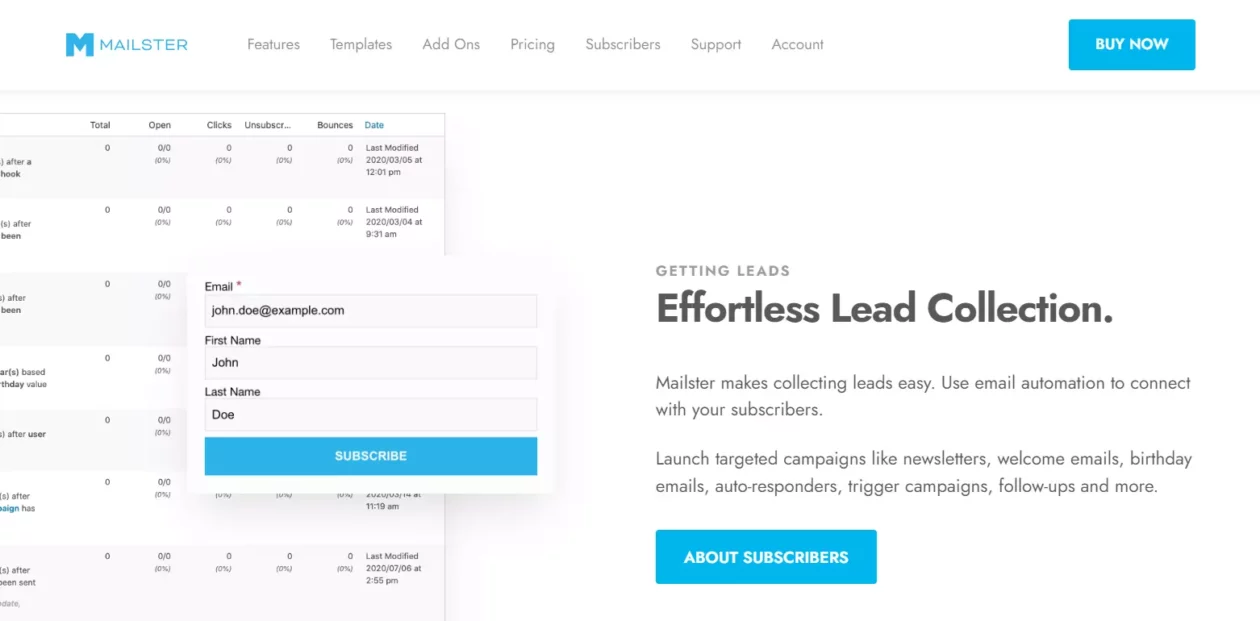
Mailster is the premium-only option, and it is unapologetic about being provider-agnostic: every plan says send with any email provider, and there is no in-house delivery service at any price. Everything stays in your database, which is the pitch.
Key features: 400 free and premium templates, campaign prechecks that score a draft for spam triggers before you send, timezone-based delivery, automation workflows, RSS campaigns, and unlimited subscribers, lists and forms on every tier including the cheapest.
Price: Starter $79/year, Professional $99/year, Agency $199/year, each for one site, on Mailster’s pricing page. A promotional price roughly half of each was showing at the check date, and the page states plainly that all renewals are at full price, so budget for the full figure. The licence keeps working after it lapses; updates and support stop. Tiers differ mainly by automation count and monthly prechecks, not by list size.
Best for: publishers who want a polished self-hosted sender with no free-tier compromises and no interest in a vendor’s delivery network.
Skip it if: you want to try before paying. Mailster is the only pick here with no maintained free tier. There is a Mailster listing on WordPress.org, but it has sat at version 2.0.2 since June 2024 and is tested only to WordPress 6.5; the current product ships from the vendor’s own site. A 14-day money-back guarantee is the real trial.
Icegram Express

Formerly Email Subscribers and Newsletters, Icegram Express is the quiet workhorse of the free tier: 50,000+ active installs, unlimited contacts and unlimited emails even on the free plan, and a feature list aimed squarely at bloggers who want new-post notifications sent reliably and nothing else.
Key features: post notifications, post digests, drip sequences, automatic batch sending with bounce handling, a managed spammer blacklist and junk-address removal on the free tier, and connectors for Amazon SES, Mailgun, SendGrid, SparkPost, Postmark, Mailjet and any plain SMTP server. Because everything lives in your database, your WordPress backup plugin is already backing up your list.
Price: Lite is $0 forever for one site; Max is $99/year for three sites, on Icegram’s pricing page. Contacts and emails are unlimited on both. Max adds detailed reporting, automation workflows, abandoned-cart sequences, WooCommerce coupons, engagement scoring and the drag-and-drop editor.
Best for: a blogger who wants free post notifications that reliably go out, with a paid path that does not scale by list size.
Skip it if: you want the polish. The free editor is basic and the interface shows its age. At 50,000+ installs it also has the smallest directory footprint here, leaving aside Mailster’s unmaintained listing.
Mailchimp for WordPress
MC4WP is the most-installed plugin on this page by a factor of two, at 1,000,000+ active installs, and it is worth being clear about what it is: a form and sync layer. It does not send anything. It puts signup forms on your site, pushes subscribers into Mailchimp, and gets out of the way. Everything after that happens in Mailchimp’s dashboard.
Key features: unlimited forms in Premium with a styling tool, checkbox integrations for comments, registration, WooCommerce checkout and most form plugins, e-commerce data sync so Mailchimp can segment on purchases, and tidy admin notifications. Well-placed signup forms are one of the cheaper levers you have to increase your conversion rate.
Price: free plugin. Premium is $59/year for one site, $99 for five and $249 for twenty-five, on the MC4WP pricing page, in US dollars excluding tax, renewing yearly at the same rate. Let it expire and premium features and updates stop. At $59 that is the cheapest paid licence among the six plugins here that sell one, with the obvious caveat attached: it buys form features, not sending, and Mailchimp bills you separately on top.
Best for: anyone already committed to Mailchimp who just wants proper WordPress forms.
Skip it if: you are choosing an email platform right now. Do not pick a bridge plugin first and let it decide your platform. Choose the platform, then pick the bridge.
Brevo
The Brevo plugin is the other bridge, and its appeal is a free tier that does not cap your list. Brevo’s pricing page allows 300 emails a day on the free plan with unlimited contacts, which is the exact inverse of how MailPoet meters its own free tier. If your list is 4,000 people you email twice a month, the daily cap is the constraint, not the list.
Key features: subscription forms and contact sync from WordPress, plus transactional email through Brevo’s SMTP relay, which means your WooCommerce receipts and password resets leave the same authenticated infrastructure as your campaigns. Segmentation, automation, SMS and chat all live in Brevo rather than in WordPress. For a blog with an income plan built on a list, the transactional side alone can justify it.
Price: the plugin is free. Paid Brevo plans start with Starter, which begins at 5,000 emails a month, and prices are set per region on the pricing page rather than as one global figure, so we are not quoting a dollar amount. Check the number your own connection is shown before committing.
Best for: a site that needs both marketing and transactional email handled by one authenticated sender, without running that infrastructure itself.
Skip it if: you want your list in your own database. Also worth knowing: the plugin’s WordPress.org listing shows 100,000+ installs but was last updated in June 2026 and is tested only to WordPress 6.9.7, a release behind.
What most newsletter roundups get wrong
They compare editors. Most plugins on this page have a drag-and-drop editor and 50-odd templates, and you will use three of them. The comparisons that decide the next two years are these:
- The pricing axis, not the price. A $129 site licence and a $108 subscriber plan look comparable at 500 subscribers. At 5,000 the licence is still $129 and MailPoet Business is $564. Ask what the number multiplies by before you ask what it is.
- WP-Cron is doing your sending. Self-hosted plugins send in batches on a schedule, and WordPress fires that schedule when someone visits your site. Low traffic means a stalled queue; large batches on shared hosting eat PHP workers and hurt server response time for everyone else. Disable WP-Cron, set a real server cron every five minutes, and keep batch sizes modest. This step is missing from most roundups entirely and it is the one that breaks sites.
- Deliverability is DNS, not a feature. No plugin can make an unauthenticated domain trustworthy. SPF, DKIM and a DMARC record on the sending domain do that. A hosted service handles the reputation half; you still publish the records.
- Free tiers are metered on different things. MailPoet caps subscribers, Brevo caps daily sends, Newsletter and Icegram Express cap neither and make you supply the sending. Three completely different constraints, all described as free.
- The list is the asset. If it lives in your database, it survives a plugin change, and it is covered by whatever backup routine you already run. If it lives at an ESP, migrating means rebuilding every automation by hand. Neither is wrong, but pick deliberately.
One last honest note on speed: any plugin that queues and sends mail from your server adds background work. If your site is already slow, fix that first. A newsletter plugin will not speed up a WordPress website, and a heavy send queue will make a slow one worse.
A short decision path
- Under 500 subscribers, want it working today: MailPoet Starter, free. No SMTP, no DNS, no decisions.
- Under 500 subscribers, no budget ever: Icegram Express Lite or the Newsletter plugin, plus Amazon SES. An hour of setup buys you a cost curve that stays flat.
- Running a WooCommerce store: MailPoet, on a paid plan, for the abandoned-cart and purchase-behaviour automation.
- List over 2,000 and growing: FluentCRM plus SES. The licence is fixed and the sending is pennies.
- Already living in Mailchimp or Brevo: MC4WP or the Brevo plugin. Do not migrate a working list to save $59.
- Just starting a blog: put a form up now on the free tier of anything above. The list you do not collect this year is the one you cannot email next year.
Frequently Asked Questions
Do I still need a separate SMTP plugin?
Usually yes, unless the plugin has its own delivery layer. FluentCRM, Newsletter, Mailster and Icegram Express all need sending credentials from you. Anything left on the WordPress default falls back to your host PHP mail, which is unsigned and leaves from a shared IP. That is the most common reason campaigns land in spam.
Which newsletter plugin works if my host limits outgoing email?
Any of them, as long as you route sending through an external service rather than the host mail function. FluentCRM, Newsletter, Mailster and Icegram Express all accept Amazon SES, Mailgun or SendGrid credentials. MailPoet and Brevo sidestep the problem entirely by sending on their own infrastructure.
Is a self-hosted list actually cheaper than a hosted service?
Below a few thousand subscribers, rarely. The free tiers win. The maths flips as the list grows: a fixed site licence plus Amazon SES at $0.10 per 1,000 emails pay-as-you-go stays flat while subscriber-priced plans keep climbing. New SES accounts start on a plan at $0.16 per 1,000 instead.
What happens if I let the licence lapse?
It varies, so check before you buy. Mailster and Newsletter keep working without updates or support. Mailchimp for WordPress Premium loses its premium features and updates. MailPoet and Brevo are subscriptions, so sending stops. FluentCRM sells one year of updates and priority support per licence term.
Do I need DMARC for a small newsletter?
Set it up regardless. Google treats anyone sending more than 5,000 messages a day to Gmail as a bulk sender and requires SPF, DKIM and DMARC plus a spam rate under 0.30 percent. Below that threshold the same records still decide whether you reach the inbox.
Can I move my list to another plugin later?
Yes, but the cost differs. Self-hosted plugins keep subscribers in your own database, so an export is one CSV away. Bridge plugins like Mailchimp for WordPress leave the list at the provider, so you export from there and rebuild every automation you built inside that platform.
Will sending newsletters slow my site down?
It can. Self-hosted plugins send in batches triggered by WP-Cron, which on a quiet site only fires when someone visits. Large queues on shared hosting consume PHP workers and drag response times. Disable WP-Cron, set a real server cron, and keep batch sizes conservative.
Which newsletter plugin is best for WooCommerce?
MailPoet. Abandoned-cart reminders, automated first-purchase emails, purchase-behaviour segmentation and customised WooCommerce transactional emails are all built in on paid plans. FluentCRM covers WooCommerce too and is stronger on automation logic, but you supply the sending service and configure the pipe yourself.
Our call
Pick FluentCRM and point it at Amazon SES. A single-site licence renews at $129 a year and does not care whether your list is 500 people or 50,000, the sending costs a couple of dollars a month at realistic volumes, and the subscribers stay in your own database where you can export them on a bad day.
Two exceptions, both real. If you run a WooCommerce store, MailPoet’s cart and purchase automation is worth the subscriber-priced bill. And if configuring DNS records is genuinely not happening, MailPoet Starter is free up to 500 subscribers and Brevo gives you 300 sends a day with no contact limit; both send the mail for you, and a newsletter that goes out beats a better one that does not.
What we would not do is pick on the strength of a template gallery. Decide who sends your mail first. Everything else on the comparison table follows from that.




[…] second a day or two after, then stop. Three is annoying and five gets you marked as spam. A decent newsletter plugin or your store’s own follow-up feature will handle the […]
[…] that turns a share click into a subscriber. If that last one interests you, pair it with proper newsletter plugins rather than relying on the sharing plugin to run your […]
[…] practical pieces: something to send with, and something to capture with. Our roundup of newsletter plugins for WordPress covers sending from your own site, and our list of popup plugins covers capture without wrecking […]
[…] email marketing integrations for Mailchimp, ActiveCampaign and the rest, from […]
[…] your reachable list is half what the dashboard implies. That is the moment to put the effort into a newsletter plugin […]
[…] Key features: large template library, drag-and-drop editing, custom SEO title and description, robots meta tag, analytics, opt-in forms that sync to the usual newsletter services. […]