

Live chat plugins are the fastest way to answer a pre-sale question before the visitor closes the tab. They are also the fastest way to put a stranger’s JavaScript on every page you own, and to start collecting personal data you now have to look after. This roundup covers six options WordPress owners actually install, with August 2026 prices, the page-speed cost, and the GDPR part most posts skip.
Quick verdict
- Best overall: Tidio. A free tier that works, a visual bot builder, and the highest wordpress.org rating of the five official plugins here (4.7). Starter is $29 a month billed monthly.
- Best free: tawk.to. The chat product costs nothing, with no advertised conversation cap. You pay $29 a month only if you want the vendor branding gone.
- Best flat rate for a small team: Crisp. Mini is $45 a month per workspace with four seats included, which is $11.25 per seat if you fill them.
- Skip it if: nobody is going to answer within a few minutes during business hours. An ignored chat bubble is a promise you are not keeping, and it still costs you the JavaScript.
- Our call: start on Tidio’s free plan, load the widget only on the pages where chat is answered, and re-measure your Core Web Vitals a week later before you pay anyone.
Best WordPress live chat plugins in 2026, compared
Read the renewal column, not the headline price. Three of these six change the unit they bill you in as you grow: Tidio counts conversations, Crisp counts workspaces, and LiveChat and Zendesk count agents. That difference matters more than the sticker.
| Plugin | Free plan | Entry paid plan | What it renews at | Best for |
|---|---|---|---|---|
| Tidio | Yes – 50 billable conversations/mo, up to 10 seats | Starter $29/mo billed monthly, or $290.04/yr | $290.04/yr ($24.17/mo) on annual billing | Small stores wanting chat plus a bot |
| tawk.to | Yes – full live chat, branded widget | $29/mo to remove branding | $29/mo, ongoing | Zero-budget sites |
| LiveChat | No – 14-day trial | Starter $19/mo per person paid yearly ($25 month-to-month) | $19/mo per person; Team $49, Business $79 | A staffed support rota |
| Crisp | Yes – 2 seats, one workspace | Mini $45/mo per workspace, 4 seats included | $45/mo per workspace, +$10/mo per extra seat | Small teams wanting one flat invoice |
| HubSpot | Yes – live chat for up to 2 users, HubSpot branding | Service Hub Starter $20/mo per seat billed monthly | $20/mo per seat; Professional $100/mo per seat plus $1,500 one-time onboarding | Sites already on HubSpot CRM |
| Zendesk | No | Suite Team US$55 per agent/mo paid yearly | US$55 per agent/mo; Copilot AI adds US$50 | Companies already running Zendesk |
Tidio – best overall for most WordPress sites
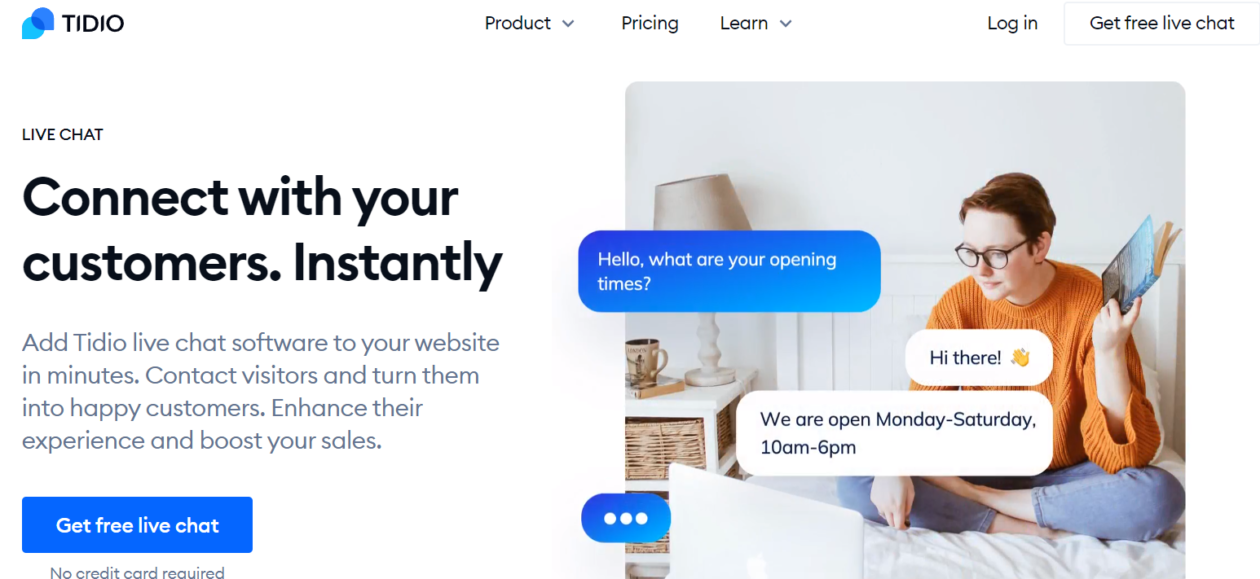
Tidio is what we reach for when a client wants chat plus a bot and does not have a support department. The plugin sits at 70,000+ active installs with a 4.7 rating from 396 reviews on its wordpress.org listing – the highest rating of the five official plugins in this roundup. Install, paste your account key, done. There is nothing running on your server to babysit.
The thing to understand before you commit is the billing unit. Tidio charges by billable conversation – any chat, ticket, email or social message a human agent replies to – not by seat. The free plan gives you 50 a month, which is under two a day. Starter gives you 100. Seats are generous by comparison: free, Starter and Growth all include up to 10.
Key features
- Live chat, email and social messages in one shared inbox
- Flows: a drag-and-drop bot builder that needs no code
- Lyro AI, which answers from your own help content, metered separately
- Live visitor list and typing preview
- Canned responses, operating hours and offline capture
Price: free plan with 50 billable conversations a month. Starter is $29 a month billed monthly, or $290.04 a year on annual billing, which is $24.17 a month. Growth starts at $49.17 a month on annual billing and lifts you to 250 conversations. Lyro AI conversations and Flows visitors are metered on top of all of it. Checked August 2026 on Tidio’s pricing page.
Best for: one-person businesses and small stores that want a bot catching after-hours questions and a human taking the rest. If you sell through WooCommerce, chat is one of a short list of additions worth the weight – our roundup of WooCommerce plugins that improve a store covers the others.
Skip it if: your chat volume is genuinely high. Conversation-metered pricing punishes success. A store handling 40 chats a day is doing roughly 1,200 a month, which is nowhere near a $29 plan and not on Growth’s 250 either.
tawk.to – the best free live chat plugin
tawk.to is free, and not freemium-with-a-wall free. The chat product itself costs nothing and the company says so in plain words on its own site: “100% Free… Forever free.” Its WordPress plugin carries 100,000+ active installs and a 4.6 rating, more installs than any other dedicated chat plugin in this list.
The trade is branding and polish. Every visitor sees “Powered by tawk.to” under the widget unless you pay, the agent dashboard looks its age, and the plugin was last updated eight months ago against WordPress 6.9.7. Free also means your transcripts live on their servers under their terms, so the data processing agreement is worth reading before you switch it on.
Key features
- Live chat with visitor monitoring, at no cost
- Knowledge base, ticketing and a basic CRM in the same account
- Chat Pages for teams without a website of their own
- Hired agents at $1 an hour if you do not want to staff it
- Android and iOS apps so chats reach a phone
Price: the live chat product is free. Removing the branding is $29 a month, AI Assist starts at $29 a month, hired chat agents are $1 an hour and virtual assistants start at $7 an hour. Checked August 2026 on tawk.to’s pricing page.
Best for: sites with no software budget, side projects, charities, and anyone testing whether their visitors will use chat at all before paying for it.
Skip it if: the branding has to go. At $29 a month, removing it costs more than Tidio’s entire Starter plan on annual billing ($24.17 a month), and Tidio’s dashboard is the nicer place to spend your day.
LiveChat – for a team that lives in the inbox
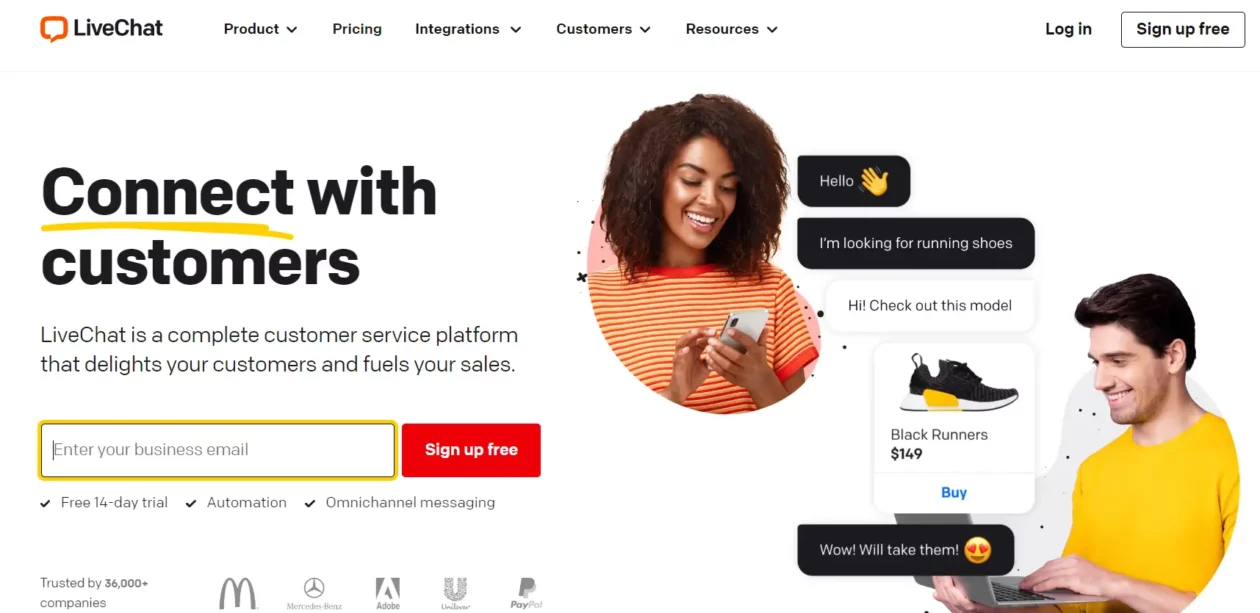
LiveChat is the grown-up option here: a proper agent console with chat transfer, tagging, canned responses and reporting that a support manager will actually use. It connects to email, Messenger, WhatsApp and SMS, so one queue covers several channels. The official plugin has 10,000+ active installs and a 4.6 rating from 98 reviews.
There is no free plan, only a 14-day trial, and pricing is strictly per person. That is fine for two agents and expensive for six: three agents on Team paid yearly is $49 x 3 x 12, or $1,764 a year, before anything else.
Key features
- Agent console with chat transfer and internal notes
- Ticketing for messages that arrive while you are offline
- Chat routing, tags and canned responses
- Widget customisation that can be made to match a theme
- A public API and a large integration directory
Price: Starter is $19 a month per person paid annually, $25 month-to-month. Team is $49 annually and $59 month-to-month. Business is $79 annually and $89 month-to-month. Enterprise is quoted by sales. Every plan comes with a 14-day trial. Checked August 2026 on LiveChat’s pricing page.
Best for: a business with two to five people who genuinely sit in a support queue during opening hours, where faster answers turn into orders. If that is the goal, pair it with the rest of our notes on how to increase conversion rate rather than treating chat as the whole plan.
Skip it if: you are one person, or your team is growing. Per-seat pricing compounds quietly, and there is no free tier to fall back to when budgets tighten.
Crisp – flat pricing per workspace
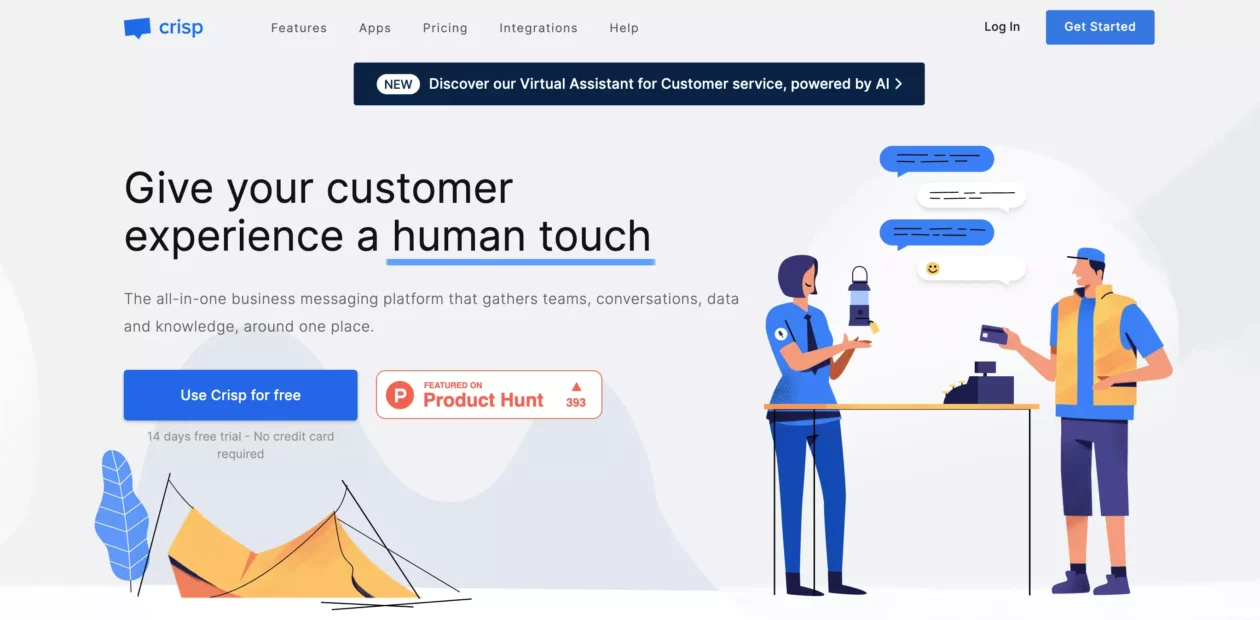
Crisp is the one that does not bill you per conversation or per agent by default. You buy a workspace and seats come with it. Mini is $45 a month and includes four seats, which works out at $11.25 per seat per month if you actually fill them. Extra agents beyond a plan’s allowance are $10 a month each.
One honest caveat: the wordpress.org plugin was last updated about a year ago and is tested only to WordPress 6.8.8, on 20,000+ active installs and a 4.6 rating. The plugin is thin – it injects the widget snippet, and the product itself lives on Crisp’s servers – so the risk is smaller than it looks. It is still worth knowing before you install it on a client site.
Key features
- Shared inbox pulling in chat, email, Messenger, WhatsApp and Telegram
- Built-in CRM and contact timeline
- Knowledge base and help centre
- Chatbots and campaign messages on paid plans
- Co-browsing so an agent can walk someone through a page
Price: free forever for 2 seats on one workspace. Mini is $45 a month per workspace with 4 seats, Essentials is $95 a month with 10 seats, and Plus is $295 a month for 20 or more. Additional agents are $10 a month. There is a 14-day trial on the paid tiers. Checked August 2026 on Crisp’s pricing page.
Best for: a three-to-five person team that wants one predictable invoice and no anxiety about a busy month costing more than a quiet one.
Skip it if: you are solo. The free plan’s two seats are generous, but the step up to $45 a month is steep next to Tidio’s $29 when you are the only person answering.
HubSpot – free chat if you are already in HubSpot
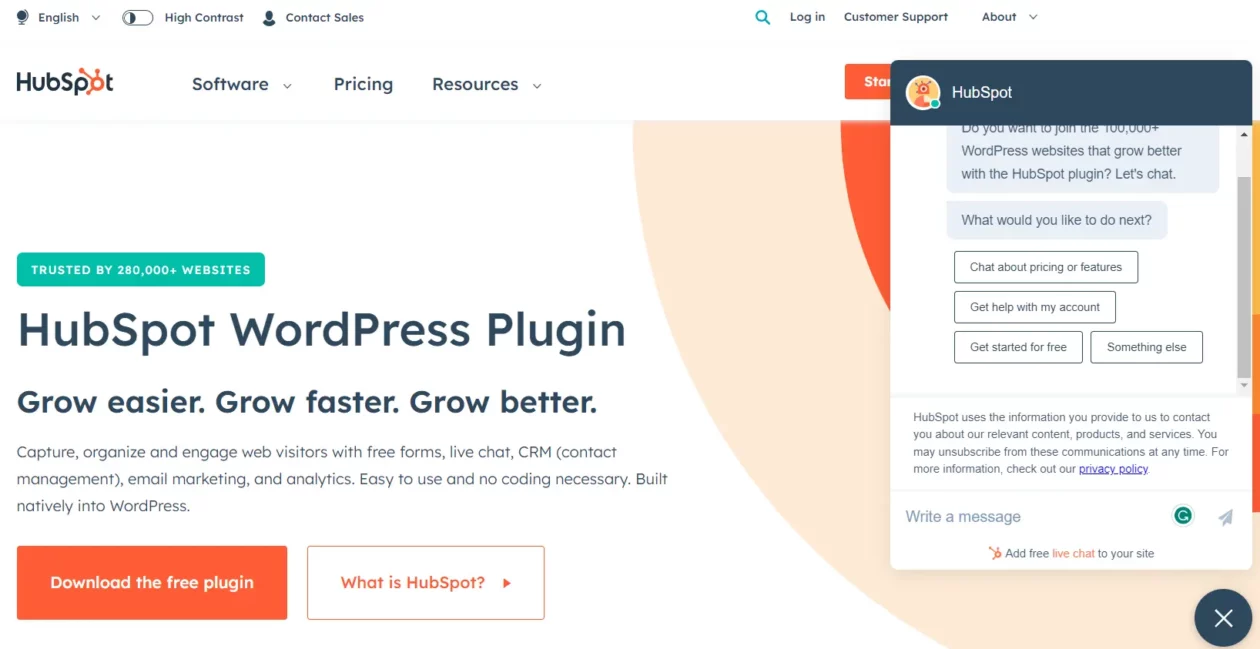
HubSpot’s WordPress plugin is the most installed thing in this roundup and the lowest rated: 200,000+ active installs and 4.3 stars from 207 reviews on its wordpress.org listing. That gap is the story. It is a whole marketing suite – forms, popups, email, CRM, analytics – and live chat is one module inside it, so people install it for chat and find themselves in a CRM onboarding flow.
Where it earns its place: if your leads already sit in HubSpot, chat transcripts land on the contact record automatically and you have not added a second vendor, a second cookie or a second script. That is a real reason to choose it over a better standalone chat tool.
Key features
- Live chat and chatbots wired into the HubSpot CRM
- Forms and popups from the same plugin
- Shared team inbox and help desk workspace
- Contact timeline showing chat alongside email and page views
- WooCommerce and Gravity Forms integrations
Price: free for up to 2 users, with HubSpot branding on the widget. Service Hub Starter is $20 a month per seat on monthly billing; an annual commitment is discounted. Professional is $100 a month per seat on monthly billing and carries a one-time $1,500 onboarding fee that is not optional. Checked August 2026 on HubSpot’s Service Hub pricing page.
Best for: sites already running HubSpot, or teams that want forms, popups and chat from one vendor instead of three separate scripts.
Skip it if: you only want chat. The free tier is genuine, but it exists to sell you seats, and that $1,500 onboarding fee at Professional is the sort of number that ends a project. If popups are the actual need, our WordPress popup plugins comparison is a lighter answer.
Zendesk – only if you already run Zendesk
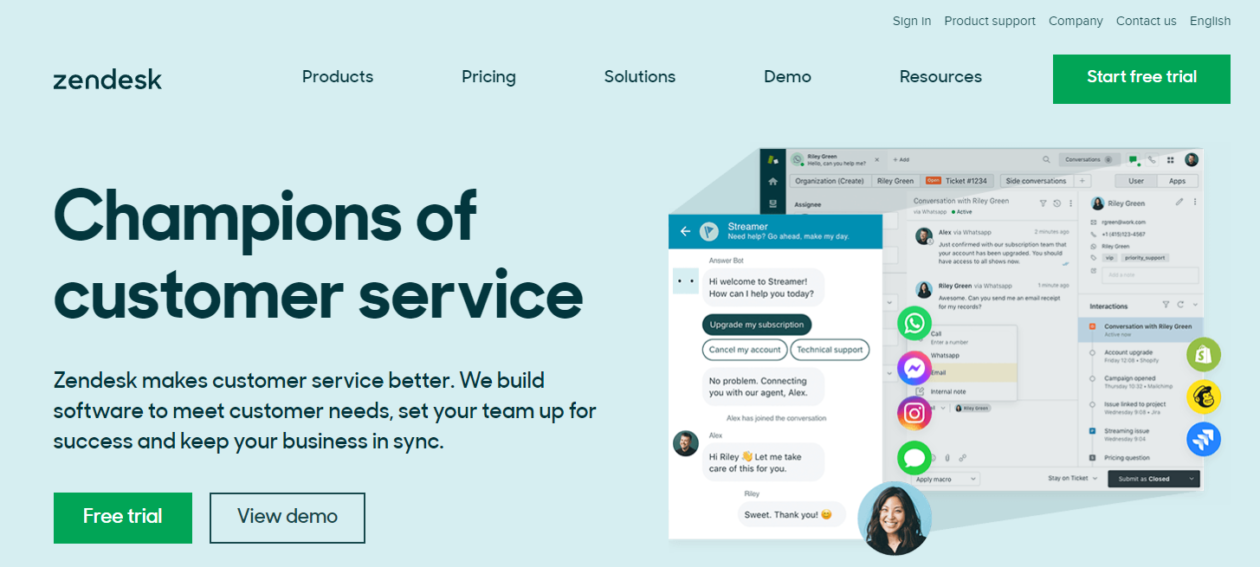
Two things about Zendesk that roundups keep getting wrong, including the earlier version of this one. First, there is no official Zendesk plugin in the WordPress directory. Search it and you get third-party form connectors with a few hundred installs. You add Zendesk by pasting the Web Widget snippet into your theme or tag manager.
Second, the $19 figure that follows Zendesk around is the Support Team plan, and Support Team is email and ticketing. Messaging and live chat begin at Suite Team. There is no standalone “Zendesk Chat” tier to buy any more.
Key features
- Messaging and live chat across web, mobile and social, in the Suite plans
- Full ticketing with routing, SLAs and automations
- Help centre and self-service knowledge base
- Reporting that a support lead can defend in a meeting
- Copilot AI as a paid add-on
Price: Suite Team is US$55 per agent per month paid yearly and Suite Professional is US$115. Support Team is US$19 per agent per month paid yearly but has no live chat. Copilot adds US$50 per agent per month. Checked August 2026 on Zendesk’s pricing page. That US$55 entry is the highest starting price in the comparison table above: US$660 a year for one agent, before add-ons.
Best for: companies already paying for Zendesk tickets, where turning messaging on is a settings change rather than a new contract.
Skip it if: WordPress is your only property and you have fewer than five agents. You would be buying a support platform to get a chat bubble.
What most roundups get wrong: the widget is a performance bill
Underneath, all six of these work the same way. The plugin drops a small script tag on your pages. That script pulls a bundle from the vendor’s CDN, opens a persistent connection, and paints a fixed-position launcher in a corner. Your hosting has almost nothing to do with how fast that happens, and your cache plugin cannot cache it, because it is not served from your domain.
Three specific things go wrong, and they are worth knowing before you blame your host.
- Main-thread contention. Interaction to Next Paint scores “good” at 200 milliseconds or less at the 75th percentile, per Google’s Core Web Vitals thresholds. A chat bundle parsing and executing while somebody taps your menu is exactly the kind of work that pushes past that number on a mid-range phone.
- Layout shift from the launcher. If the bubble arrives late and pushes a sticky bar, a cookie notice or a mobile call-to-action, you pay in Cumulative Layout Shift, which scores “good” at 0.1 or less. Pin the widget so it overlays rather than displaces; our guide to avoiding layout shift in WordPress goes through the CSS.
- Corner wars. The chat launcher, the cookie banner, an exit-intent popup and a sticky WhatsApp button all want the bottom-right of a 390px screen. Pick one. On mobile, two of them stacked usually means neither gets tapped.
What to do about it
- Load it only where chat is answered. A script manager such as Perfmatters can switch the widget off on blog posts and archives and keep it on pricing, product and checkout pages, which is where anyone was going to ask a question anyway.
- Delay execution until first interaction. WP Rocket and most competent caching plugins can hold third-party JavaScript back until a scroll or a tap. The launcher appears a beat later; almost nobody notices, and the initial load stops competing with your content.
- Measure the same URL before and after. Run PageSpeed Insights on a page with the widget and the same page without it, and read the field data rather than only the lab score. The rest of the checklist is in our WordPress speed optimisation guide.
To be straight about it: we have not benchmarked these six widgets against each other, and any post that hands you a tidy kilobyte ranking without showing its method is guessing. Test it on your own site. The result depends on your theme, your other third-party scripts and the phones your visitors actually hold.
GDPR: a chat transcript is personal data
The moment a visitor types a name, an order number or an email into your chat box, you are processing personal data. So is the IP address the widget collects before anyone types anything. Under the General Data Protection Regulation, that brings a short list of obligations that no plugin settings screen will handle for you.
- A lawful basis. For a conversation the visitor started, legitimate interest or contract usually covers it. Reusing those transcripts for marketing is a different purpose and generally needs consent.
- A processor agreement with the vendor. Every serious chat company publishes a data processing agreement. Find it, accept it, and check which country the transcripts are stored in before you promise anything in your privacy policy.
- A privacy policy that names chat. What is collected, why, how long transcripts are kept, and who inside your business can read them. “We use cookies” does not cover a chat log.
- A retention window. The usual failure is transcripts sitting in a vendor inbox forever because nobody chose a number. Choose one, set it in the vendor’s settings, and write it down.
- Consent before loading, where the widget sets non-essential cookies. Several of these drop an identifier the second the script runs. That is why plenty of EU sites load the launcher only after the consent banner has been answered – which, conveniently, is also the faster setup.
- A way to honour deletion requests. If a customer asks to be forgotten, the chat transcript is in scope, and it is not in your database.
If chat is the first system on your site holding customer conversations, our comparison of GDPR compliance plugins handles the consent banner and policy side. The vendor paperwork is on you, and it takes about an hour once.
A short decision path
- No budget, no team: tawk.to. Free, branded, and it works.
- One or two people, want a bot covering nights: Tidio. Watch the conversation counter, not the seat count.
- Three or four people, want one predictable invoice: Crisp Mini at $45 a month.
- A staffed support rota that sits in a console all day: LiveChat.
- Already paying for HubSpot or Zendesk: use theirs. A second chat vendor means a second script, a second cookie and a second inbox nobody checks.
- Nobody will answer it: install none of them. Put a good form on the page instead – our WordPress form plugins comparison has lighter options – and state your reply time honestly.
Frequently Asked Questions
Do live chat plugins slow down a WordPress site?
Yes, a little, and it is not your host’s fault. The widget is third-party JavaScript pulled from the vendor’s CDN, so a cache plugin cannot help. Load it only on pages where chat is answered, delay it until first interaction, then re-measure INP and LCP on the same URL.
What is the best free live chat plugin for WordPress?
tawk.to. Its live chat product is free with no conversation cap advertised, and its WordPress plugin has 100,000+ active installs at a 4.6 rating. You pay only for extras: $29 a month removes the branding. Tidio and Crisp have free tiers too, but both cap usage.
Is a chat transcript personal data under the GDPR?
Yes. Names, order numbers, email addresses and the visitor’s IP all qualify. You need a lawful basis, a data processing agreement with the chat vendor, a privacy policy that names chat specifically, a retention window for transcripts, and a way to delete them on request.
Does a live chat widget need a cookie banner?
It depends what the widget sets. If the script drops non-essential cookies or a tracking identifier the moment it loads, that needs consent first. The safest setup loads the chat launcher only after the visitor has answered your consent banner, which also speeds up the initial page load.
How much does live chat cost per agent per year?
Using the plans in the table above: LiveChat Starter is $228 a year per person paid annually, Zendesk Suite Team is US$660 a year per agent paid yearly, and Crisp Mini is $540 a year for a workspace with four seats included. Prices checked August 2026.
Can I use these plugins on a site that is not WordPress?
Yes. Every tool here is a hosted service with a JavaScript snippet, and the WordPress plugin only pastes that snippet for you. It also means deleting the plugin does not close your account or erase transcripts, so cancel with the vendor separately when you switch.
Do I need a chatbot, or is live chat enough?
If you cannot reply within a few minutes during business hours, a bot that collects an email and sets expectations beats a bubble nobody watches. Tidio’s Flows and Crisp’s chatbots both cover this. Tidio’s Lyro AI conversations are metered on top of the plan, so budget for them.
Will a live chat widget cause layout shift?
It can. A launcher that appears late and pushes a sticky bar or cookie notice adds to Cumulative Layout Shift, where a good score is 0.1 or less at the 75th percentile. Pin the widget so it overlays content instead of displacing it, and reserve its space in your own CSS.
What happens if I install two chat widgets?
Two scripts, two corners, two sets of cookies, and usually one broken layout on mobile. Pick a single vendor. If you are switching, remove the old plugin and any leftover snippet from your theme or tag manager before the replacement goes live.
Our call
Start with Tidio. The free plan is enough to find out whether your visitors chat at all, the bot builder is the friendliest here, and $29 a month is a reasonable place to land if they do. If that $29 is not available, use tawk.to and accept the branding – a branded widget that gets answered beats a polished one you cancelled.
Pick Crisp instead when three or four people share the queue and a flat $45 invoice is easier to defend than a per-seat one. Pick LiveChat when support is somebody’s actual job. Only pick HubSpot or Zendesk if you are already inside them; buying either for the chat bubble alone is an expensive way to get a chat bubble.
Whichever you choose, do the two boring things on install day: restrict the widget to the pages where chat is answered, and write down how long you keep transcripts. Those two decisions cost nothing and save you the two arguments – the slow-site one and the data one – that live chat usually starts six months later.