
Most dark mode plugins for WordPress repaint your site at runtime with JavaScript. That works until it meets a logo on a transparent background, a product screenshot, or a brand colour you paid a designer to pick. Then it looks broken. Five of the ten plugins this guide used to recommend have since been pulled from the directories that listed them, two of them over security issues. Here is what still works, and when to skip the plugin.
Quick verdict
- Best overall: Darkify. It builds a dark palette instead of inverting one, lets you exclude specific images and elements, and is tested against WordPress 7.1. Free tier is genuinely usable; Pro starts at $39/year list for one site.
- Best free: Darkify’s free tier for the front end. If you only want a dark admin, Dark Mode for WP Dashboard is free with no paid tier at all.
- Cheapest paid upgrade: Dark Mode Toggle Pro at $29 one-time for one site — the lowest list price in the table below, and it does not renew.
- Skip it if: your site leans on photography, screenshots or exact brand colours, or you control the theme’s CSS. In both cases a plugin costs you more than it gives you.
- Our call: if you own the theme, write the CSS yourself and install nothing. If you inherited a theme you cannot touch, use Darkify.
The best dark mode plugins for WordPress in 2026
| Plugin | Active installs | Tested up to | Rating | Paid entry (list, USD) | Verdict |
|---|---|---|---|---|---|
| Darkify | 700+ | 7.1 | 4.8 (22) | $39/yr, 1 site · $119 lifetime | Best overall |
| Dark Mode Toggle | 2,000+ | 7.1 | 4.6 (19) | $29 one-time, 1 site | Cheapest upgrade |
| Darklup | 1,000+ | 7.0.4 | 4.5 (44) | $49/yr, 1 site · $179 lifetime, 3 sites | Most switch styles |
| Dark Mode for WP Dashboard | 3,000+ | 7.1 | 4.8 (30) | No paid tier | Admin only |
| DarkMySite | 1,000+ | 6.8.8 | 4.7 (14) | Pro exists, price not listed publicly | Falling behind |
| WP Dark Mode | Listing closed | 7.0.4 | Not shown while closed | $109/yr, 5 sites · $267 lifetime, 1 site | Wait it out |
| Night Eye | 60+ | 5.9.16 | 5.0 (8) | Extension plans only | Abandoned |
How these plugins work, and what they break
There are two techniques, and the difference decides whether your site looks designed or looks like a photo negative.
Filter inversion. The plugin drops a CSS filter over the page and flips every colour to its opposite. It is one line of CSS and it covers everything instantly, which is why cheap plugins love it. It also turns your navy logo orange, your photographs into negatives, and your carefully chosen accent colour into whatever sits opposite it on the wheel. Chrome’s own dark mode guidance notes that people dislike inverted photographs and suggests a light grayscale filter for images instead of flipping them, which tells you how well full-page inversion goes.
Palette mapping. The plugin reads the computed colours on your page and substitutes a dark equivalent per element, keeping hue relationships roughly intact. It is slower to run and needs more configuration, but logos survive and brand colours stay recognisable. Darkify and Darklup both work this way. Dark Mode Toggle uses inversion.
Whichever technique you pick, three things reliably break on first install: logos with transparent backgrounds (they invert into a colour that fights the new background), embedded screenshots and charts (their white backgrounds become black rectangles), and any colour you set inline through a page builder rather than through the theme. Budget an hour for exclusion rules. Anyone who tells you it is a one-click job has not shipped one on a real site.
The route with no plugin at all
If you can edit your theme’s CSS, you do not need any of these. Browsers already tell you what the visitor wants through the prefers-color-scheme media feature, which MDN lists as Baseline widely available and supported across browsers since January 2020. That is a six-year-old capability, not an experiment.
The pattern is short. Define your colours as custom properties on :root, redefine them inside a @media (prefers-color-scheme: dark) block, and add color-scheme: light dark so the browser also darkens form fields, scrollbars and text selection for you. On a block theme you can do most of this through theme.json rather than raw CSS — worth knowing if you are already on one of the full site editing block themes.
Three advantages matter. It ships zero JavaScript, so it adds nothing to your render path. It cannot get the colours wrong, because you chose them. And it cannot be closed on WordPress.org next August. If you would rather not edit theme files directly, drop it in through one of the code snippet plugins so a theme update does not wipe it.
The catch is real, though: this only covers colours you control. Content pasted in over five years, inline styles baked in by a page builder, and third-party embeds will keep their light backgrounds. On a site with a long archive, a plugin’s blunt coverage genuinely beats a tidy stylesheet that only styles half the page.
Darkify
The current pick. Darkify’s WordPress.org listing shows version 2.1.1, last updated 26 August 2026, tested against WordPress 7.1, on 700+ active installs with a 4.8 rating from 22 reviews. It is one of the smallest install bases in this table and the most current codebase, which is an honest trade rather than a flaw.
Key features: configurable colour presets rather than filter inversion; brightness, contrast and grayscale controls for images with per-image exclusions; include or exclude any HTML element, class or ID; front-end and admin dark mode in the same plugin. Pro adds swapping a specific image for a dark-optimised version, which is how you handle a logo properly.
Price: free on WordPress.org. Per Darkify’s pricing page, Pro lists at $39/year for one site, $79/year for five, $139/year unlimited; lifetime lists at $119, $199 and $399 for the same tiers. Promotional discounts were running at the check date. The vendor states that when a yearly licence expires the plugin keeps working, but updates and support stop. Note the arithmetic on the unlimited tier: three years of the $139 yearly plan comes to $417, more than the $399 lifetime licence.
Best for: sites with a real brand palette and images you cannot afford to have inverted, especially if you also want the admin dark without a second plugin.
Skip it if: 700+ installs is below your comfort threshold for a plugin that touches every page. That is a fair objection and the reason Darklup is next.
Darklup
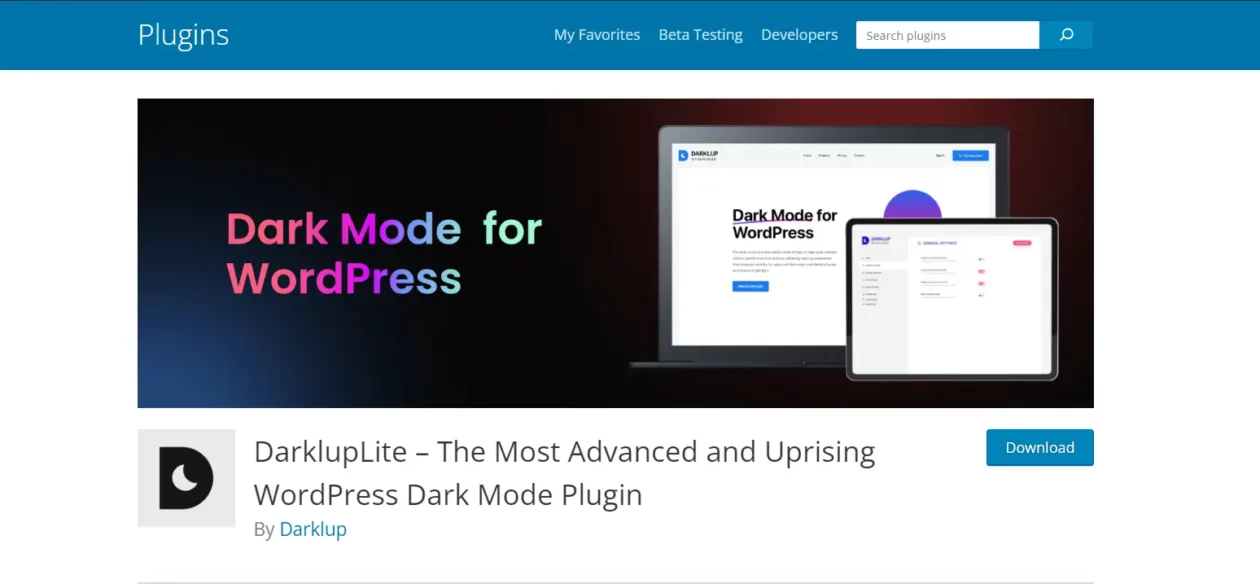
The listing still carries the old DarklupLite name in places, but the WordPress.org page now shows version 4.0.1, updated within the last month, 1,000+ active installs, 4.5 stars from 44 ratings, tested to WordPress 7.0.4 and requiring PHP 7.4. It also has the most divided reviews here: 35 five-star against 4 one-star.
Key features: a luminance-based engine that assigns a dark colour per element rather than inverting the page, 15+ toggle switch styles, time-based activation, admin dark mode, and an accessibility panel (contrast, larger text, readable font, stop animations). Pro adds a separate dark-mode logo upload, WooCommerce compatibility, element exclusion, scheduling and custom CSS.
Price: free core plugin. Darklup’s pricing page lists Starter at $49/year for one site, Business at $119/year for ten, Ultimate at $499/year; lifetime lists at $179 for three sites, $349 for a hundred and $999 for a thousand. Discounts were live at the check date, and renewal terms are not spelled out on the page — confirm at checkout. The $179 lifetime Starter pays for itself against the $49/year plan during the fourth year, and covers three sites instead of one.
Best for: agencies handing a client a toggle they will actually notice, and anyone who wants the accessibility controls bundled in rather than bolted on.
Skip it if: you want the dark logo swap, which sits behind the paid tier here while Darkify’s exclusion rules get you most of the way for free.
Dark Mode Toggle
The pragmatist’s option, and the most installed front-end plugin in this table. The listing shows version 1.7.5, updated about a month ago, 2,000+ active installs, 4.6 stars from 19 ratings, tested to WordPress 7.1 and needing only PHP 7.0.
Be clear about the trade: this one inverts. It applies CSS classes to control which block elements get flipped back, so you can rescue individual sections, but you are working against inversion rather than with a palette. On a text-heavy blog that is fine and fast. On a portfolio full of photographs it is not.
Key features: a toggle button you can position and restyle, per-element inversion overrides, and a shortcode for placing the switch. Pro adds admin and post-editor dark mode, custom button images and emoji labels, dark mode on by default, and auto-matching the OS theme on first load.
Price: free, with Pro sold as a one-time payment — $29 for one site, $49 for five, $79 for unlimited. No renewal is listed, which makes it the cheapest paid entry here at list price by a clear margin.
Best for: blogs, documentation and text-first sites where inversion is harmless and you would rather pay once than subscribe.
Skip it if: images are your product. Also note that auto-matching the visitor’s OS preference on first load is a Pro feature, which is the one thing the free CSS route gives you for nothing.
Dark Mode for WP Dashboard
This one only darkens wp-admin. No front-end anything. Its listing shows version 1.3.7, updated within the last week, 3,000+ active installs and 4.8 stars from 30 ratings, tested to WordPress 7.1 — the most installed plugin still listed in this guide, and among the highest-rated here.
Key features: an admin bar toggle that switches without a page reload, and a per-user preference of Dark, Light or Auto that follows the system setting. Because it is per-user, your client can keep the bright admin while you do not.
Price: free, with no paid tier.
Best for: people who edit at night and do not care what visitors see.
Skip it if: a mildly darker admin is enough, because WordPress already ships that. Users → Profile → Admin Color Scheme has offered Midnight, Ectoplasm, Coffee and Ocean for years; that setting is documented on the profile screen and costs you no plugin. Reviewers also flag that the block editor canvas stays white, which is where most of us actually spend the evening.
DarkMySite
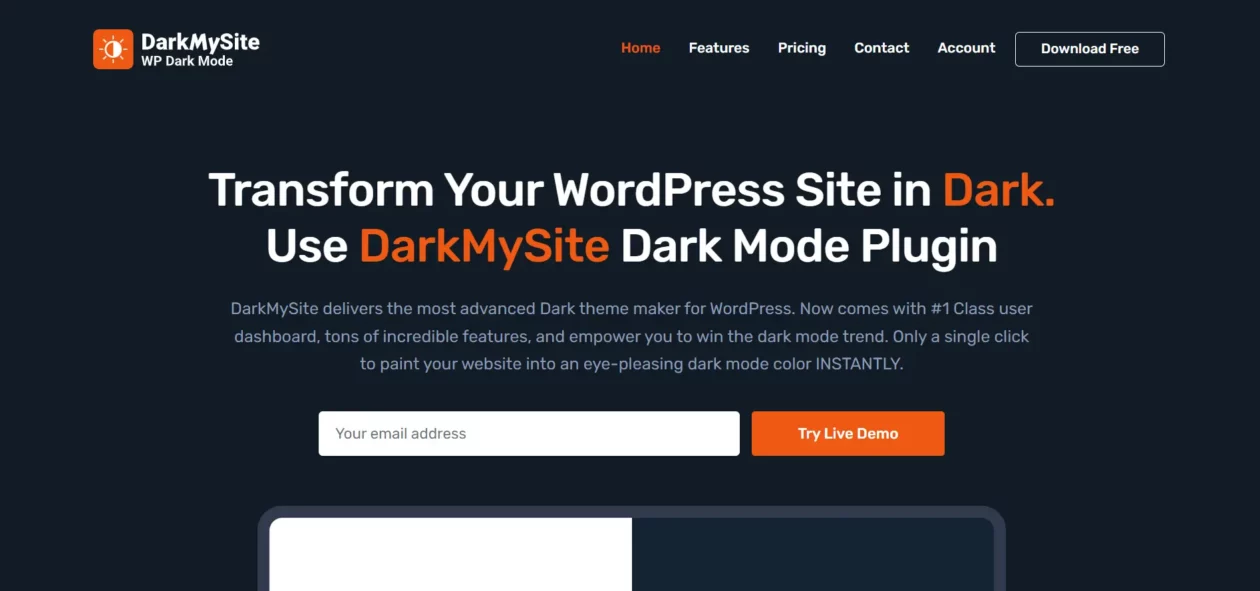
Still available, but drifting. The listing shows version 1.2.9 last updated eleven months ago and tested only to WordPress 6.8.8, which triggers the directory’s own warning: “This plugin hasn’t been tested with the latest 3 major releases of WordPress.” Ratings are good — 4.7 from 14 — but 14 ratings and a year of silence is a thin basis for putting code on every page load.
Key features: one-click activation, automatic switching based on the visitor’s device preference, and a colour customiser.
Price: free version on WordPress.org. A Pro tier is advertised; no current price is quoted here because we could not confirm one against the vendor’s own pricing page at the check date.
Best for: nobody starting fresh today.
Skip it if: you are on WordPress 7.x, which is everyone reading this on a maintained site. Existing users should not panic, but should plan a move.
WP Dark Mode: currently unavailable
For years this was the default recommendation in every roundup, this one included. It is not available right now. The WordPress.org listing carries this notice: “This plugin has been closed as of August 5, 2026 and is not available for download. This closure is temporary, pending a full review.” No reason is published.
Worth being precise about what that does and does not mean. A temporary closure pending review is not proof of a vulnerability; the directory closes plugins over guideline disputes, trademark complaints and licensing questions too. But while a listing is closed, nobody can install it and existing installs get no updates through the normal channel. That is not a state to start a new project in.
Price, for reference: WPPOOL lists Pro at $109/year for five sites and $267 lifetime for one, with promotional prices below both at the check date and renewal terms not stated on the page. That yearly figure is the most expensive entry point in this guide, for a plugin whose free tier you cannot currently download.
What to do: if it is already running and working, leave it and watch the listing. If you are choosing today, choose something else and check back in a few months. If you run several client sites, this is a decent reminder to keep a current backup plugin in place before any plugin decision gets made for you.
Night Eye
Included here to correct the record. Night Eye is a well-regarded browser extension, and the earlier version of this guide quoted its $40 one-time price as if that bought a WordPress plugin. It does not.
The Night Eye WordPress plugin listing sits at version 1.0.2, last updated four years ago, tested to WordPress 5.9.16, with 60+ active installs and the same untested-with-recent-releases warning. The $9/year, $14/year and $40 one-time tiers on Night Eye’s pricing page buy browser slots for the extension, not a site licence.
Best for: reading other people’s badly lit sites, on your own machine. Not for shipping to visitors.
What we removed, and why
This guide previously recommended five plugins that we can no longer stand behind. Leaving them up would be the easy option, so here is the accounting instead.
- Droit Dark Mode — closed on WordPress.org as of 7 March 2024. The stated reason is “Security Issue”. Last version was 1.1.2, tested to 6.2.11. If this is on a site you manage, remove it today.
- QS Dark Mode — closed as of 16 April 2025, also for “Security Issue”. Last version 3.0, tested to 6.6.7. Same advice: remove it.
- Go Night Pro — the CodeCanyon listing now returns “410 Gone”, the status a marketplace serves for an item that has been permanently withdrawn. There is no supported way to buy or update it.
- Night Mode for WordPress and Blackout: Dark Mode Widget — neither appears in the plugin directory under those names any more. An unrelated plugin simply called Night Mode exists on 30+ installs; it is not the same one.
Two closures for security issues out of ten recommendations is a rate worth sitting with. Dark mode plugins run on every page, touch the DOM broadly, and are often maintained by very small teams. Treat them as a real part of your attack surface and keep a proper security plugin watching, because you will not read every changelog.
What most roundups get wrong: the performance bill
Almost nobody mentions the cost, so here it is. A dark mode plugin adds at minimum a stylesheet and a script to every page on your site. To avoid a white flash before the dark theme applies, that script usually has to run early — which means synchronously, in the head, before first paint.
Chrome’s documentation on render-blocking resources is blunt about what that costs: scripts in the head without defer or async, and stylesheets without a device-specific media attribute, stop the browser painting anything until they have downloaded and been processed. So the plugin lands directly on the critical path, and your Largest Contentful Paint moves the wrong way.
This creates a trap that catches people constantly. You install the plugin, your scores drop, so you go and defer its script in Perfmatters or WP Rocket — and now visitors get a flash of the light theme before it repaints. Fix the flash and you take the render-blocking hit; fix the score and you get the flash. There is no setting that resolves this, only a choice about which one you would rather have. The native CSS route sidesteps it entirely because the browser knows the preference before it paints.
Two more things to check after installing any of these. The repaint can shift elements as widths change with new fonts or borders, so re-measure and read up on how to avoid layout shift in WordPress before you assume the toggle is free. And if you serve pages from a page cache, remember the visitor’s mode preference lives in their browser, not the cached HTML — the toggle state has to be applied client-side on every cached page, which is precisely why the flash exists. If any of that pushed your numbers around, the wider guide to speeding up a WordPress site covers where to claw it back.
One more, less obvious: dark mode plugins invert or remap images too, and if you have spent time on image optimisation you may find the plugin applying filters over the top of images you carefully compressed. Filters are composited at paint time on every scroll. On long pages with many images, that is measurable.
Which one should you actually pick?
- You can edit the theme’s CSS. Do that.
prefers-color-scheme, custom properties,color-scheme: light dark. No plugin, no render-blocking script, nothing to maintain. - You cannot touch the theme, and images matter. Darkify. Palette mapping and per-image exclusions are the two features that keep a site looking intentional.
- Text-heavy blog, want to pay once. Dark Mode Toggle Pro at $29 one-time. Inversion is fine when there is little to invert.
- Client site needing a visible switch and accessibility controls. Darklup, and budget for Pro if the logo has to change with the theme.
- You only want a dark admin. Try Users → Profile → Admin Color Scheme first. Add Dark Mode for WP Dashboard only if that is not dark enough.
- Heavy page-builder site. Test before you commit. Inline styles from a builder frequently survive both techniques; see the Elementor add-ons and page builder guides for how much of your styling lives outside the theme stylesheet.
Frequently Asked Questions
Do dark mode plugins slow down a WordPress site?
Yes, measurably. Each one adds a stylesheet and a script to every page, and the script usually runs in the head before first paint to prevent a white flash. Chrome’s Lighthouse documentation classes exactly that pattern as render-blocking, so expect a Largest Contentful Paint cost.
Why does my logo look wrong after enabling dark mode?
Because most plugins invert colours rather than remap them, so a transparent-background logo flips to its opposite hue. Fix it by excluding the logo element by class or ID, or by uploading a separate dark-mode version. Darkify and Darklup both support one of those routes.
Is WP Dark Mode still available?
Not from WordPress.org. The listing states the plugin was closed on 5 August 2026, temporarily, pending a full review, with no reason published. Existing installs keep running but receive no directory updates. Choose a different plugin for new projects and check the listing again later.
Can I add dark mode without any plugin?
Yes, if you can edit your theme’s CSS. Define colours as custom properties, redefine them inside a prefers-color-scheme dark media query, and set color-scheme to light dark. MDN lists prefers-color-scheme as Baseline widely available, supported across browsers since January 2020.
Which is the best free dark mode plugin for WordPress?
Darkify’s free tier. It maps a dark palette instead of inverting the page, includes element and per-image exclusion rules, and is tested against WordPress 7.1. Dark Mode Toggle is the alternative if you want a larger install base and your site is mostly text.
What is the cheapest paid dark mode plugin?
Dark Mode Toggle Pro at $29 one-time for a single site, the lowest list price in our comparison table. Darkify lists at $39 per year and Darklup at $49 per year for one site. Vendors were running discounts when prices were checked in August 2026.
Do I need a separate plugin for a dark WordPress dashboard?
Often not. WordPress already ships admin colour schemes including Midnight and Ectoplasm under Users, Profile, Admin Color Scheme. If those are not dark enough, Dark Mode for WP Dashboard is free, adds a per-user Dark, Light or Auto preference, and has no paid tier.
Are dark mode plugins a security risk?
They deserve caution. Two of the ten plugins this guide previously recommended, Droit Dark Mode and QS Dark Mode, were closed on WordPress.org, with a security issue given as the reason in both cases. These plugins run on every page and are often maintained by tiny teams, so check the last-updated date before installing.
Will dark mode work with my page cache?
Yes, but the preference is stored in the visitor’s browser, not the cached HTML. The plugin has to apply the mode client-side on every cached page, which is why a flash of the light theme can appear. Deferring the script to improve scores makes that flash worse.
Our call
For most sites, the answer is not a plugin. Thirty lines of CSS using prefers-color-scheme gives you a dark mode that respects the visitor’s system setting, ships no JavaScript, cannot pick the wrong colours, and will still be working in five years. That is the recommendation whenever you can edit the theme.
When you cannot — an inherited theme, a client who will not fund the work, an archive of a thousand posts with inline styles — install Darkify. It maps a palette rather than inverting one, it handles images per-image, it is tested against current WordPress, and the free tier is enough to find out whether your site survives dark mode before you spend $39. If your site is plain text and you would rather pay once than annually, Dark Mode Toggle Pro at $29 one-time is the better deal and the inversion will not hurt you.
Whatever you choose, check the plugin’s last-updated date before you install and again every few months. This category has a worse survival rate than most: five of our previous ten picks are gone, two of them over security issues, and the biggest name in it is sitting closed pending review. Dark mode is a nice thing to offer visitors. It is not worth an abandoned plugin on every page of your site.