
Choosing between WordPress accordion plugins is a different job than it was two years ago, because core now ships an Accordion block and a plugin has to earn its slot. One of the big names in this category has gone months without an update. Below is what each one costs on renewal, which ones handle a keyboard properly, and how Google actually treats text you have hidden behind a click.
Quick verdict
- Best overall: the Accordion block already in WordPress. Free, no extra JavaScript library, and the headings behave like buttons without you wiring anything up.
- Best free plugin: Easy Accordion, if you need accordions in places the block editor cannot reach, such as a classic-theme template or a widget area.
- Skip a plugin entirely if: you want one collapsible box. Core’s Details block, or a hand-written
<details>element, covers that in about thirty seconds. - Our call: install nothing, use core’s block, and see whether you still have a problem. If you do, Easy Accordion Pro is the cheapest verified list price here at $29 a year for one site, though PickPlugins was discounting to $15 for three sites at the check date.
Best WordPress accordion plugins in 2026, side by side
| Tool | Free version | Paid entry price | Renews at | Active installs |
|---|---|---|---|---|
| Accordion block (WordPress core) | Included in WordPress | Free | None | Ships with core |
| Easy Accordion | Yes | $29 / year, 1 site | $29 / year | 70,000+ |
| Accordion FAQ (wpshopmart) | Yes | Not published | Not published | 30,000+ |
| Accordions (PickPlugins) | Yes | $15 / year, 3 sites (list $39) | Yearly, for another year of updates | 20,000+ |
| Shortcodes Ultimate | Yes | $49 / year, 1 site | $49 / year | 400,000+ |
| Ultimate Blocks | Yes | $39 / year, 1 site | $39 / year | 50,000+ |
| FAQ Schema (Pluginic) | Yes | Not published | Not published | 2,000+ |
The accordion WordPress already ships
Before you install anything, open the block inserter and type /accordion. Core has an Accordion block now, built from Accordion Item, Accordion Heading and Accordion Panel inner blocks. It landed in the WordPress 6.9 cycle, so if your inserter does not offer it, your update is overdue.
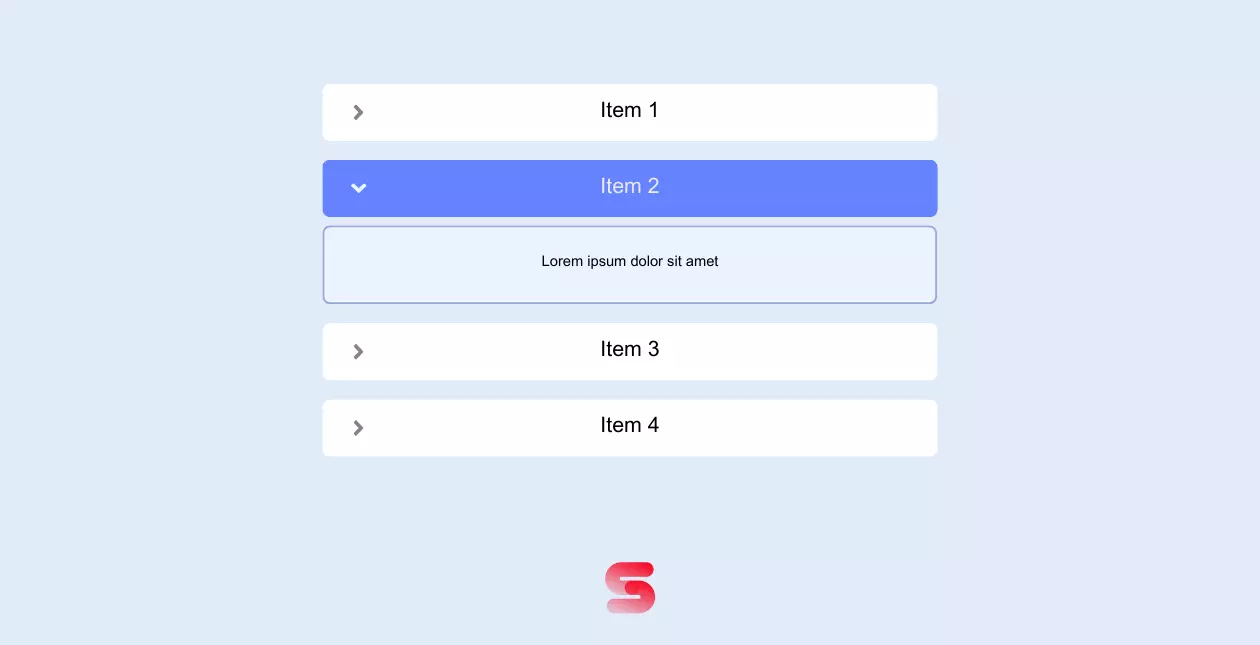
It does the things people used to buy plugins for. You can set the heading level so the accordion fits your page outline, turn auto-close on so opening one item shuts the rest, and move or hide the toggle icon. The official Accordion block documentation notes that headings act as buttons and panels announce their expanded and collapsed state to assistive technology, and the block reference confirms the markup carries role="group" on the container and role="region" on each panel.
For a single collapsible box there is the Details block, which outputs a plain <details> and <summary> pair. If you are writing markup by hand, that element has been Baseline widely available since January 2020 and needs no script at all. Giving several of them the same name makes them mutually exclusive, which is the classic accordion behaviour with zero JavaScript:
<details name="faq">
  <summary>How long does delivery take?</summary>
  <p>Two to four working days in the UK.</p>
</details>

<details name="faq">
  <summary>Can I return an item?</summary>
  <p>Within 30 days, unopened.</p>
</details>
Support for the name attribute is newer than the element itself, so check the compatibility table before you rely on it. Where it is unsupported, every panel simply opens independently, which is a soft landing rather than a broken page. Drop that snippet into a code snippet plugin if your theme has no other route to raw HTML.
Key features: heading level control, auto-close, icon position, any block inside a panel, and the Details block for one-offs.
Price: free, and no extra plugin in your update queue.
Best for: anyone on a block theme or on the block editor generally, which now covers most new builds.
Skip it if: you need accordions inside a classic-theme template, a widget area, or a shortcode you can drop anywhere. Core’s block only exists where blocks exist.
Easy Accordion
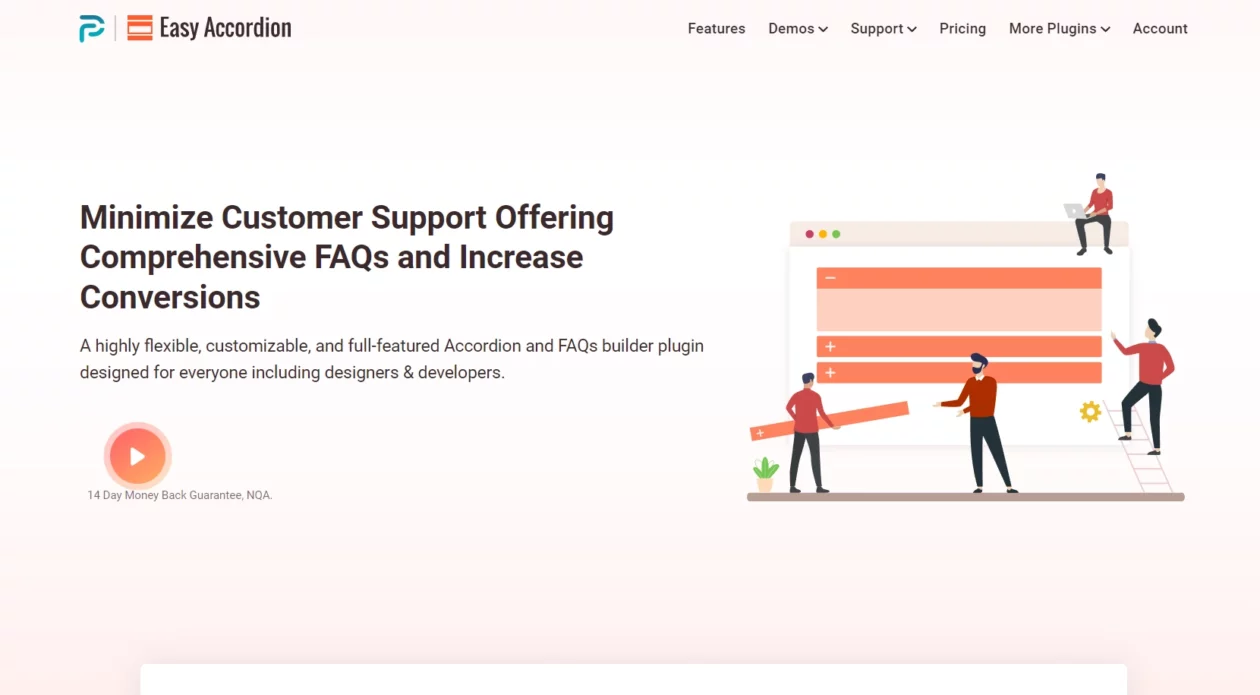
ShapedPlugin’s Easy Accordion is the one we still install when core’s block cannot go where the accordion needs to go. Its WordPress.org listing reports 70,000-plus active installs and a 4.9 rating across 358 reviews, and it was updated within the last month at the check date. That last figure matters more than the star count.
The free version is genuinely usable: unlimited accordions, a shortcode you can paste into posts, pages, widget areas or a template file, and a WYSIWYG editor for the panel content so images and embeds work without fighting it. Pro adds accordions generated from WordPress categories and custom taxonomies, which is the feature worth paying for. If you publish a knowledge base and want each category to render itself, that saves real editing time.
Key features: shortcode placement anywhere, WYSIWYG panel content, colour and icon controls, multisite and translation ready, category and taxonomy driven accordions in Pro.
Price: free on WordPress.org. Pro is $29 a year for one site, $99 for five and $199 unlimited, each renewing at the same figure, per the Easy Accordion pricing page. Lifetime licences were listed at $129, $229 and $399 under a 50 percent discount, with a 14-day money-back guarantee. At $29 a year, the single-site lifetime deal pays for itself after roughly four and a half years.
Best for: classic themes, widget areas, and sites where an editor needs one shortcode rather than a nested block structure.
Skip it if: your whole site is already block-based. You would be paying for a shortcode you will never paste.
Accordion FAQ by wpshopmart
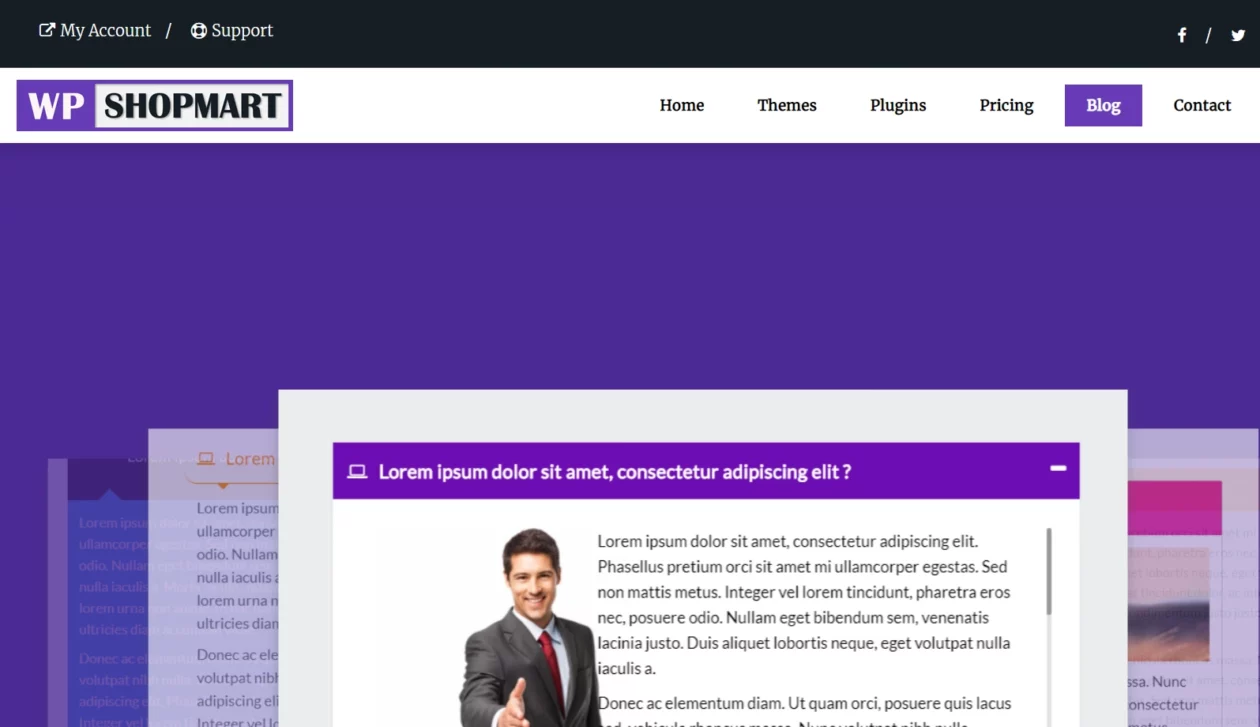
This is the Bootstrap-based one, and it is popular: 30,000-plus active installs and 4.6 stars from 676 reviews on its WordPress.org page. It has a drag-and-drop builder, a pile of templates, Font Awesome icons and more than thirty content animations in Pro. On paper it reads well.
The problem is maintenance. At the check date the listing showed a last update roughly eleven months earlier and compatibility tested only to WordPress 6.8.8, several releases behind current. An accordion is not a security-critical plugin, but a stale one is still code you are responsible for, and Bootstrap-derived CSS has a habit of leaking into the rest of a page’s typography.
Key features: drag-and-drop builder, Bootstrap-based responsive markup, shortcode output, eight templates and 30-plus content animations in Pro.
Price: free on WordPress.org. The vendor’s Accordion Pro pricing page was not reachable at the check date, so no figure is quoted here. Confirm at checkout before you buy.
Best for: a site already running Bootstrap, where the styles will not collide with anything.
Skip it if: you care about update cadence. Check the last-updated date on the listing yourself before installing, because that is the number that will have moved by the time you read this.
Accordions by PickPlugins
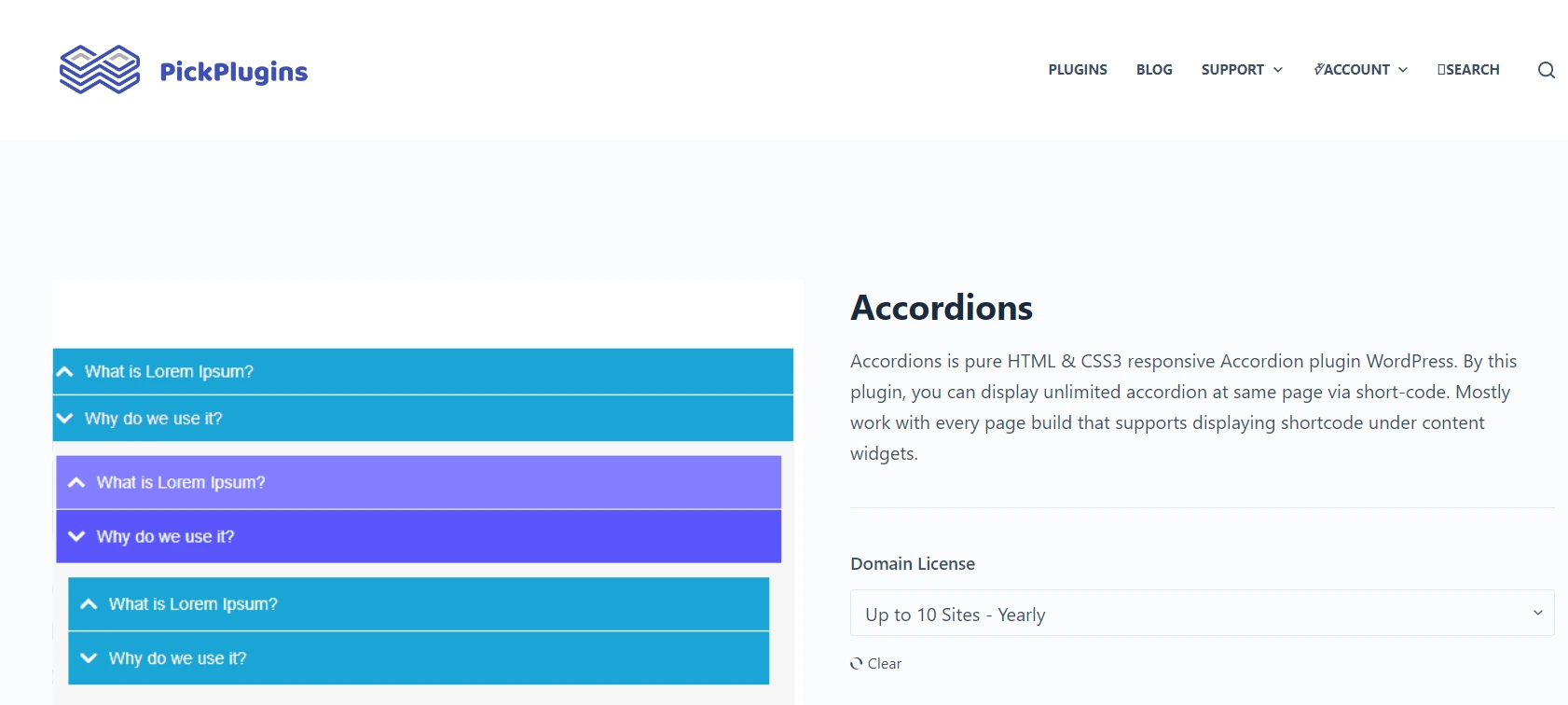
PickPlugins bills this one as pure HTML and CSS3, and its WordPress.org listing shows 20,000-plus active installs at 4.5 stars from 90 reviews. It builds unlimited accordions and outputs them by shortcode, which means it works with any page builder that renders shortcodes, and with none at all.
It is a fair shortcode accordion. The reason it sits in the middle of this list rather than the top is the licence structure: the pricing is heavily and permanently discounted, which makes it hard to know what you will actually pay at renewal. Budget against the list price, not the banner price.
Key features: unlimited accordions, shortcode output, nested accordions, vertical tabs and a search field in the premium build.
Price: free on WordPress.org. The Accordions pricing page showed Personal at $15 a year for three sites against a $39 list price, Plus at $65 for ten sites and Agency at $135 for 500, plus lifetime licences at $45, $90 and $210. Those discounted figures undercut every other price verified here while the promotion runs; at the $39 list price they do not.
Best for: freelancers covering three to ten client sites who want one licence rather than one per project.
Skip it if: you want a predictable renewal figure. Permanent sale pricing is a renewal you cannot forecast.
Shortcodes Ultimate
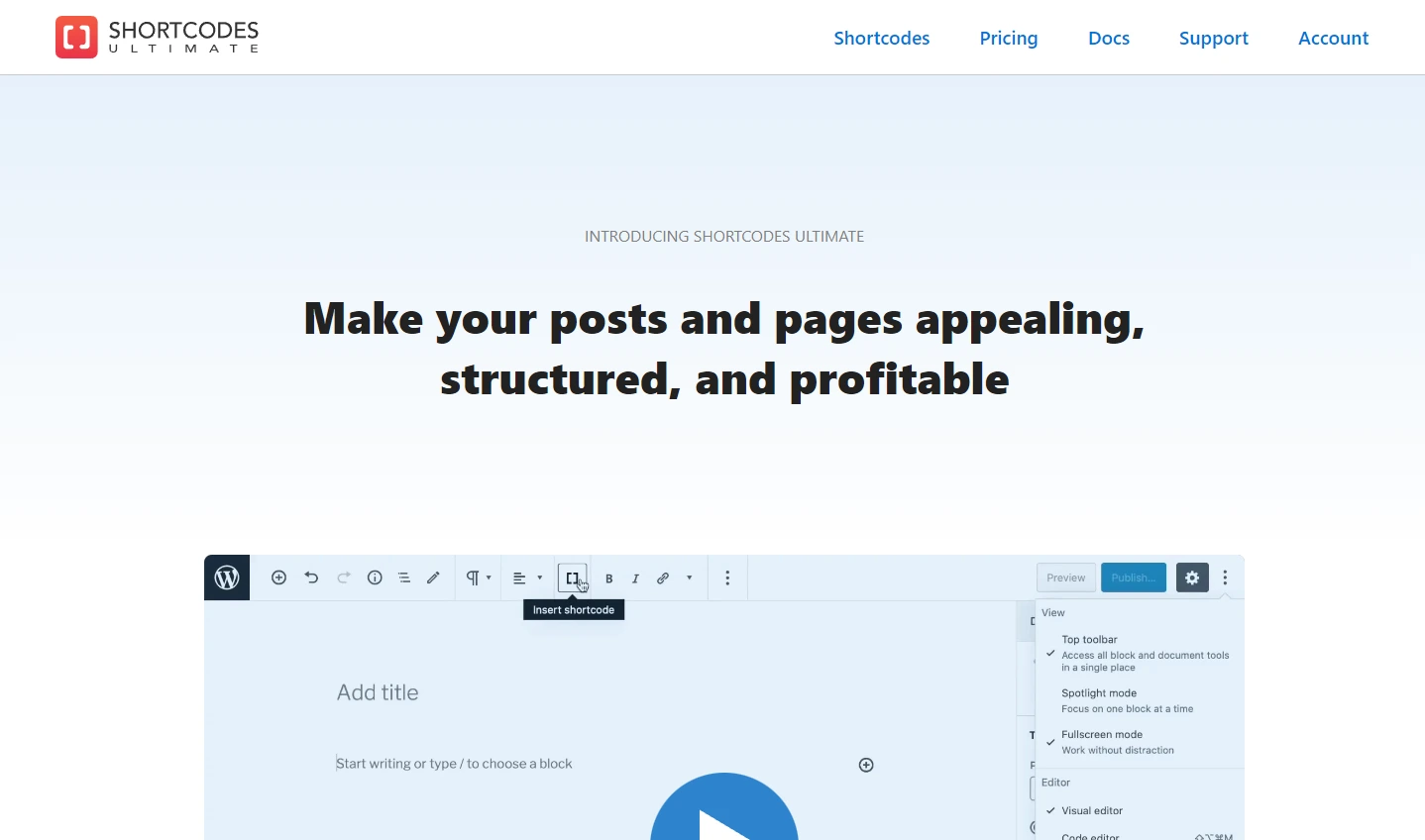
With 400,000-plus active installs and 4.9 stars from nearly 6,000 reviews, Shortcodes Ultimate has the largest install base in this table by a wide margin. Accordions are one item on a menu of more than fifty shortcodes covering tabs, spoilers, buttons, galleries and dividers.
That breadth is the whole argument and the whole objection. If you are already using it for tabs and buttons, its accordion costs you nothing extra. If you are not, installing a fifty-shortcode toolkit to collapse three paragraphs is the kind of decision that turns into a speed problem six months later. Check its WordPress.org listing for what the free build covers before you decide.
Key features: 50-plus shortcodes including accordions, spoilers and tabs, a shortcode inserter in the editor toolbar, custom CSS editor, Google Fonts and icon support.
Price: free on WordPress.org. Pro runs $49 a year for one site, $59 for ten and $199 for 100, each renewing at the same rate, with a 30-day money-back guarantee, per the Shortcodes Ultimate pricing page. Lifetime options exist on the multi-site tiers. At $49 that single-site plan is the most expensive entry price verified here.
Best for: sites already leaning on shortcodes for layout, especially older classic-theme builds.
Skip it if: the accordion is the only shortcode you would ever use. That is a lot of plugin for one element.
Ultimate Blocks
Ultimate Blocks is a block library rather than an accordion plugin, and its Content Toggle block is the accordion. Its WordPress.org listing shows 50,000-plus installs and 4.9 stars across 729 reviews, and the plugin was updated within the last month at the check date.
The honest question now is what it adds over core’s Accordion block, and the answer is styling controls and the other twenty-odd blocks: table of contents, review, tabbed content, call to action. If you would use three or four of those, the accordion comes along free. If you only want the accordion, core already gave you one. Note that older write-ups sell this plugin’s FAQ schema option as a ranking feature, which no longer means what it once did. More on that below.
Key features: Content Toggle accordion with colour, border, icon and initial-state controls, plus 20-plus other blocks including table of contents and tabbed content.
Price: free on WordPress.org. Pro is $39 a year for one site or $79 a year unlimited, renewing at the same figure, with lifetime licences at $99 and $199 and a 30-day money-back guarantee, per the Ultimate Blocks pricing page. The single-site lifetime licence beats the yearly plan after a bit over two and a half years.
Best for: block-editor sites that want a table builder worth of blocks without installing a full page builder.
Skip it if: the Content Toggle block is the only block on the list you actually want.
FAQ Schema by Pluginic
This one was in the previous version of this article on the strength of its FAQ schema markup, and it is worth explaining why it has been demoted rather than quietly dropped.
The pitch is rich snippets. Google narrowed FAQ rich results in 2023 so the feature is only shown for well-known, authoritative government and health websites. Unless you run one of those, FAQPage markup will not get you the expanded result the marketing pages still show. Meanwhile the WordPress.org listing sat at version 1.0.2 with roughly 2,000 installs and a 3.8 rating from nine reviews at the check date, and the reviews complain about missing options screens. That is a young plugin selling an outcome you cannot have.
Key features: accordion, tab and slider FAQ layouts, ready-made designs, shortcode generator, FAQPage structured data.
Price: a free version is on WordPress.org. The Pluginic pricing page was not reachable at the check date, so no figure is quoted here.
Best for: a government or health publisher that is genuinely eligible for FAQ rich results and wants a layout picker with it.
Skip it if: you are anyone else. If you want FAQ structured data anyway, Rank Math and the other major SEO plugins already output it at no extra cost.
Keyboard, aria-expanded and the part most roundups skip
An accordion is a keyboard control before it is a design element. If it only responds to a mouse, a chunk of your visitors cannot open it at all, and no amount of animation options fixes that. The WAI-ARIA Authoring Practices accordion pattern sets out what a correct one does, and it is short enough to check by hand.
- The header title sits in an element with
role="button", and that button is the only child of a heading with a sensible level. - The button carries
aria-expanded="true"when its panel is visible andaria-expanded="false"when it is not. - The button carries
aria-controlspointing at the id of its panel. - Enter and Space both toggle the panel. Tab and Shift+Tab move between headers in the normal page order.
You can test all of that in under a minute without any tooling. Load the page, press Tab until focus lands on the first accordion header, and check that you can see where focus is. Press Space. If the panel opens, right-click the header, inspect it, and look for aria-expanded flipping between true and false as you toggle. A plugin that binds a click handler to a bare <div> fails at step two, and quite a few of the older ones do.
Native <details> handles the keyboard for you, but it is not a free pass. MDN warns that the role browsers assign to <summary> varies, and some still apply a button role that strips the roles from its children, so a heading placed inside a summary can stop being announced as a heading. Keep summary content as plain text and put your headings outside the element.
Two more habits worth keeping. Do not animate a panel with a transition that leaves focus stranded inside a collapsed region, and respect prefers-reduced-motion if you animate at all. If you want a smooth open, interpolate-size and calc-size() now make animating a height to auto possible, though MDN lists them as limited availability rather than Baseline, so treat the animation as optional polish.
Does Google index content inside a collapsed accordion?
Yes, and this is settled enough that you can stop worrying about it. Google’s own mobile-first indexing guidance says you can move content into accordions or tabs, as long as it is equivalent to the desktop content, because indexing comes from the mobile version of your site. Text behind a click is indexed text.
Three caveats stop that from being the whole story.
- It has to be in the HTML. Indexed means present in the rendered page. If your plugin fetches panel content over AJAX only after a click, there is nothing to index. Load a page with JavaScript disabled and search the source for your panel text.
- Indexed is not the same as read. Google can see it; visitors mostly do not open it. Anything that drives a conversion belongs in visible text, which is the same rule that applies when you are optimising a blog post for search.
- Find-in-page is a real behaviour. Someone pressing Ctrl+F on your documentation page will miss collapsed text unless the markup accounts for it. MDN documents
hidden="until-found"for exactly this case.
What has changed is the reward. FAQ rich results are now limited to well-known, authoritative government and health sites, so the FAQPage markup that half this category advertises will not produce a snippet on a normal business site. Add it because it is accurate structured data, not because you expect a bigger listing.
What most accordion roundups get wrong
The category is full of articles that list ten plugins, call every one of them lightweight and SEO-friendly, and never mention the two things that actually bite.
Assets load everywhere. Older accordion plugins queue jQuery, their own script and a stylesheet on every page of your site, including the ones with no accordion on them. Open the network panel on your homepage and look. Some plugins let you limit asset loading; most do not, and that is when you end up reaching for a caching plugin to paper over a problem you could have avoided.
Accordions move the page. An accordion whose JavaScript initialises after first paint renders every panel open, then snaps them shut, and everything below jumps. That is a Cumulative Layout Shift problem, and it is the single most common way a decorative accordion damages a page’s Core Web Vitals. If your accordion sits above other content, read up on how to avoid layout shift in WordPress before you ship it.
Lifetime deals need arithmetic. Several vendors here push a lifetime licence, and the break-even is further out than the badge suggests. Easy Accordion’s $129 single-site lifetime licence breaks even against its $29 annual plan after about four and a half years; Ultimate Blocks’ $99 lifetime licence breaks even against $39 a year after a bit over two and a half. Ask yourself honestly whether the site will still exist, and whether the plugin will still be maintained, by then.
And builder owners often already have this. If you run Elementor Pro or one of the Elementor addon packs, you have an accordion widget included. Installing a second one is duplicated JavaScript for no gain.
Which one should you install?
- Block theme or block editor, standard FAQ: core’s Accordion block. Install nothing.
- One collapsible box: core’s Details block, or a hand-written
<details>element. - Classic theme, widget area, or an editor who needs a shortcode: Easy Accordion free, then Pro at $29 a year only if you need category-driven accordions.
- Three to ten client sites on one licence: Accordions by PickPlugins, budgeting against the $39 list price rather than the promotional one.
- You already use a shortcode toolkit: Shortcodes Ultimate, because its accordion costs you nothing you have not already paid.
- You want a whole block library rather than one accordion: Ultimate Blocks.
- You are chasing FAQ rich results: stop. Unless you are a government or health publisher, that result is not available to you.
Frequently Asked Questions
Does Google index content inside a collapsed accordion?
Yes. Google’s mobile-first indexing guidance says you can move content into accordions or tabs as long as it stays equivalent to your desktop content. The catch is that the text has to be in the HTML at page load. If your plugin fetches panel content by JavaScript only after a click, Google may never see it.
Do accordions still earn FAQ rich results in Google?
Almost certainly not. Since 2023 Google has limited FAQ rich results to well-known, authoritative government and health sites. Adding FAQPage markup to an accordion on an ordinary business site will not produce the snippet, so pick a plugin for how it behaves on the page, not for its schema.
Do I need a plugin for accordions in WordPress at all?
No. Core includes an Accordion block built from Accordion Item, Heading and Panel inner blocks, plus a Details block for a single collapsible section. A plugin only earns its place if you need shortcode placement, accordions generated from categories, or a widget inside a page builder.
Are accordion plugins accessible to keyboard and screen reader users?
Some are, some are not. The header needs to be a real button inside a heading, carry aria-expanded, and open on both Enter and Space. Tab through your accordion before you ship it. Plenty of older plugins bind a click handler to a plain div and fail all three tests.
What is aria-expanded and why does it matter?
It is the attribute that tells assistive technology whether a panel is currently open or closed, flipping between true and false as the user toggles it. Without it a screen reader announces a button with no state, so the listener cannot tell whether pressing it revealed anything at all.
Should important content go inside an accordion?
Put it in visible text instead. Indexing is not the problem; attention is. Visitors skim the headings and open one panel if you are lucky. Prices, delivery terms and anything a reader must see before they buy should never sit behind a click on a page that matters.
Will an accordion plugin slow my site down?
It can. Older accordion plugins queue jQuery, a Bootstrap stylesheet and their own script on every page, whether or not that page contains an accordion. Open your browser’s network panel on a page with no accordion and see what still loads. Core’s block adds no extra library.
Can I animate a native details element open and closed?
Partly. The CSS properties interpolate-size and calc-size make animating a height to auto possible, but MDN still lists them as limited availability rather than Baseline. Build the open and closed states so they work with no animation first, then add the transition as a bonus.
The verdict
Use the Accordion block in WordPress core. It is free, it adds no library to your front end, it exposes the expanded and collapsed state to assistive technology without configuration, and it is maintained by the same people who maintain the rest of your site. For the large majority of FAQ sections and long service pages, that is the end of the decision.
Buy a plugin only for a reason you can name. The reason is usually placement: you are on a classic theme, or an editor needs a shortcode, or you want a knowledge base that builds itself from categories. In that case Easy Accordion at $29 a year for one site is the pick, and it is the cheapest verified list price in the table. If you want a block library rather than an accordion, Ultimate Blocks at $39 a year does more for slightly more.
Whatever you install, run the keyboard test before you call it finished. Tab to the header, press Space, watch aria-expanded change. An accordion that fails that test is not a design choice, it is a bug that happens to look tidy.