



Most WordPress backup plugins will happily hand you a backup you can never restore. The archive builds, the green tick appears, and months later the site is down and the file turns out to be missing half the uploads folder because the job timed out. This roundup ranks seven plugins on the thing that matters at 2am: whether you can actually get the site back. Prices are current, renewals included, and one old favourite no longer has a price we can verify.
Quick verdict
- Best overall: UpdraftPlus Premium. Incremental backups, a backup taken automatically before every update, and your files land in cloud storage you already own. Personal is $70 a year for two sites.
- Best free: WPvivid. Its free tier schedules backups to OneDrive and SFTP among others, both of which UpdraftPlus holds back for Premium, and it restores in one click. UpdraftPlus free is a close second. Duplicator free does no scheduling or cloud storage at all.
- Best if you never want to touch storage: BlogVault, which keeps the copies on its own servers and restores from its dashboard. It starts at $99 a year for one site.
- Skip it if: you were about to renew BackupBuddy, now called Solid Backups. Its own product and pricing pages no longer resolve, so there is no price on this page for it.
- Our call: the plugin matters less than the drill. Whichever you install, restore it onto a throwaway copy this week, before you need to.
Best WordPress Backup Plugins in 2026 Compared
| Plugin | Free tier | Paid entry plan | Renewal price | Sites | Backups stored |
|---|---|---|---|---|---|
| UpdraftPlus | Yes, scheduled | Personal | $70/year | 2 | Your cloud accounts |
| WPvivid | Yes, scheduled | Blogger | $49/year | 2 | Your cloud accounts |
| Duplicator | Yes, manual only | Basic | $79/year | 2 | Your cloud accounts |
| Total Upkeep | Yes | Premium | $2.50/month billed annually, so $30/year | Not stated | Local plus your FTP or S3 |
| BlogVault | No | Personal | $99/year | 1 | BlogVault servers |
| Jetpack VaultPress Backup | Plugin free, plan required | Backup | SGD 13.95/month billed yearly | 1 | Automattic servers |
| Solid Backups (BackupBuddy) | No | Not listed for sale | No verifiable price | Not stated | Local plus your cloud |
Restore Testing Beats Every Feature List
Backups are the one area of WordPress where the marketing and the reality point in opposite directions. Vendors compete on how many cloud destinations they support and how clever the incremental engine is. None of that helps at the moment you need it. What helps is whether the archive is complete, whether you know the restore procedure without reading documentation, and whether the storage account is still reachable when your site is not.
Three failure modes account for most of the backups that turn out to be worthless. The job silently truncates because PHP hit a timeout partway through the uploads folder, and the plugin still marks it complete. The database dumps fine but the files were excluded by a rule someone set two years ago. Or the backup is perfect and the person restoring it has never done a restore, so the site stays down for four hours while they learn.
Worth being blunt about the other half of this: a backup is not a security control. If someone got in, restoring puts the vulnerability back too, along with any backdoor that was already present in the last few archives. Backups sit next to WordPress security plugins and a proper cleanup with malware removal tools, never instead of them. Restore first if the site is merely broken. Clean first if it was compromised.
UpdraftPlus
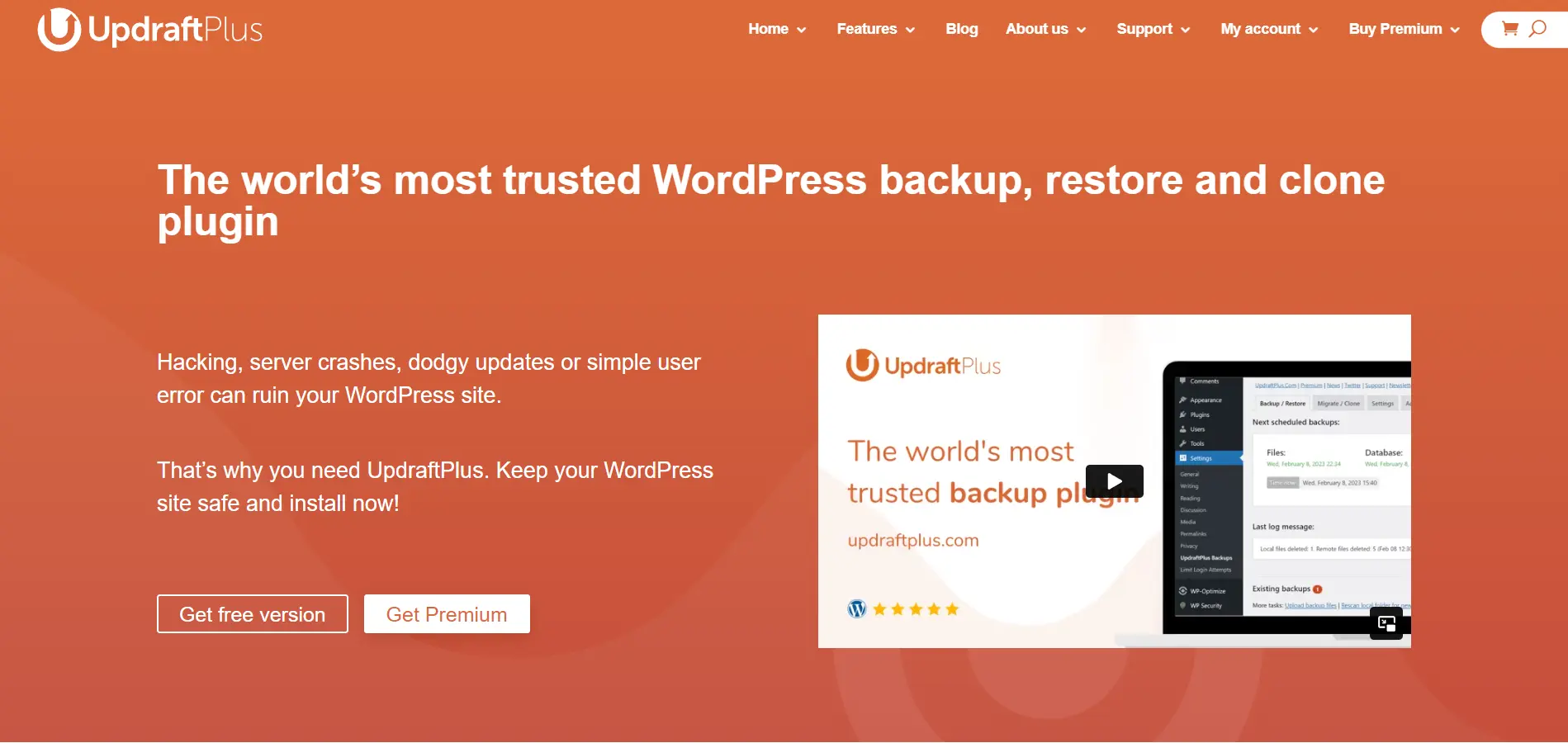
UpdraftPlus is the default answer for a reason: it sits on 3+ million active installs, and the free version is genuinely usable rather than a trial. Scheduled backups, and destinations including Dropbox, Google Drive, Amazon S3, Rackspace Cloud, FTP, DreamObjects, OpenStack Swift and email, all cost nothing.
One practical note before you go looking: the brand now lives at teamupdraft.com, and the old updraftplus.com shop URLs redirect there. If you bookmarked a pricing page a couple of years ago, it will not be where you left it.
Key features
- Incremental backups, so the second run only ships what changed instead of rebuilding the whole archive.
- Automatic backups immediately before a core, plugin or theme update. This is the feature that saves the most weekends.
- Premium storage destinations on top of the free list: OneDrive, Azure, Google Cloud, Backblaze B2, SFTP, SCP, pCloud and WebDAV.
- Database encryption, multisite and multi-network support, and 1GB of UpdraftVault storage bundled in.
- Cloning and direct site-to-site migration, which makes it a reasonable stand-in for the dedicated WordPress migration plugins if you only move sites occasionally.
Price: free core plugin. Premium runs $70 a year for 2 sites, $95 for 10, $145 for 35, $195 for unlimited and $399 for the Gold tier, per the UpdraftPlus pricing page, which defaults to USD and offers EUR and GBP. No renewal discount is stated, so budget for the same figure next year. There is a 14-day money-back guarantee.
Best for: a single site or a handful, run by someone who already has a Dropbox, Drive or S3 account and wants pre-update snapshots without paying a monthly fee.
Skip it if: you do not want to own the storage. UpdraftPlus mostly writes to accounts you set up and pay for, and if you lose access to that account you lose the backups with it.
WPvivid Backup & Migration
WPvivid is the one that quietly outclasses the big names on the free tier. Its WordPress.org listing shows 900,000+ active installs, and the free plugin does scheduled backups on a 12-hourly, daily, weekly, fortnightly or monthly cycle, sends them to Dropbox, Google Drive, OneDrive, Amazon S3, DigitalOcean Spaces, SFTP or FTP, and restores with one click. Most competitors put at least two of those behind the paywall.
Key features
- Scheduling and remote storage in the free version, which is the whole argument for it.
- One-click restore and auto-migration to a new domain, useful when a client finally approves the new host.
- Backup splitting, which is what keeps large sites from dying mid-archive on cheap shared hosting.
- A lifetime licence option, rare in this category and priced sensibly.
Price: free core plugin. Pro is $49 a year for 2 sites, $69 for 10, $99 for 50 and $149 for unlimited, with lifetime licences at $99, $139, $199 and $299 respectively, per the WPvivid pricing page. The lifetime Blogger licence at $99 pays for itself just past the two-year mark against the $49 annual.
Best for: freelancers with a stack of client sites. At $99 a year for up to 50 sites, WPvivid Small Business works out at $1.98 per site. The comparable multi-site tiers are UpdraftPlus Agency at $145 for 35 sites, which is $4.14 each, and Duplicator Pro at $399 for 20 sites, which is $19.95 each. Past 50 sites the unlimited tiers change the sum: WPvivid Ultimate is $149 a year and UpdraftPlus Enterprise $195.
Skip it if: you want a vendor holding a copy for you, or a support team with a phone number. Also worth checking your host first: if backups keep failing you may need to raise the WordPress memory limit before blaming the plugin.
Duplicator
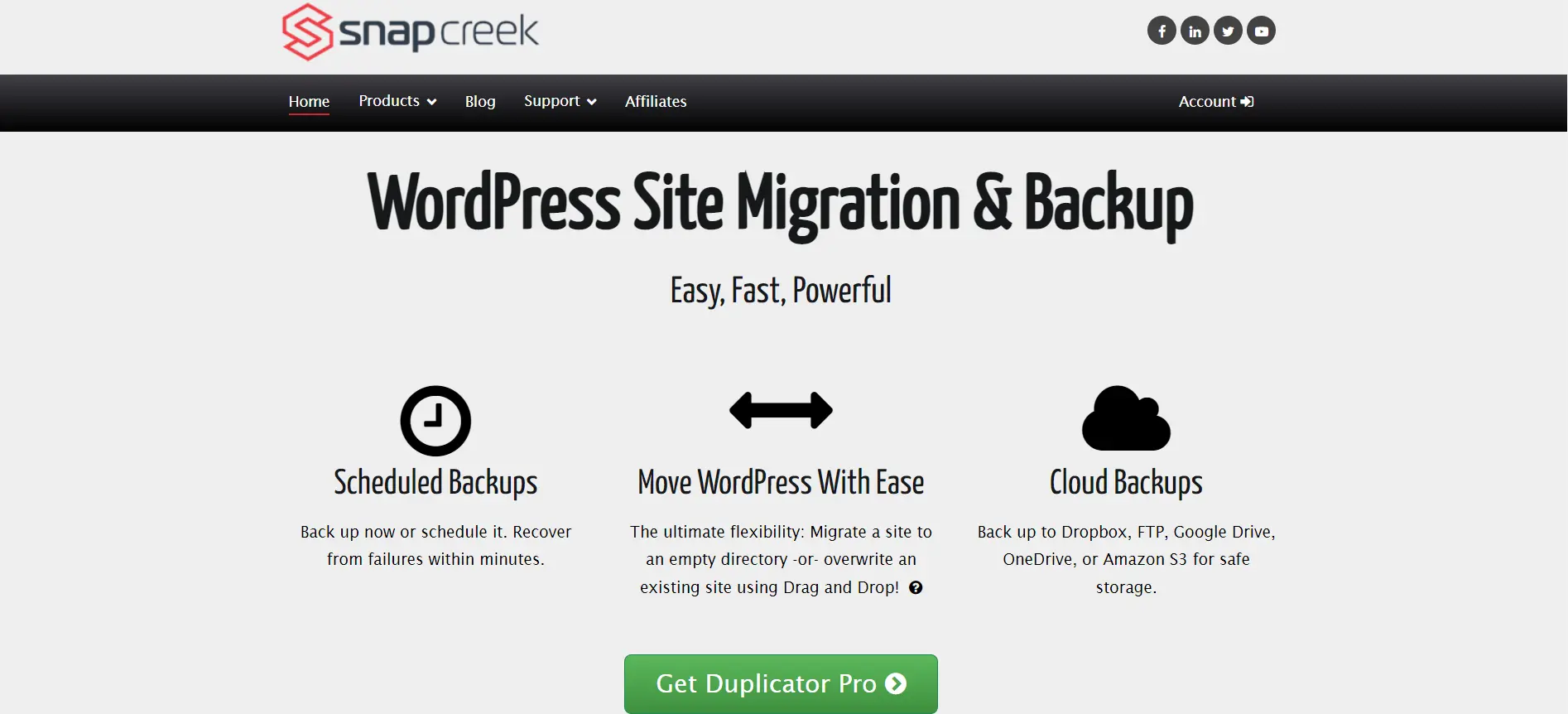
Duplicator started as a migration tool and still behaves like one. It has 1+ million active installs, and the free version packages a whole site into one archive plus an installer you drop on the destination server. That is excellent for moving sites and close to useless as a backup routine, because scheduling and cloud storage are both Pro features. A backup you have to remember to run is a backup you will forget to run.
Key features
- Recovery Points, a one-URL rollback to a known-good state. The closest thing here to an undo button for a bad deploy.
- Drag-and-drop installs: drop the archive on the destination site to overwrite it, no installer wizard.
- Scheduled backups and cloud destinations (Dropbox, Google Drive, OneDrive, S3, FTP and SFTP) in Pro.
- Partial archives, so you can package only the database, only the themes, or only the plugins.
- Multisite migration, including pulling a single subsite out as a standalone install.
Price: free core plugin. Pro is $79 a year for 2 sites, $199 for 5, $399 for 20 and $599 for 100, per the Duplicator pricing page. Those are the renewal figures, and they matter: the site runs a 60% first-year discount and states plainly that renewals are at full price. Refunds within 14 days.
Best for: anyone who moves sites for a living, and anyone who wants a staging-to-live workflow with a rollback. Pair it with a throwaway sandbox such as InstaWP and your restore rehearsal takes minutes.
Skip it if: you wanted free automated backups. At renewal its entry tier is also the priciest of the plugins here that back up to storage you own: $79, against $70 for UpdraftPlus, $49 for WPvivid and $30 for Total Upkeep. You are paying for scheduling that WPvivid gives away.
Total Upkeep by BoldGrid
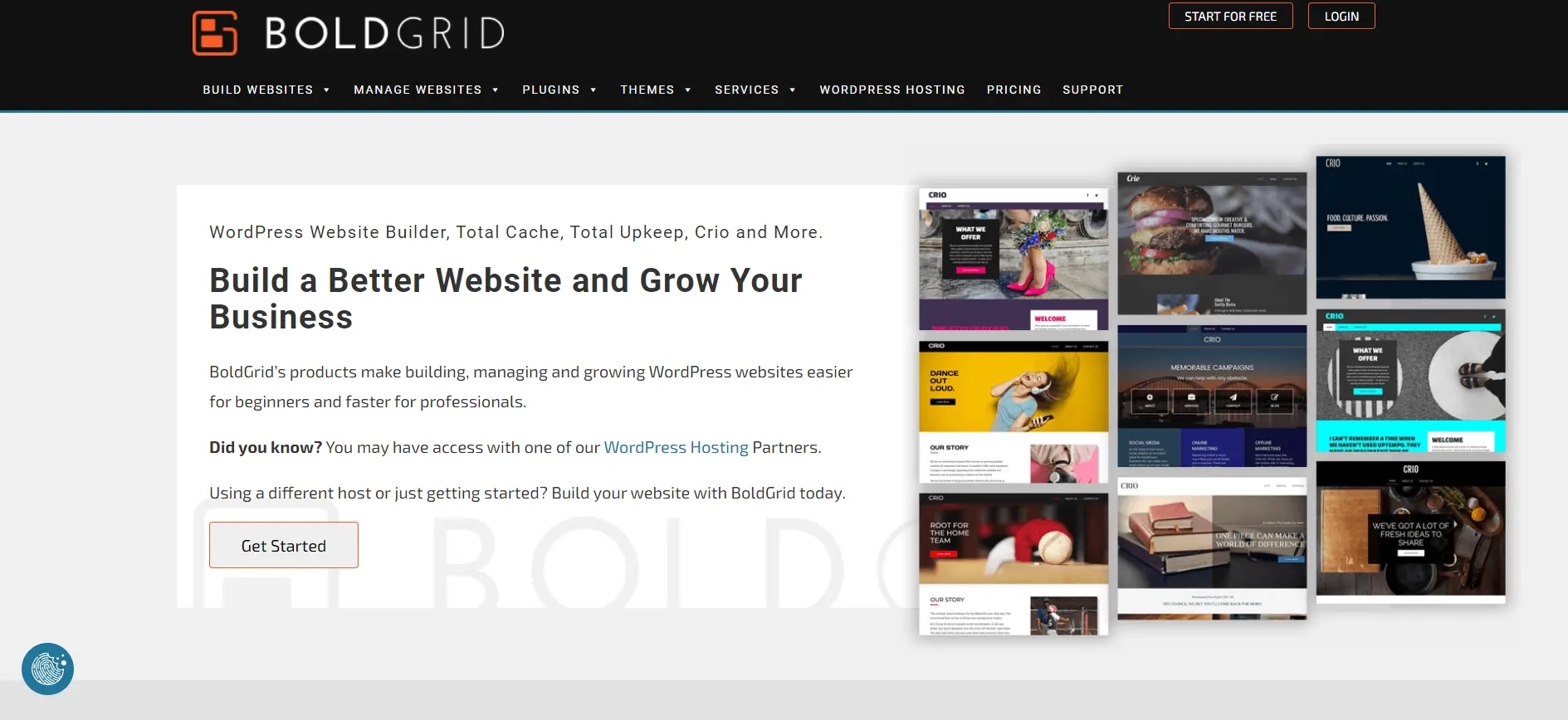
Total Upkeep is the small one, at 50,000+ active installs, and it earns its place on one feature. Automated Fault Protection takes a backup before an update and rolls the site back on its own if the update takes the site down. Nothing else here advertises an automatic rollback.
Key features
- Automated Fault Protection: pre-update backup, automatic rollback if the update breaks the site.
- Single-file restore from inside the backup browser, for when one theme file got mangled and a full restore would be overkill.
- Remote storage to SFTP, FTP or Amazon S3, plus local archives kept on the server.
- Database encryption and scheduled backups.
Price: free core plugin. Total Upkeep Premium is listed at $2.50 a month billed annually on the BoldGrid pricing page, which works out at $30 a year. That is the cheapest paid tier of any USD-priced plugin in the table. The bundles that include it start at $5 a month billed annually. The page does not state how many sites the standalone premium licence covers, or what it renews at, so check both at checkout.
Best for: sites you have handed over to a client who auto-updates everything and calls you when it breaks. Also a sensible pairing when you are still choosing hosting for WordPress and have not yet got host-level snapshots.
Skip it if: you want a large, well-staffed vendor behind the product, or you need the licence terms spelled out before you buy. The install base is a fraction of the others here.
BlogVault
BlogVault takes the opposite approach to everything above. Backups are built on its servers rather than yours, which keeps the load off a struggling host, and they are stored on its infrastructure so there is no cloud account for you to configure or lose. Restores run from its dashboard, not from inside a WordPress admin that may not be loading.
One correction to the numbers this article used to carry: the WordPress.org listing shows 80,000+ active installs, not the 400,000+ that got quoted for years. It is a smaller product than its marketing suggests, which does not make it a worse one, but it should temper the claim that everybody uses it.
Key features
- Incremental, off-server backups that put almost no load on the site being backed up.
- One-click staging, which doubles as the fastest way to rehearse a restore without risking the live site.
- Real-time backups on the WooCommerce tier, so orders taken between scheduled runs survive.
- Multi-site dashboard, activity log and uptime monitoring in one place.
- Restores that run from BlogVault rather than from wp-admin, which is the point when wp-admin is the thing that died.
Price: no free tier. Personal is $99 a year for one site, Business $299 and WooCommerce $499, per the BlogVault pricing page, with a 14-day refund window. That $99 entry point is the highest of the USD plans in the table. The page advertises a discount on annual plans but does not state a renewal price, so confirm what year two costs before you commit.
Best for: shops. If you run WooCommerce and take orders through the night, real-time backup is not a luxury, and the off-server model means the backup job is not competing with checkout for the same PHP workers.
Skip it if: you are running a blog or a brochure site. You would be paying $99 a year for capability a free plugin covers, and there is no free tier to fall back to if you stop paying.
Jetpack VaultPress Backup
VaultPress is the Automattic option, and the one most people already own without realising it, because it is bundled into the Jetpack Security, Growth and Complete plans. The plugin itself is free to install with 20,000+ active installs, but it does nothing until you attach a paid Jetpack plan that includes Backup.
Key features
- Real-time backups on every tier, including the entry one.
- Restores from the Jetpack mobile app, which genuinely matters if the site goes down while you are nowhere near a laptop.
- An activity log that ties each backup point to what changed, so you can restore to just before the bad plugin update.
- 10GB of backup storage to start, held on Automattic infrastructure.
Price: the Jetpack Backup page geo-switches currency, and at the check date it showed SGD 6.95 a month for the first year and SGD 13.95 a month after that, billed yearly. Because that is a different currency from every other row, we are not ranking it on price against the USD plans, and neither should you until you see what your own checkout shows.
Best for: anyone already paying for a Jetpack plan. You may be entitled to this already, in which case adding a second backup plugin just doubles the server load.
Skip it if: you object to Jetpack connecting your site to a WordPress.com account. That connection is a login worth protecting with two-factor authentication, because whoever holds it can restore, and therefore overwrite, your site.
Solid Backups, formerly BackupBuddy: Do Not Buy This Blind
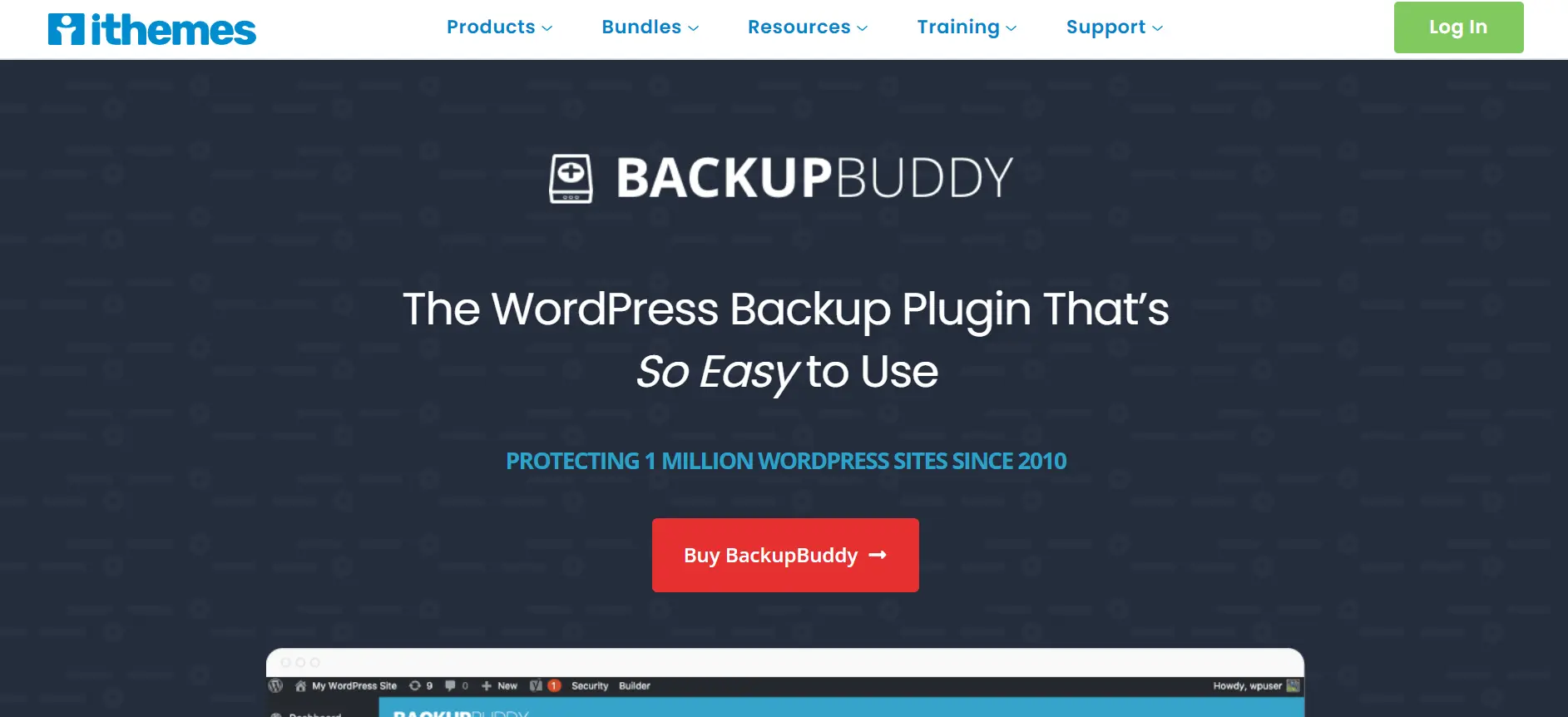
The screenshot above is a museum piece, and that is the point. BackupBuddy began life under iThemes, became Solid Backups under the SolidWP brand, and SolidWP was absorbed by Liquid Web. Earlier versions of this article recommended it at a 2023 price. That recommendation no longer stands.
At the check date, solidwp.com/pricing redirects to Liquid Web’s own pricing page, the Solid Backups product page returns a 410 Gone, and Solid Backups does not appear among the add-ons Liquid Web sells alongside Kadence. The plugin still ships updates. What is missing is a vendor page quoting a price, and a price we cannot verify is a price we will not print.
Our call: if you already hold a licence, keep taking backups but start rehearsing a move. If you do not, buy something whose renewal terms you can read today. A backup tool whose vendor is mid-reorganisation is the wrong place to be relying on year-three support.
Test a Restore in Twenty Minutes
Do this once, on a calm afternoon, and you will find out whether you actually have a backup. Do not do it on the live site.
- Spin up an empty WordPress install somewhere disposable: a subdomain, a local environment, or a sandbox you can delete afterwards.
- Download the most recent backup from wherever it actually lives, not from a local copy on the server. If you cannot download it without help, that is the finding.
- Check the archive size against the site. A 900MB site with a 40MB archive did not finish.
- Restore it onto the empty install using the plugin’s own restore routine, timing yourself as you go.
- Verify: log in as admin, load the homepage, open your newest post and your oldest, load an archive page, check that images render rather than 404, and if you run a shop, open the most recent order. Then compare the post and user counts against production.
- Write the elapsed time and the steps in a text file next to your hosting credentials. Future you will not remember any of this.
What breaks
Restores fail in a small number of predictable ways. The archive exceeds the upload limit, so it has to go up by SFTP instead. PHP times out mid-import on a large database and leaves half the tables in place, which means starting from an empty database rather than retrying on top. Images 404 because the site URL was rewritten in the database but the uploads path was not. Serialised data in theme options breaks when the domain changes, which is why a proper search-and-replace tool beats a raw SQL find. And the backup job itself is expensive: running a full archive during business hours will show up in your server response times, so schedule it for your quietest hour.
What Most Backup Roundups Get Wrong
They quote the intro price. Duplicator is the clearest example: a 60% first-year discount, and the vendor states outright that renewals are at full price. Year one feels cheap, year two is $79. Every figure in the table above is the renewal figure for that reason.
They treat host backups as a substitute. Most managed WordPress hosts include daily snapshots, which is great until the account itself is suspended, the card expires, or you need a file from three weeks ago and retention is seven days. On budget shared hosting the snapshots often sit on the same disk as the site. Two copies, two providers, or you have one copy.
They ignore what is inside the archive. Your database holds customer names, addresses, order histories and comment email addresses. Copying it to a personal Dropbox is a data transfer nobody documented, and retention rules apply to backups too. If you are working through GDPR compliance, the backup schedule belongs in that conversation.
They score plugins on feature counts. Twelve cloud destinations is not twice as good as six. You will use one. What you want to know is whether the restore works when you are panicking, and no feature table answers that.
Which One Should You Pick
- One site, no budget: WPvivid free. Scheduling and cloud storage without paying, which few free tiers here offer.
- One site, small budget: UpdraftPlus Premium Personal at $70 a year. You are buying incremental and pre-update backups, and those are the two that pay for themselves.
- Ten to fifty client sites: WPvivid Small Business at $99 a year, or UpdraftPlus Agency at $145 for 35 if you prefer the bigger vendor.
- A shop taking real orders: BlogVault WooCommerce, or Jetpack if you already pay for it. Anything less than real-time and you will eventually lose an order.
- Sites that auto-update unattended: Total Upkeep, for the automatic rollback, at $30 a year.
- You move sites constantly: Duplicator Pro, and treat the backups as a bonus rather than the reason.
Frequently Asked Questions
Do I still need my host backups if I use a plugin?
Keep both. Host backups are fast and usually free, but they live on the same account you might lose, and support restores can be slow. A plugin backup stored in your own cloud account is the copy you control. Two independent copies, two different providers.
How often should WordPress backups run?
Match the schedule to how much work you are willing to redo. A brochure site changes monthly, so weekly files and a daily database dump is plenty. A busy blog wants daily. A shop taking orders every hour needs real-time or hourly database backups.
Do I need real-time backups?
Only if losing an hour of data costs you money. Shops, membership sites and busy forums qualify. For everything else, real-time backups add cost and background load for a gain you will never notice. Daily database backups cover most sites fine.
Where should backups be stored?
Anywhere except the server being backed up. Dropbox, Google Drive, Amazon S3, Backblaze B2 or a vendor cloud all work. Keep at least one copy somewhere a compromised WordPress login cannot reach, and turn on two-factor authentication for that storage account.
Why does my backup keep failing halfway?
Usually PHP timeouts or memory limits on shared hosting rather than the plugin. Raise the memory limit, exclude the uploads folder from the first run, then add it back in chunks. If the job still dies, the site has outgrown that hosting plan.
Is a free backup plugin good enough?
For a single site, often yes. WPvivid and UpdraftPlus both schedule backups and send them to your own cloud storage at no cost. You pay for incremental backups, multisite, pre-update snapshots and support, which start to matter once you manage sites for other people.
How do I know a backup actually works?
Restore it. Pull the latest archive onto a staging copy or a throwaway install, log in, load the homepage, open a post and an image, and compare the post and user counts against production. A backup you have never restored is a guess, not a backup.
Does a backup protect me from getting hacked?
No. It protects you from staying hacked. Restoring an infected site just reinstalls the infection unless you clean the malware and close the hole first. Backups sit alongside security hardening and malware scanning, never instead of them.
Our Verdict
For most people running one site, install UpdraftPlus Premium on the Personal plan at $70 a year. Incremental backups keep the job small enough to finish, the pre-update snapshot catches the failure mode that actually happens, and the files land in storage you already control. If the budget is zero, WPvivid free covers scheduling, cloud storage and one-click restore without asking for a card, and UpdraftPlus free is a fair alternative.
If you take orders, pay for real-time backups: BlogVault WooCommerce, or Jetpack if it is already on the invoice. If you are still on BackupBuddy, stop planning around it and pick a replacement while nothing is on fire.
Then do the twenty-minute restore drill. Everything above is a preference. That part is the job.




[…] today and pick a plugin afterwards. If it is clean, run Wordfence free alongside real off-server WordPress backup plugins and put the money into better hosting […]
[…] and renewing at 1,171.95 per month. If backups are the actual gap, compare it against dedicated WordPress backup plugins before you […]
[…] away at the door. Print the recovery codes, store them somewhere that is not the site, and keep a current backup before you enforce anything on anyone […]
[…] it if: you are on a hobby blog. Detection plus a good WordPress backup plugin and a fresh install is a cheaper recovery path than $299 a […]
[…] not backups. You want off-server retention and a self-serve restore button, and you want your own independent backup regardless of what they […]
[…] it if: weekly backups make you nervous. A week is a long time to lose. Pair it with one of the WordPress backup plugins that push to your own […]
[…] no tooling beyond your browser. Do this before you tell a client the job is finished, and take a full backup first if you are about to swap one consent plugin for another, because they leave settings and […]
[…] back into WordPress, and you want that done and verified before you deactivate anything. Take a full backup first, because comment imports are one of the few operations that can duplicate hundreds of rows if […]
[…] rewrite permalinks and touch every post, and a rollback is far easier with one of the standard WordPress backup plugins already in place. Then check your caching, because most cache plugins need to be told to vary by […]
[…] back in a few months. If you run several client sites, this is a decent reminder to keep a current backup plugin in place before any plugin decision gets made for […]
[…] for: every site, without exception. Our WordPress backup plugin comparison covers the options if you want scheduled off-site copies with retention […]