
Chrome extensions for WordPress are the fastest way to shave five minutes off jobs you do twenty times a day: checking what theme a site runs, grabbing a hex code, hiding the admin bar before a client screenshot. The catch is churn. Extensions get abandoned and delisted far faster than plugins do. Every entry below was checked against its Chrome Web Store listing on 31 August 2026, with user counts and last-update dates in the table.
Quick verdict
- Best overall: the official WordPress Browser Extension. Free, open source, built by the WordPress Foundation, and it does the admin-bar job that a decade of third-party extensions did badly.
- Best free: Wappalyzer. Reads the whole stack, including host and CDN, and it is maintained weekly rather than annually.
- Best for writing: Grammarly on the free tier. The paid tier is worth it only if you write for a living.
- Skip it if: the listing has not been updated in two years and the extension asks to read and change data on every site you visit. That combination is how a useful tool becomes someone else’s data pipe.
- Our call: three installs cover 90% of the work. The official WordPress extension, Wappalyzer, and Grammarly free. Everything else is situational.
Best Chrome Extensions for WordPress Users in 2026
| Extension | Users | Rating | Listing last updated | Cost to use |
|---|---|---|---|---|
| WordPress Browser Extension | 3,000 | 5.0 (8) | 25 Aug 2026 | Free, open source |
| Wappalyzer | 3,000,000 | 4.6 (2K) | 26 Aug 2026 | Free to install; paid plans from $250/mo |
| Scan WP | 40,000 | 3.9 (55) | 30 Apr 2024 | Free |
| Grammarly | 38,000,000 | 4.5 (43.1K) | 26 Aug 2026 | Free tier; paid tier is geo-priced |
| ColorZilla | 4,000,000 | 4.6 (3.9K) | 22 May 2024 | Free |
| WhatFont | 3,000,000 | 4.0 (2.1K) | 4 Mar 2024 | Free |
| InstaWP Launcher | 635 | 5.0 (4) | 2 Jun 2025 | Free; InstaWP sites from $2/mo each |
| Keyword Surfer | 600,000 | 4.2 (1K) | 29 Jan 2026 | Free, no Surfer account needed |
| MozBar | 900,000 | 3.3 (2.5K) | 5 Jul 2026 | Free with a Moz account |
| Jasper Everywhere | 70,000 | 4.6 (125) | 31 Aug 2026 | $59/mo annual or $69/mo monthly |
| NordPass | 8,000,000 | 4.6 (7.4K) | 20 Aug 2026 | Free tier; paid tier is geo-priced |
1. WordPress Browser Extension
For eleven years the answer to “how do you hide the admin bar” was a third-party extension nobody maintained. In August 2026 WordPress shipped an official one, and it makes most of the alternatives redundant.
Key features: detects whether the site you are on runs WordPress, tucks the admin bar away while keeping its shortcuts in the browser toolbar, jumps you straight into editing a post, page or template, and adds developer helpers including block-boundary outlines and cache-busting. The announcement is explicit that your preferences and your list of signed-in sites stay on your device.
Price: free and open source, with development on GitHub. Also on the Mac App Store for Safari.
Best for: anyone who takes screenshots for clients, and anyone tired of the admin bar eating 32 pixels of viewport on every page they preview. The cache-busting helper pairs well with an aggressive caching plugin, which is exactly when stale previews bite.
Skip it if: you want it today and you are on Firefox. At the check date the Chrome Web Store listing showed 3,000 users and eight ratings, so it is new. New from the WordPress Foundation is a very different risk profile from new from an anonymous developer, but it is still early.
2. Wappalyzer
Scan WP tells you the theme. Wappalyzer tells you the theme, the CDN, the analytics, the payment processor and the JavaScript framework somebody bolted on three redesigns ago. For pitching work, that wider picture is worth more.
Key features: the listing describes detection across more than a thousand technologies in dozens of categories, from CMS and ecommerce platform down to CRM and CDN, with CSV export and a light/dark toggle. It is not WordPress-specific, which is the point.
Price: installing it and reading a site’s stack costs nothing. Wappalyzer sells plans on top for bulk lookups and company data, and its pricing page lists Pro at $250/mo, Business at $450/mo and Enterprise from $850/mo, with an annual option advertised at 17% off. You do not need any of that to see what a site runs.
Best for: freelancers auditing a prospect’s site before quoting. Seeing the host in the panel tells you a lot about the budget you are walking into, and whether a move to better WordPress hosting platforms belongs in the proposal.
Skip it if: you only ever want the theme name. Wappalyzer’s panel is denser than Scan WP’s and takes a beat longer to read. The Chrome Web Store listing was last updated 26 August 2026 with 3,000,000 users.
3. Scan WP
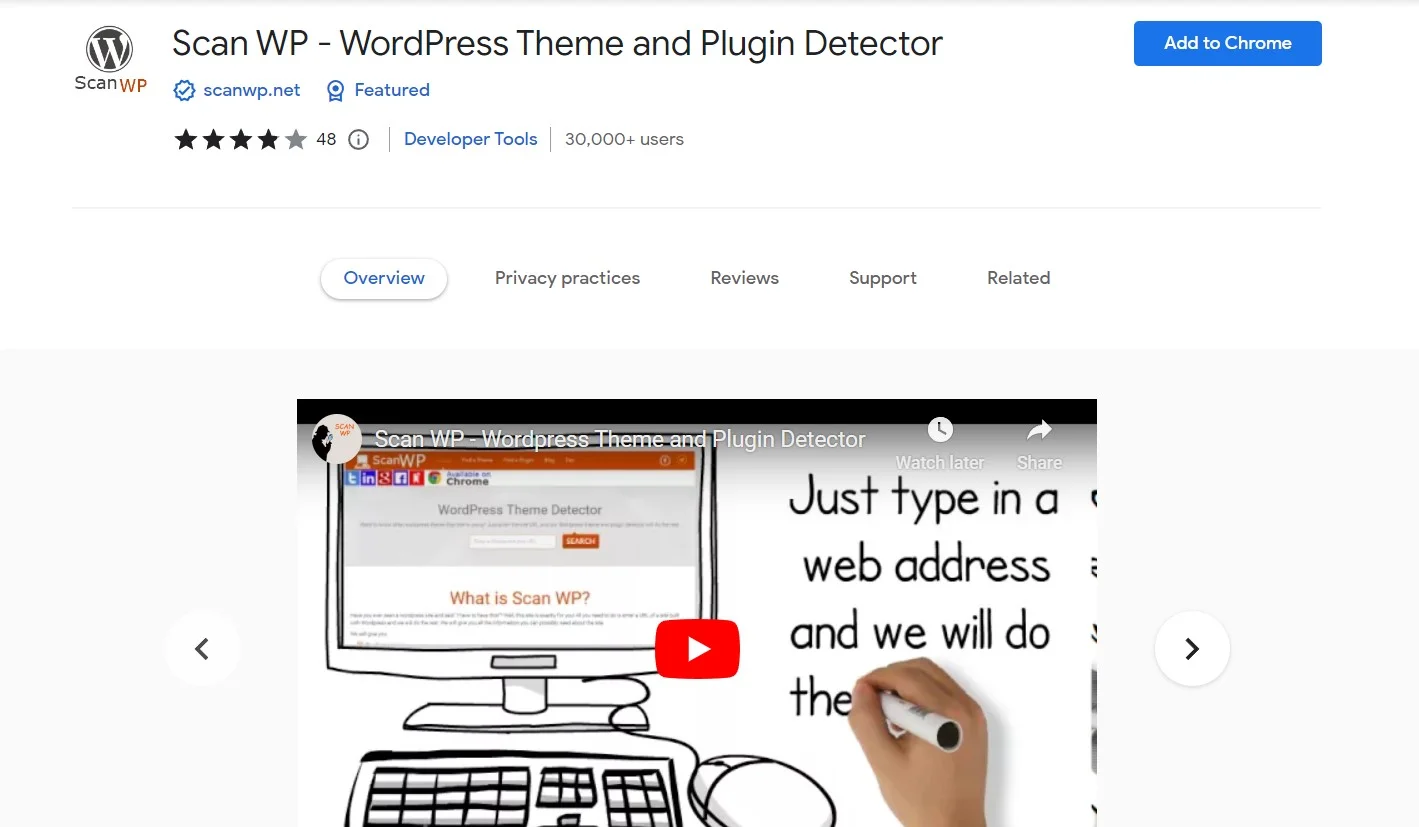
Scan WP does one job: click the WordPress icon on any site and it names the theme and the plugins it can fingerprint. It is still the quickest answer to “what did they build this with”, and it is still free.
Key features: theme and plugin detection in a single click, from a publisher whose listing is verified against scanwp.net.
Price: free.
Best for: a fast sanity check on a competitor’s site, especially working out which visual page builder is behind a layout you are being asked to copy.
Skip it if: you need current data or complete data. The listing was last updated 30 April 2024 and sits at 3.9 stars from 55 ratings across 40,000 users. Detection also fails on any site behind a full-page cache or an aggressive optimisation layer, which is most well-built sites. Treat a blank result as “cannot tell”, not “not WordPress”.
4. Grammarly
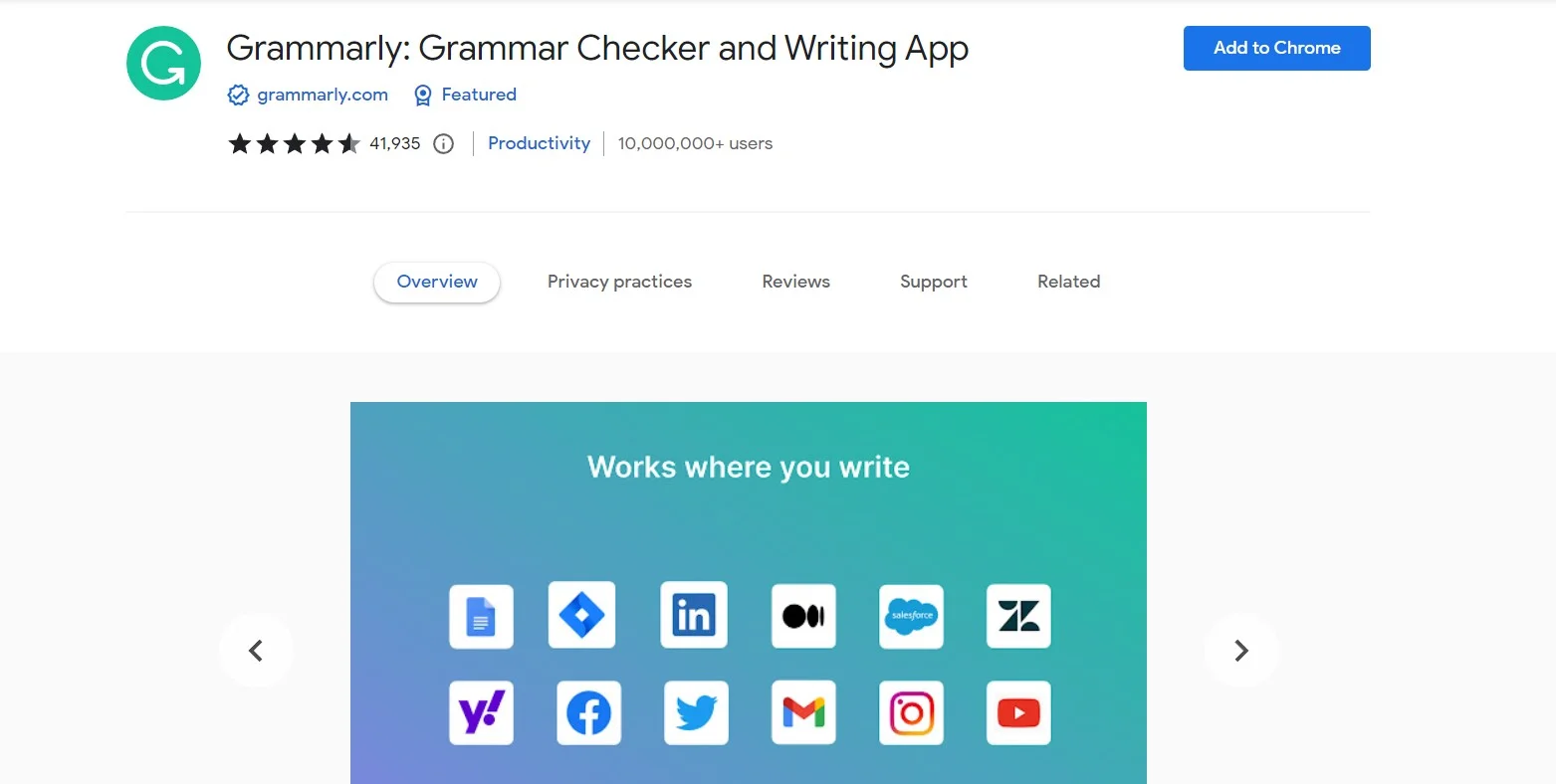
Grammarly has the largest user base of anything in this table at 38,000,000, and in the block editor it earns it. Catching a homophone in a client’s About page before they do is worth the toolbar space on its own.
Key features: inline grammar, spelling and clarity suggestions wherever you type, including Gutenberg, WooCommerce product descriptions and the customer emails you write between builds. Paid tiers add tone rewriting and plagiarism checking.
Price: there is a genuine free tier. Grammarly’s plans page geo-switches currency and served INR at the check date: ₹0 for Free, and for the paid individual tier ₹392 per member per month billed annually, which works out to ₹4,704 a year, or ₹1,000 billed monthly. Enterprise is quote-only. Confirm your own currency at checkout rather than trusting a converted figure.
Best for: solo publishers doing their own proofreading. Pair it with a real process for SEO-optimising a blog post, because clean grammar and a well-structured post are different problems.
Skip it if: you write in a locked-down client environment. Grammarly reads what you type, by design, which is a fair trade for your own drafts and a harder conversation for anything under NDA. The listing was updated 26 August 2026 and the download is around 46MB, which is heavy for a browser extension.
5. ColorZilla
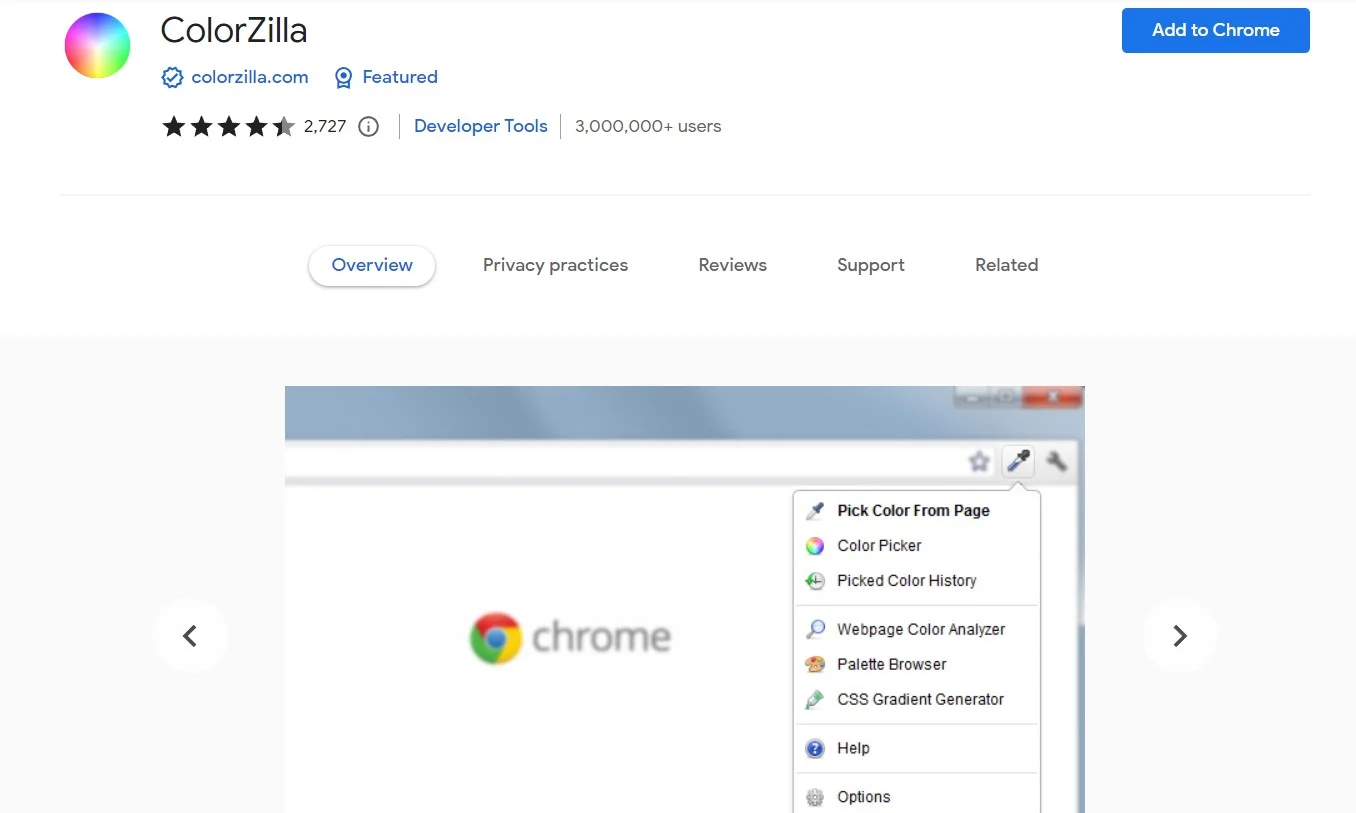
An eyedropper you can reach in one click, plus a page-wide colour analyser. Unglamorous and used constantly.
Key features: pick a colour from anywhere on the page, keep a history of picked colours, run a webpage colour analyser that pulls every colour a page actually uses, browse palettes, and generate CSS gradients.
Price: free.
Best for: matching a client’s brand colour when all they sent you was a JPEG of their logo. The colour analyser is also the fastest way to prove a “consistent” design uses nine different greys, which is a useful thing to hand a client before you rebuild their sections with Elementor add-ons.
Skip it if: Chrome’s own DevTools eyedropper already covers you. The listing was last updated 22 May 2024, so it is on the stale side, though a colour picker has a small enough surface that this matters less than it would elsewhere.
6. WhatFont
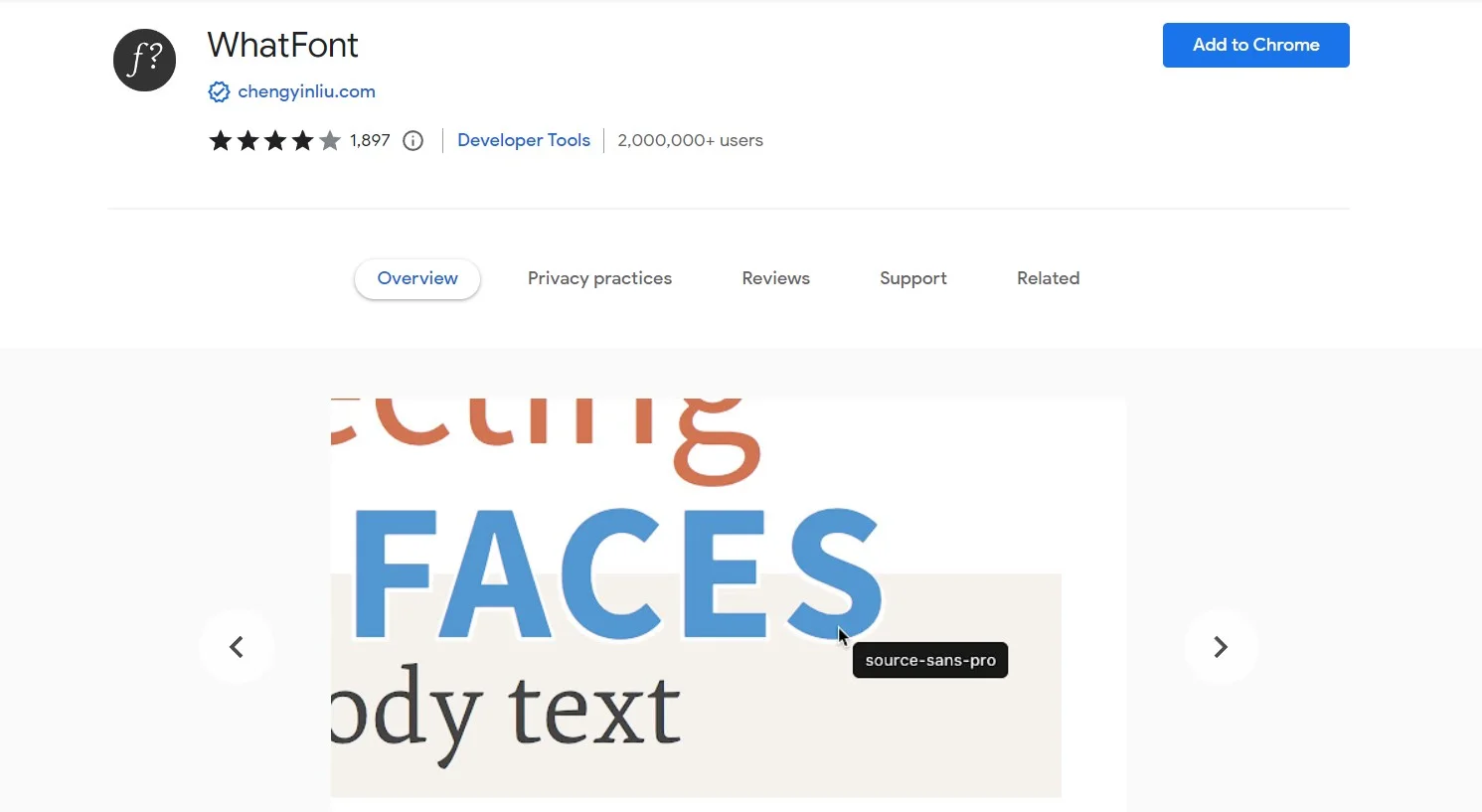
Hover over any text and WhatFont names the family, size, weight, line-height and colour. When a client says “make it look like this site”, this is how you find out what “this” is.
Key features: hover-to-identify typography, with a tooltip that names the rendered font rather than the first entry in the CSS stack.
Price: free.
Best for: the moment before you decide how to load a typeface. Once you know the family, the next question is delivery, and self-hosting or a proper service beats a random Google Fonts embed. Our walkthrough on how to enable Adobe Fonts in GeneratePress covers the licensed route.
Skip it if: you live in DevTools already, where the Computed panel gives you the same answer. WhatFont carries the oldest update date in this table, 4 March 2024 on its listing, and its 4.0 rating from 2,100 ratings reflects occasional misses on sites using variable fonts.
7. InstaWP Launcher
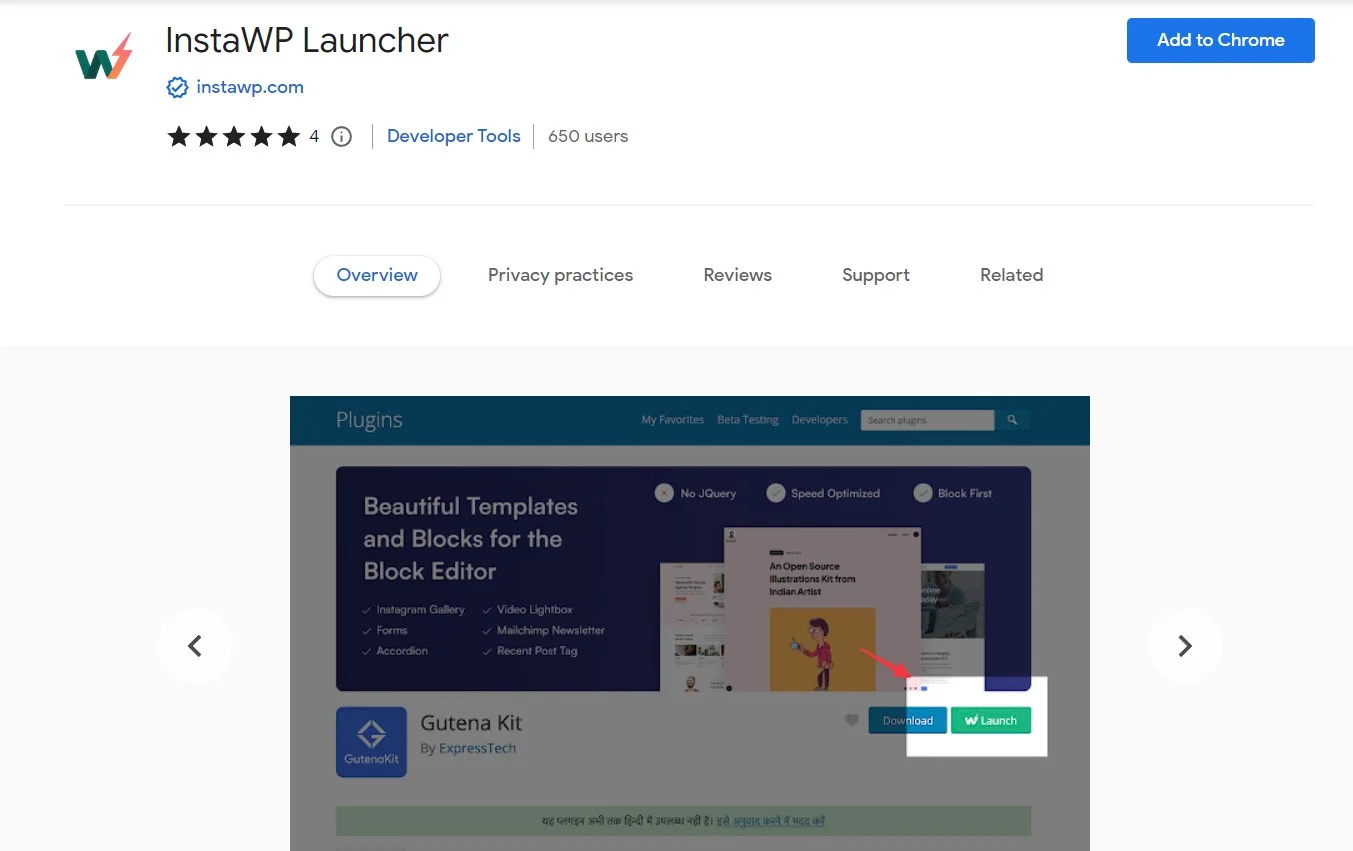
Browsing the WordPress.org plugin directory, the Launcher adds a green Launch button next to Download. Click it and you get a throwaway WordPress site with that plugin already installed, without touching your own server.
Key features: one-click sandbox creation from any WordPress.org plugin or theme page, and from a GitHub repo hosting a plugin or theme. The full InstaWP platform behind it does staging, templates and Git deployments.
Price: the extension is free. InstaWP’s pricing page no longer advertises a standing free plan; it offers $25 in credits when you add a card, then bills per site from $2/mo for Sandbox up to $45/mo for Elite, billed daily and invoiced monthly.
Best for: evaluating a plugin you would never install on a live site. Thirty seconds versus twenty minutes of local setup.
Skip it if: you already have a local stack you trust. Be aware this is the smallest listing in the table by a wide margin: 635 users and four ratings, last updated 2 June 2025 on its Chrome Web Store page. InstaWP has also written up a spell when Google pulled the extension over a developer-verification issue, so keep the platform bookmarked independently of the extension.
8. Keyword Surfer
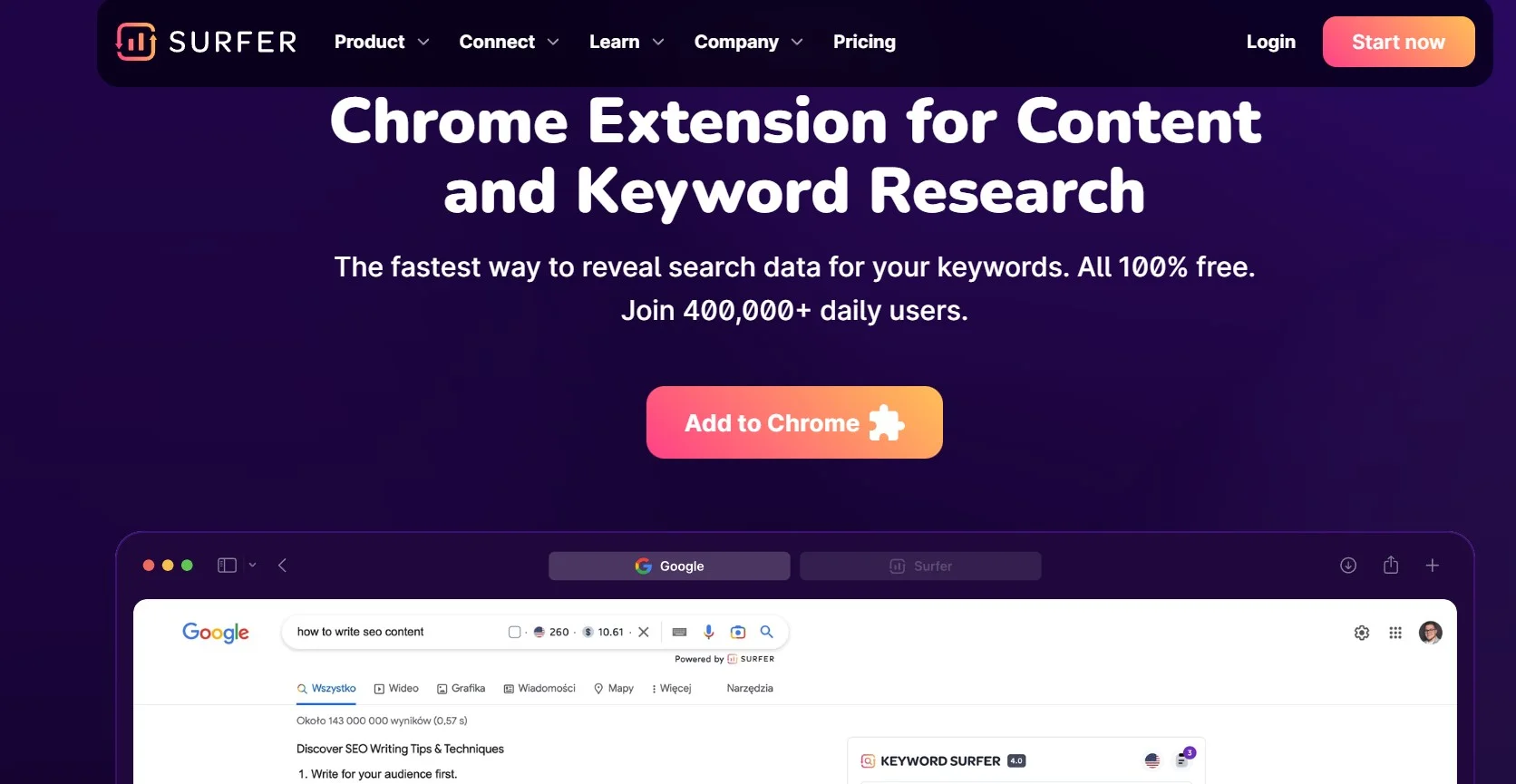
Search something in Google and Keyword Surfer prints monthly volume and CPC next to the query, plus estimated traffic and word count for each result. The old version of this article listed the Surfer SEO platform here; the free extension is the part most WordPress users actually want.
Key features: search volume and CPC inline in the SERP, keyword suggestions and related terms in a sidebar, and per-result data including estimated monthly traffic, on-page word count and exact keyword matches.
Price: free, and Surfer does not require an account for the core keyword features. The paid platform is a separate purchase; Surfer’s pricing page starts at $49/mo for Discovery billed yearly, which is $588 a year, rising to $182/mo for Pro.
Best for: deciding whether a post idea is worth writing, before you open the editor. It complements rather than replaces the on-page work your WordPress SEO plugin handles.
Skip it if: you make budget decisions on these numbers. Extension volume estimates are modelled, not measured, and they drift from what you see in Search Console. The listing was updated 29 January 2026 with 600,000 users at 4.2 stars.
9. MozBar
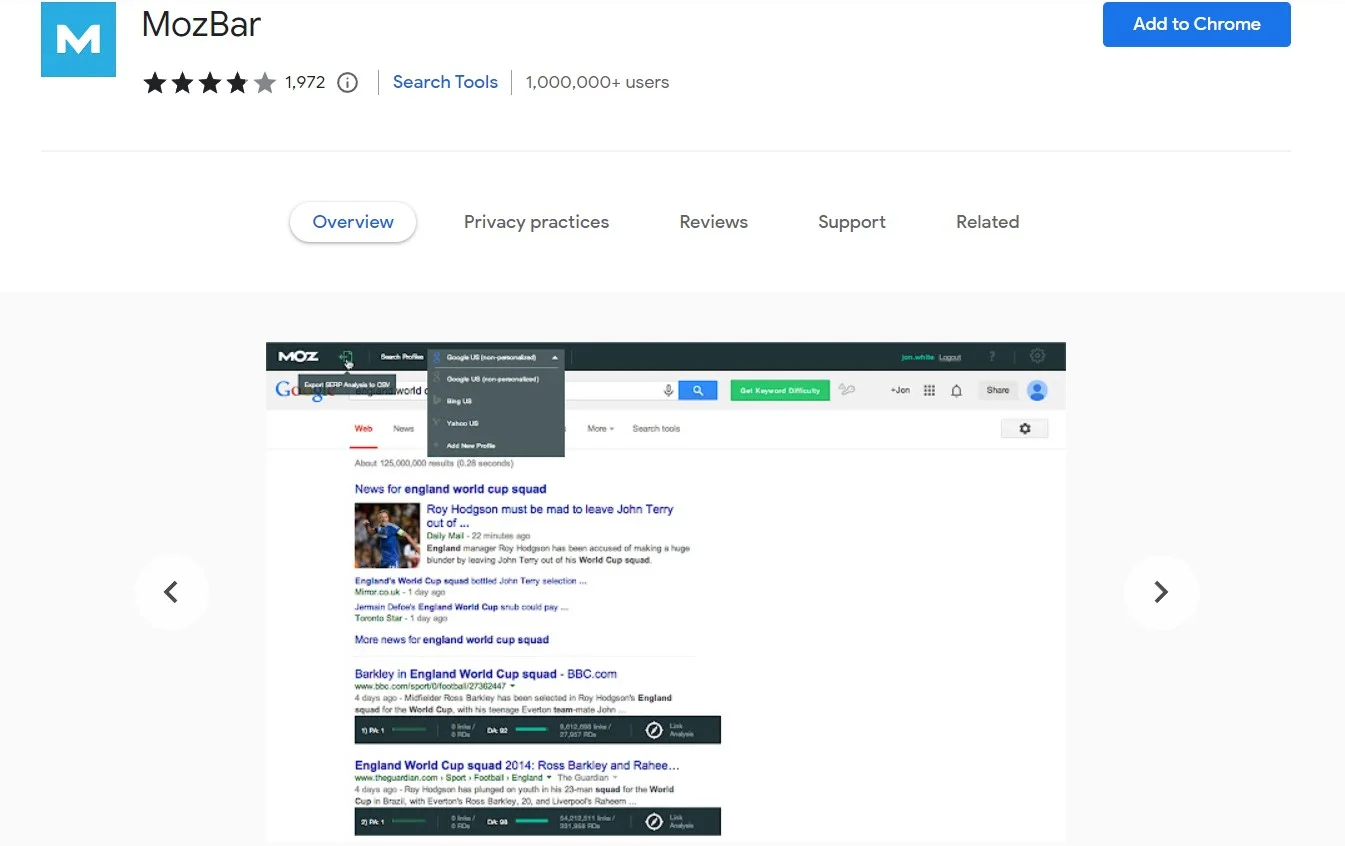
MozBar overlays Domain Authority, Page Authority and spam score onto Google results. It is the fastest way to eyeball whether a SERP is winnable before you commit a week to the post.
Key features: DA, PA and spam score inline in search results and on any page you visit. Moz Pro subscriptions upgrade it to MozBar Premium; a free Moz Community account gets the authority metrics without link research or rank tracking.
Price: free with a Moz account. Paid Moz Pro tiers exist and are quoted on Moz’s own pricing page – check there rather than trusting a third-party figure, because these tiers change.
Best for: competitive triage. Combine it with the keyword targeting you set in Rank Math and you have a rough go/no-go on any topic in about ten seconds.
Skip it if: you expect polish. MozBar is the lowest-rated extension in this table at 3.3 stars from 2,500 ratings on its listing, and the store screenshots still show a Google results page from the 2014 World Cup. It was updated 5 July 2026, so it is maintained; it just is not loved. Domain Authority is also a Moz metric, not a Google one, and treating it as a ranking factor will lead you astray.
10. Jasper Everywhere
Jasper Everywhere puts Jasper’s writing tools into whatever text box you are in, so you can rewrite, expand or retone a paragraph without switching tabs. There is no free tier behind it: a 7-day trial, then a bill.
Key features: rewrite, simplify, expand and change tone inside Gmail, Google Docs, Canva and the WordPress editor, working from your Jasper brand voice rather than a generic model.
Price: a Jasper subscription. The pricing page lists Pro at $69 per seat per month, or $59 per seat per month billed annually, which is $708 a year per seat. Business is quote-only. There is a 7-day free trial and nothing beyond it.
Best for: agencies already paying for Jasper who want the brand voice available outside the app.
Skip it if: you are not already a Jasper customer. As a standalone reason to subscribe it no longer holds up, when the assistant you already pay for probably has a browser extension of its own. Its listing is actively maintained, updated 31 August 2026 with 70,000 users.
11. NordPass
If you hold logins for fifteen client sites, the extension that fills them matters more than any other on this list. Reused admin passwords are still how most small WordPress sites get taken.
Key features: generate and autofill strong passwords, store passkeys, cards, notes and files, flag weak or reused credentials, and check whether your details have surfaced in a breach.
Price: there is a free plan for one user with the essential features. Paid tiers are geo-priced and promotional, and NordPass’s plans page loads its figures dynamically rather than serving them in the page, so no price is quoted here. Nord’s first-term rates renew higher than the advertised intro rate; read the renewal line at checkout before you commit.
Best for: freelancers who need per-client credentials that are not stored in a spreadsheet.
Skip it if: you work across a laptop and a phone at the same time. NordPass’s own support documentation is clear that the free plan allows one active session on one device, and logging in on a second device ends the first. That is the limitation that pushes most people to pay. A password manager also protects the credential, not the login form, so pair it with a brute-force protection plugin on the site itself. The listing was updated 20 August 2026 with 8,000,000 users, and the free versus premium comparison spells out the rest.
What most roundups get wrong
Almost every list of Chrome extensions for WordPress is a copy of a list written years ago, and it shows in three places.
They still recommend the Web Vitals extension. Google retired it. The Chrome team announced it was ending support on 7 January 2025 and folding the functionality into the DevTools Performance panel, which since Chrome 129 shows real-time Core Web Vitals alongside the rest of the performance tooling. If a roundup tells you to install it, that roundup has not been checked since 2024. Use DevTools, and do the actual speed work on the site itself.
They still recommend WordPress Admin Bar Control. Its listing is technically still live, at 3,000 users and a last update of 9 February 2015. Eleven years without a release, through two manifest versions. Earlier versions of this very article claimed it had over 10,000 installs, which is no longer true either. The official WordPress Browser Extension does the same job and is maintained. Uninstall the old one.
Nobody reads the update date. It is the single most useful number on a Chrome Web Store listing and it never appears in these articles. Staleness is not automatically fatal – ColorZilla and WhatFont have not shipped since 2024 and still work, because picking a colour is a small, stable problem. Staleness matters enormously when the extension holds a session, reads every page you visit, or handles credentials. Judge the update date against what the extension is allowed to touch, not on its own.
Which ones should you actually install
- Installing exactly one: the official WordPress Browser Extension.
- Pitching and auditing client sites: Wappalyzer, with Scan WP as a second opinion on WordPress-specific detection.
- Publishing several posts a week: Grammarly free plus Keyword Surfer. Both cost nothing and cover different halves of the job.
- Design and front-end work: ColorZilla and WhatFont, then close them and use DevTools for anything harder.
- Testing plugins constantly: InstaWP Launcher, accepting that it is a small project.
- Holding logins for more than five sites: NordPass or an equivalent manager, and budget for the paid tier if you use more than one device.
Before installing any of them, open the Privacy practices tab on the listing and read what the extension is asking for. Anything that requests permission to read and change your data on all websites is being handed your wp-admin session on every site you manage. Sometimes that is necessary. It should always be a decision.
Frequently Asked Questions
Do Chrome extensions slow down your WordPress site?
No. Extensions run in your browser only, so your visitors never load them and they cannot affect Core Web Vitals for anyone else. They can slow down your own browsing, which is a separate problem. If your dashboard feels sluggish, disable extensions one at a time before blaming a plugin.
How can you tell whether a Chrome extension has been abandoned?
Open its Chrome Web Store listing and read the Updated date in the Additional information panel. Anything over eighteen months old deserves a second look. Check the ratings trend and the developer response in reviews too, because a silent developer is usually a gone developer.
Are these extensions safe on the browser you use for client sites?
Most are, but read the Privacy practices tab first. An extension with permission to read and change data on all websites can see your logged-in wp-admin session. Keep client work in a separate Chrome profile with a minimal extension list, and back that up with proper security plugins on the sites themselves.
Will these work in Edge, Brave or Arc?
Yes. Every Chromium-based browser can install from the Chrome Web Store, though Edge shows a banner asking you to allow it first. Firefox and Safari cannot; they need separate builds. The official WordPress extension is one of the few here with a native Safari version, on the Mac App Store.
Which extension shows what theme and plugins a WordPress site uses?
Scan WP for WordPress-specific detection, Wappalyzer for the wider stack including host and CDN. Neither is reliable on sites behind a full-page cache or heavy optimisation, which strips the fingerprints they look for. A blank result means cannot tell, not not WordPress.
Is there an official WordPress browser extension?
Yes, since August 2026. The WordPress Foundation ships an open source extension for Chrome and Chromium browsers, plus Safari on macOS. It detects WordPress sites, hides the admin bar while keeping its shortcuts in the toolbar, and adds developer helpers. Preferences stay on your device.
What happened to the Web Vitals Chrome extension?
Google retired it. Support ended on 7 January 2025 and the functionality moved into the Chrome DevTools Performance panel, which has shown real-time Core Web Vitals since Chrome 129. Roundups that still recommend installing it have not been rechecked in years.
Do you need MozBar if you already use an SEO plugin?
They do different jobs. An SEO plugin handles your own titles, schema and sitemaps. MozBar tells you how hard a search result will be to beat before you write anything. If you only pick one, keep the plugin; the extension is for research, not for output.
Our call
Install three and stop: the official WordPress Browser Extension, Wappalyzer, and Grammarly on the free tier. That combination is free, actively maintained, and covers the three things a WordPress freelancer does hourly – previewing a site cleanly, working out what someone else built with, and not shipping typos.
Add ColorZilla and WhatFont if you do design work, Keyword Surfer if you plan content, and NordPass if you are still keeping client logins somewhere you would not want to explain to a client. Everything else on this page is situational, and Jasper Everywhere only makes sense if the subscription already exists.
Then put a reminder in your calendar for six months’ time to open chrome://extensions and remove whatever you have stopped using. An extension you forgot about still has every permission you granted it, and the fastest-moving risk on this page is not the tools themselves – it is the ones that quietly stop being maintained while they are still installed. Reviewing what you have installed is the cheapest security work you will do all year, and it pairs with keeping proper WordPress security plugins on the sites themselves.